• Menu
  • Skip to primary navigation
  • Skip to main content
  • Skip to primary sidebar

Country Life In BC Logo

The agricultural news source in British Columbia since 1915

  • Headlines
  • Calendar
  • Subscribe
  • Advertise
  • About
  • Archives
  • Contact
  • Search
  • Cart
  • Checkout
  • Headlines
  • Calendar
  • Subscribe
  • Advertise
  • About
  • Archives
  • Contact
  • Search
  • Cart
  • Checkout

Primary Sidebar

Originally published:

MARCH 2022
Vol. 108 Issue 3

Subscribe Now!

Sign up for free weekly FARM NEWS UPDATES

Loading form…

Your information will not be
shared or sold ever

Stories In This Edition

Lucky chickens

$227m rebuild fund

Glyphosate shortage looms

Province opens ALR to agritech development

Editorial: Divorced from the earth

Back 40: Broken supply chain weakens food system

Viewpoint: BC’s emergency response needs improvement

Building back better means avoiding past mistakes

Sidebar: Grand Forks initiative protects farms

Rural, urban areas prepare for extreme weather

Ag Briefs: Property owner appeals BC SPCA seizure

Ag Briefs: Province sued over mind ban

Farm income projected to reach new heights

Potato growers brace for higher input costs

Keeping cranberries cool a hot topic

Rewarding farmers for enhancing riparian areas

Sidebar: Farmers need not apply

Diversification drives growth of organic farm

Leadership skills can help farmers cope with disaster

Winter rainbow

Compost facilities facing pushback

Cheese leads the way as BC dairies seek capacity

Island yogurt producer boosting production

Grape growers prepare for climate change

The perfect solution for farmers on the go

Small-lot egg producer awarded quota

Sidebar: Future quota draws likely limited

Broiler health in spotlight for small-lot farmers

Pest data helps with management decisions

Research: Researchers discover a world of apple microbiomes

Farms meet the demand for local food

Better berry harvester meets growers’ needs

Farm Story: Spring demands the old heave-ho

Safety in the spotlight as farms recover

Woodshed: Henderson style has chins wagging

Chilliwack teams plow past the century mark

Jude’s Kitchen: Spring has sprung! Time to make bread!


All content on this website is copyrighted, and cannot be republished or reproduced without permission.
More Headlines

Follow us on Facebook

Comments Box SVG iconsUsed for the like, share, comment, and reaction icons

6 hours ago

... See MoreSee Less

View Comments
  • Likes: 3
  • Shares: 0
  • Comments: 0

Comment on Facebook

6 hours ago

Fall chores. Near Oliver, fruit tree and vine grower Chamkaur Gill cleans up the first fall pruning on his cherry trees on November 6. He says the first prune took off new growth, but he'll do a second pruning to try to ensure a better cherry crop on these trees in 2027 than in 202#BCAg#BCAg ... See MoreSee Less

Fall chores. Near Oliver, fruit tree and vine grower Chamkaur Gill cleans up the first fall pruning on his cherry trees on November 6. He says the first prune took off new growth, but hell do a second pruning to try to ensure a better cherry crop on these trees in 2027 than in 2026. 

#BCAg
View Comments
  • Likes: 6
  • Shares: 1
  • Comments: 0

Comment on Facebook

23 hours ago

BC has detected this fall's first case of highly pathogenic avian influenza in a commercial poultry flock in Chilliwack. Canadian Food Inspection Agency staff confirmed the detection on November 6, relatively late compared to previous years. However, disease pressure has been high, with 16 cases in wild birds across the Lower Mainland and multiple detections in Manitoba and Alberta since early September. Strong biosecurity protocols are in place to protect the industry, and BC dairy producers are also on alert, with detections in 43 herds south of the border in Eastern Washington this fa#BCAg#BCAg ... See MoreSee Less

BC has detected this falls first case of highly pathogenic avian influenza in a commercial poultry flock in Chilliwack. Canadian Food Inspection Agency staff confirmed the detection on November 6, relatively late compared to previous years. However, disease pressure has been high, with 16 cases in wild birds across the Lower Mainland and multiple detections in Manitoba and Alberta since early September. Strong biosecurity protocols are in place to protect the industry, and BC dairy producers are also on alert, with detections in 43 herds south of the border in Eastern Washington this fall.

#BCAg
View Comments
  • Likes: 27
  • Shares: 18
  • Comments: 48

Comment on Facebook

not from backyard Coops? shocking

No ostriches to kill this year…

Just so everyone knows culling infected birds happens in almost every country around the world. It's standard procedure. Unless you want to get sick or have a pandemic I would stop pooping on CFIA.

So many opinions, so few actual farmers.

Do people realize that it has affected dairy herds in the USA and it is not unheard of it affecting equine?

Chicks are vaxx right after hatching...google it ..

Avian flu is so bad at our local park in the valley. We stopped counting bodies at 20 (all cackling geese) on a walk this past Wednesday. The infected were all falling down & couldn’t stand very well - it was incredibly heartbreaking. An ACO was there to pick up bodies and goes there each day. He said they’re falling out of the sky. He told us that people need to call Environment Canada when you see infected birds, so they can be made aware of the numbers. Do NOT touch or attempt to rescue them. 😢

Funny this never happened for all the years I worked chicken barns ..

🐂💩

CFIA is up to no good once again

Oh of course

Nothing but constantly attacking our food source

I think my cousin's the one that infected them he said he's got bird flu

They really need to thin out the wild water foul in Saskatchewan seen lots of sick and dead geese. Also not much left for deer population. Not sure if its cwd or coyotes maybe wheater what evere it is its kicking the hell out of the deer

Ahhh the good ol bird flu PROPAGANDA rears its ugly head again

The CFIA or any agency should show the proof the Avian Flu actually exists or at the very least the virus has been isolated.

BS

It’s crazy the government can come up with a MRNA vaccine for everything but the bird flu…

Ya ok

On to their next cull

Maybe if they weren't all overcrowded in barns!

Keep feeding them Bio hazardous waste, confined feces ridden or sterile barns-

If we are really serious about bird flu and other zoonotic pandemics like covid-19 and Swine flu then we need to stop this neanderthal habit of ramming animals down our throat three times a day. The source of Highly pathogenic bird flu is factory farmed chickens, and that continues to be their Reservoir. If the H5zmN1 strain mutates so that it can pass human to human, something the World Health Organisation has warned is totally possible, then the resulting carnage will make covid-19 look like a sniffle.

well, that is the absolutely ONLY answer, just keep slaughtering animals - I call BS

Here we go again.

View more comments

3 days ago

With the province signalling no new money for farm water infrastructure, BC producers are turning to collaboration to secure water storage. In the Salmon River watershed, where temporary protection order curtailed forage irrigation again this summer, producers will host a public information session in Salmon Arm on December 9. The BC Wildlife Federation is backing their efforts, saying farmers and conservationists want the same outcomes. For more, see today's Farm News Update from Country Life in BC: [www.countrylifeinbc.com/momentum-builds-for-water-solution#BC

#BC
... See MoreSee Less

With the province signalling no new money for farm water infrastructure, BC producers are turning to collaboration to secure water storage. In the Salmon River watershed, where temporary protection order curtailed forage irrigation again this summer, producers will host a public information session in Salmon Arm on December 9. The BC Wildlife Federation is backing their efforts, saying farmers and conservationists want the same outcomes. For more, see todays Farm News Update from Country Life in BC: [https://www.countrylifeinbc.com/momentum-builds-for-water-solutions/]

#BC
View Comments
  • Likes: 21
  • Shares: 12
  • Comments: 3

Comment on Facebook

Has anyone considered the introduction of analogue beaver dams or possibly beaver families if the sites would support them. there are projects with beavers in lagging watersheds in the States.

I just wish they would also look at Chase Creek (from Pillar Lake to the South Thompson River.......it's a complete mess.

That entire program was just an exercise is harvesting information from producers. There was so few projects approved considering they boasted about having millions upon millions available.

6 days ago

... See MoreSee Less

View Comments
  • Likes: 5
  • Shares: 4
  • Comments: 0

Comment on Facebook

Subscribe | Advertise

The agricultural news source in British Columbia since 1915
  • Email
  • Facebook

The perfect solution for farmers on the go

Shipping container offers packing facilities and cold storage

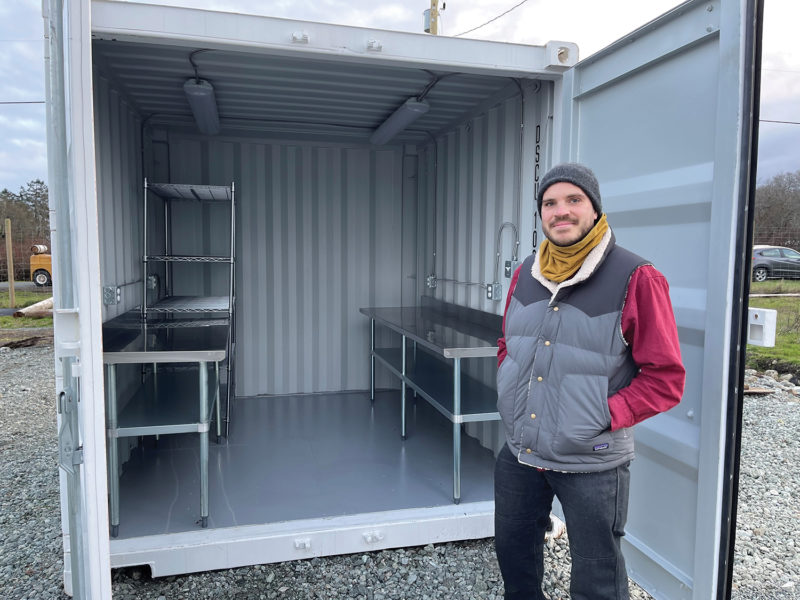
Matthew Kyriakides, director of land management at the Sandown Centre for Regenerative Agriculture in North Saanich, standing in front of the centre’s new GAP Can vegetable packing cube. SUBMITTED

March 1, 2022 bySandra Tretick

NORTH SAANICH – Out in the fields of the Sandown Centre for Regenerative Agriculture in North Saanich, something innovative is happening.

If you drive by the 83-acre site on Glamorgan Road, once home to the Sandown Racetrack, you’d be hard-pressed to see anything out of the ordinary. Sure, there are two new 10-foot shipping containers sitting out there, but those are just used to store tools, aren’t they?

But according to Ty James, the man behind the containers, they’re a game-changer for small farmers that produce field crops, especially those who want to avoid sinking cash into costly infrastructure on leased properties.

James, a 35-year-old market gardener who grows produce on leased farmland in North Saanich and sells to grocery stores like Country Grocer and Red Barn Market, knows what it’s like to move his operations from one farm to another. He used to lease two acres in Central Saanich before outgrowing that space three years ago. He now farms five acres in field production and 20,000 square feet of greenhouses.

“I quickly realized that farming is a business of economies of scale and that I needed more land in order to make a living, and I also needed better infrastructure,” says James. “I was packing in a greenhouse in the summertime that was getting up to 40 degrees. I had a couple little household fridges strapped together, packing into clamshells, just trying to make the most of it.”

It was insufficient for what he needed to do to meet his buyers’ exacting specifications.

James says the CanadaGAP program is one of the must-haves for farmers today, because that’s what larger grocery chains demand. Even though there are about 1,000 farms in BC with GAP certification – the highest rate of participation in the country – James notes that most farmers don’t have it yet, especially smaller growers.

GAP stands for good agricultural practices and James wanted to design infrastructure that would give farmers access to affordable GAP and HACCP-compliant infrastructure. He says CanadaGAP certification is important because it provides assurance to retailers that fresh produce growers are following appropriate food safety procedures.

James believes having access to post-harvest infrastructure is just as important as having fields and fencing. By infrastructure, he means packinghouses and walk-in coolers; a dry place to store labels and packing materials and a cool place to store product during hot weather.

Several companies, like Freight Farms out of the US, sell vertical farming and hydroponic farming systems in shipping containers but through his own company, GAP Can, James is planning something entirely different.

“We’re providing infrastructure for field-growing operations,” says James. “With the heat dome we had last year, it would be virtually impossible to grow successfully without this type of infrastructure. You need access to a shady cold spot to keep your produce fresh as you pack it and get it ready to go to market.”

Two summers ago, he built an early prototype on the farm he is currently leasing with a grant from the BC On-Farm Food Safety Program.

To further develop the concept, James obtained $32,000 through the Canada-BC Agri-Innovation Program and entered into contracts last summer with Sandown Centre and Lytton First Nation to build what he calls “version two prototypes.” James worked with Keith Hayton of K. Hayton Construction Ltd. on the build.

Each unit – built from a shipping container sold off after a one-way trip from China – is custom-built to meet the customer’s needs. That means a lot of discussions on layout and design. They are built to allow producers to achieve CanadaGAP certification, are Canada Safety Association-approved and inspected for road transportation.

“We wanted to design something around CanadaGAP because I get audited on my farm every year,” says James. “We’re trying to service the area of the market that’s like myself, leasehold farmers, people that want to farm but need infrastructure and don’t want to spend hundreds of thousands of dollars to build it.”

The prototype at Sandown was built using two 10-foot shipping containers, avoiding the need for a building permit. One unit is set up for packing and the other is cold storage. Another unit – in a standard 20-foot container – was in the process of being delivered to the Lytton First Nation last month for a large-scale market garden project. Delivery was delayed by wildfires, flooding and mudslides last year.

The little cubes, which arrived at Sandown in January, still need an electrical hookup. Sandown Centre has a 10-year lease on the land from North Saanich and it in turn subleases small plots to farmers. What the centre offers its growers is a cross between land-leasing and farm school that includes learning about horticulture and business.

Sandown director of community and partner engagement Jen Rashleigh says the GAP cubes, as she likes to call them, are a complete and utter game-changer.

Growers will be able to use Sandown’s units this spring to weigh, bunch, pack and store produce, giving them the option to achieve CanadaGAP certification if they want to enter bigger markets.

“If we don’t have a processing unit it’s a major setback,” says Rashleigh. “[With it] they can get the audit and they can get into the bigger retailers.”

Having the units on site means they can also serve as a demonstration for other growers.

The cubes, sold through James’ company GAP Can, come in different sizes and configurations – what James terms modular infrastructure. The company’s flagship unit is a 20-foot container with a vegetable processing area and a walk-in cooler starting around $35,000. Forty-foot containers are also possible for larger applications.

With these prototypes complete, James is now in discussions on two bigger projects, including a multi-unit food hub for Lytton First Nation and a three-unit prototype for a poultry processing plant at Glassen Farms near Nanaimo. He’s also looking for a new yard in Langford for the upcoming builds.


All content on this website is copyrighted, and cannot be republished or reproduced without permission.
Related Posts

You may be interested in these posts from the same category.

CanadaGAP participation drops

Poultry processing goes mobile

CanadaGAP expands options

CanadaGAP participation drops

Small farmers raise concerns about CanadaGAP

Previous Post: « Rewarding farmers for enhancing riparian areas
Next Post: ALR opened for agritech »

© 2026 COUNTRY LIFE IN BC - ALL RIGHTS RESERVED