
• Menu
  • Skip to primary navigation
  • Skip to main content
  • Skip to primary sidebar

Country Life In BC Logo

The agricultural news source in British Columbia since 1915

  • Headlines
  • Calendar
  • Subscribe
  • Advertise
  • About
  • Archives
  • Contact
  • Search
  • Cart
  • Checkout
  • Headlines
  • Calendar
  • Subscribe
  • Advertise
  • About
  • Archives
  • Contact
  • Search
  • Cart
  • Checkout

Primary Sidebar

Originally published:

DECEMBER 2020
Vol. 106 Issue 12

Subscribe Now!

Sign up for free weekly FARM NEWS UPDATES

Loading form…

Your information will not be
shared or sold ever

Stories In This Edition

Abattoirs eye pandemic funding

Water fight

Turkey sales strengthen

Orchardists forge ahead following late-season freeze

Editorial: Back to the future

Back 40: Pandemic gives leaders a bosst, but what about farmers

Viewpoint: BC agriculture set to ead food conversations

Kamloops farmers push back on irrigation plan

Sidebar: A new tool for municipalities

ILT puts broiler farms on the defensive

Snowed under

Antimicrobial phase-out delayed

BC Tree Fruits makeover gets green light

Keremeos supply store closes

Province rethinks land matching pitch

Ag Briefs: Land commission appts announced

Ag Briefs: Blueberry council set for elections

Ag Briefs: Award honours young agrologist

Ag Briefs: Horticultural loss

Ag in the Classroom prepares for change

Beekeepers go virtual for 100th anniversary

Sidebar: Pandemic puts pause on bee research

Island farmers frustrated by ferry waits

Slaughter limitations forcing producers out

Livestock specialist has close ties to ranching

Cattle take lead in fire prevention efforts

New food hub planned for Salmon Arm

Passion and schooling pay off for young grower

Cleanfarms looks into ag plastic recycling program

Robotic strawberry picker on the horizon

Agritech venture aims to unite data management

Sidebar: Microsoft moves in

Up in smoke

New tool helps farmers avoid nutrient runoff

Peace region weather network expanded

Sidebar: Adaption network hosts webinar series

Tarps provide targeted alternative to cover crops

Orchardists making greater use of decisionaid system

Asian parasitoids come to the rescue of berry growers

Research: Keeping cows’ reproductive cycle on track

Agroforestry project makes farm viable

Young farmers encouraged to cultivate resilience

Farm Story: A change of season brings a change of mind

Universal broadband fund cheers farmers

Woodshed: New beginnings for Deborah and Susan

4-H members finish season at virtual Ag Expo

Jude’s Kitchen: Classic festive appies for the holidays

All content on this website is copyrighted, and cannot be republished or reproduced without permission.
More Headlines

Follow us on Facebook

Comments Box SVG iconsUsed for the like, share, comment, and reaction icons

2 days ago

The committee of MLAs charged with setting priorities for the next provincial budget is recommending regular, annual funding for water storage infrastructure associated with food production, including for engineering inspections, maintenance and upgrades. The recommendation builds on the BC Cattlemen's Association's recommendation of an annual allocation of $5 million for water storage infrastructure related to food production, noting that it could also support resilience in the face of climate-related events. While the province has allocated $120 million for agricultural water infrastructure, agriculture minister Lana Popham told Country Life in BC this week that other ministries and the federal government will need to be involved in funding future p#BCAgts#BCAgCAg

#BCAg
... See MoreSee Less

The committee of MLAs charged with setting priorities for the next provincial budget is recommending regular, annual funding for water storage infrastructure associated with food production, including for engineering inspections, maintenance and upgrades. The recommendation builds on the BC Cattlemens Associations recommendation of an annual allocation of $5 million for water storage infrastructure related to food production, noting that it could also support resilience in the face of climate-related events. While the province has allocated $120 million for agricultural water infrastructure, agriculture minister Lana Popham told Country Life in BC this week that other ministries and the federal government will need to be involved in funding future projects.

#BCAg

#BCAg
View Comments
  • Likes: 24
  • Shares: 6
  • Comments: 3

Comment on Facebook

A typical small-to-medium farming operation featuring a house, main barn, and machine shed generally has around 8,000 to 12,000 square feet of total roof surface. The Okanagan Valley is one of the driest regions in Canada, averaging roughly 300 millimetres (11.8 inches) of annual precipitation. Storing a full year's collected rainwater from those roofs yields roughly 262,500 litres. In the three regional districts that make up the Okanagan valley proper (North Okanagan, Central Okanagan, and Okanagan-Similkameen), the 2021 Statistics Canada Census of Agriculture records roughly 3,100 total farms. Multiply that number by 262,500 litres of harvested rainwater equals 813.75 million litres of water saved per year. Capturing that volume of water across every farm roof in the region would significantly ease peak summer pumping pressure on local groundwater aquifers and Okanagan Lake.

Fantastic!! We will work hard to be involved and do what we can as well as a collective group on the Salmon River!

Absolutely! Long over due and very welcomed. Let's make this happen.

2 days ago

... See MoreSee Less

View Comments
  • Likes: 2
  • Shares: 0
  • Comments: 0

Comment on Facebook

2 days ago

About 40 community members gathered at Silver Creek Community Hall near Salmon Arm last Thursday to discuss ways to improve water availability for both farms and spawning salmon. While the province has since rescinded a fish protection order for the watershed that shut down irrigation, future risks to water access remain top of mind. "We are here because water matters to each of us," says rancher and organizer Trudy Schweb. Farmland Riparian Interface Stewardship Program manager Lee Hesketh outlined the potential for upland water storage while Rob Dinwoodie highlighted cost-shared funding opportunities through the Environmental Farm Plan program for riparian assessments, irrigation efficiency upgrades and other water-related projects available to producers. Photo credit | Facebook/Trudy Schweb

#BCAg
... See MoreSee Less

About 40 community members gathered at Silver Creek Community Hall near Salmon Arm last Thursday to discuss ways to improve water availability for both farms and spawning salmon. While the province has since rescinded a fish protection order for the watershed that shut down irrigation, future risks to water access remain top of mind. We are here because water matters to each of us, says rancher and organizer Trudy Schweb. Farmland Riparian Interface Stewardship Program manager Lee Hesketh outlined the potential for upland water storage while Rob Dinwoodie highlighted cost-shared funding opportunities through the Environmental Farm Plan program for riparian assessments, irrigation efficiency upgrades and other water-related projects available to producers. Photo credit | Facebook/Trudy Schweb

#BCAg
View Comments
  • Likes: 37
  • Shares: 4
  • Comments: 4

Comment on Facebook

Salmon River Watershed Roundtable should be looked into again.

Well done my girl,the voice of Silver Creek ranchers and more

Thanks for covering this🌟

3 days ago

The BC Fruit Growers Association is urging Greater Vernon Water and the Regional District of North Okanagan to halt water shut-offs hitting 2,100+ acres of Okanagan orchards mid-season. With losses potentially topping $250 million, fruit growers say decisions of this scale demand a coordinated plan with farmers and the province — not one-sided cuts. They’re not the only producers affected by this year’s dry conditions.

#BCAg
... See MoreSee Less

Cash Flows

www.countrylifeinbc.com

VERNON – Water restrictions intensified across the southern Interior in late July, with record low stream flows clouding the cash outlook for ranches and orchards. Fourteen agricultural water users...
View Comments
  • Likes: 5
  • Shares: 3
  • Comments: 1

Comment on Facebook

Food should ALWAYS come first. Allow the farmers their water. My grandad watered the apples by flume from the mountain. Let’s get on with AG and get out of the way!

3 days ago

The BC Fruit Growers Association has joined Apples Canada, a new national voice for provincial apple organizations in BC, Ontario, Quebec, New Brunswick and Nova Scotia. Charles Stevens of Ontario chairs the new group, an evolution of the apple working group within Fruit & Vegetable Growers Canada (FVGC), the new group will tackle production, sustainability, research and policy issues as well as advocate for market access in partnership with FVGC. It follows the creation of the Greenhouse Produce Alliance of Canada earlier this year, which replaced the former greenhouse vegetable working group. The berry and field vegetable sectors will continue to maintain working groups with FVGC, while the long-estblished Canadian Potato Council serves the interests of potato growers under the FVGC umbrella.

#BCAg
... See MoreSee Less

The BC Fruit Growers Association has joined Apples Canada, a new national voice for provincial apple organizations in BC, Ontario, Quebec, New Brunswick and Nova Scotia. Charles Stevens of Ontario chairs the new group, an evolution of the apple working group within Fruit & Vegetable Growers Canada (FVGC), the new group will tackle production, sustainability, research and policy issues as well as advocate for market access in partnership with FVGC. It follows the creation of the Greenhouse Produce Alliance of Canada earlier this year, which replaced the former greenhouse vegetable working group. The berry and field vegetable sectors will continue to maintain working groups with FVGC, while the long-estblished Canadian Potato Council serves the interests of potato growers under the FVGC umbrella.

#BCAg
View Comments
  • Likes: 4
  • Shares: 0
  • Comments: 0

Comment on Facebook

Subscribe | Advertise

The agricultural news source in British Columbia since 1915
  • Email
  • Facebook

4-H members finish season at virtual Ag Expo

BC 4-H planning for next season

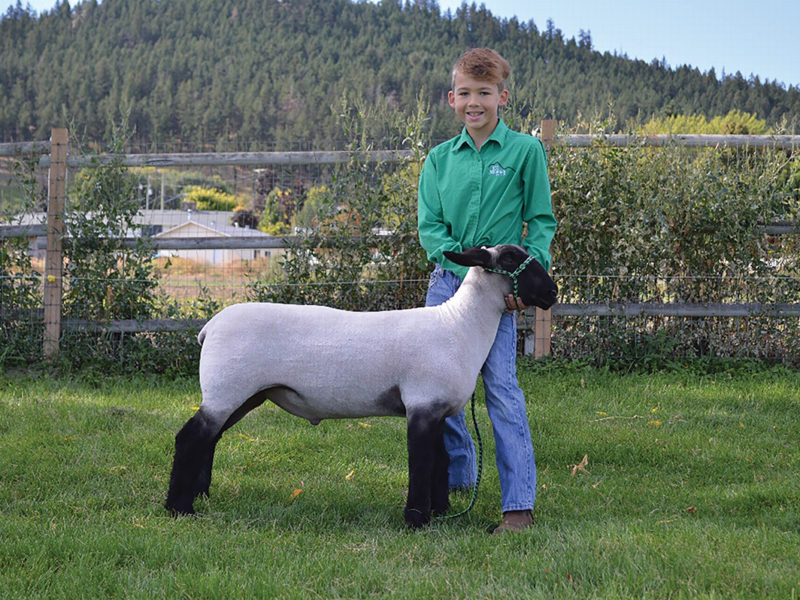
Picture perfect! And fancy enough to catch the judge’s eye. Noah Sherwood from the Tod Mountain 4-H Club raised the BC Ag Expo champion market lamb this year. Members submitted photos and videos of their livestock projects so they could be judged and entered in the three-day online sale. Noah’s lamb sold for $650 to A&T Developments. PHOTO / BC AG EXPO

December 1, 2020 byJackie Pearase

BARRIERE – The 4-H community continued to demonstrate its resiliency with a much different show and sale at the BC Ag Expo in Barriere, September 25-28.

With pandemic restrictions still in place, organizers put together a virtual show and sale for 4-H and open youth.

“When we made our decision to go virtually, we really wanted to deliver an

in-person fair but with the numbers that we have, it just wasn’t feasible. We couldn’t wrap our heads around the size restrictions,” says BC Ag Expo Society president Evelyn Pilatzke.

Organizers quickly adapted a recently purchased software package from an in-person fair to a virtual format, with the volunteer members learning the ropes as plans progressed.

Over 125 youth from the Cariboo, Shuswap, Okanagan, Boundary and Thompson Nicola Regional District participated in the 4-H and open categories. The fair typically has about 300 youth entrants plus adults.

The youth competed in classes for beef, cavy, goat, lamb, photography, rabbits, carcass and educational display, plus the Fred Nicol, Twemlow and Boundary Dash events.

Participants provided front, side and rear photos of their entries plus a 30-second video of their animal walking.

The online auction showcased the various classes, champions and auction items including beef, lamb, photographs, a chevon goat and a rabbit.

Fewer youth took part in the three-day auction but active bidding at the end resulted in decent prices for all participants.

“It was a different concept than an in-person auction for us,” says Pilatzke. “It was a nail-biter right up to the end.”

Over 70 bidders signed in over 52 hours. The average price for market steers was $3.09 a pound, $5.98 a pound for carcass steers, $583 a head for market lambs, $512 a head for carcass lambs and $176 each for photographs.

South Thompson 4-H Club member Conor Brown entered in the beef and sheep classes this year to raise money for university.

He is grateful for the community support that enabled the show and sale to take place despite the pandemic but missed the in-person aspect of a traditional fair.

“It was a heartbreaker not to be able to show. That’s our grand finale,” he says. “The show means so much; it’s the time we get to show all our work. We work our beef for almost a year and the sheep for about six months. Plus the social part of the fair is gone, where you see old friends, kids you grew up with in 4-H.”

Tod Mountain 4-H Club member Hailee Lamb was disappointed that COVID-19 limited opportunities to show her steer and heifer projects this year. But the 16-year-old was impressed by her sale prices at the online auction and vows to continue with 4-H next year.

Stepping up

BC 4-H manager Aleda Welch says clubs have stepped up this year to provide their members with some regular events during such an unusual year.

“It’s fabulous that a lot of these fairs and third-party organizers were able to arrange for virtual auctions, shows and sales so that our members could complete their project year,” she says. “At the end of the year, a lot of clubs and districts were actually able to have their in-person achievements in a modified version. It wasn’t what they were used to in the past but the feedback was that they were very appreciative that the leaders rallied behind them and were able to have a little bit of normalcy for the end of the year.”

BC 4-H also adapted, changing its annual five-day Food for Thought event involving 45 youth to six

one-day events in different locations across BC where group restrictions could be met.

“It all worked out extremely well. We got some great feedback from the kids; they were very happy to have gotten out at least for that one day and participate in the 4-H program,” Welch says about the event.

BC 4-H and 4-H groups across BC are now looking forward to an uncertain future with great hopes that things return to normal.

“As for next year, we’re hoping for the best. We’re currently planning for

in-person programming with the hope that we’ll be able to do the programs as we have been able to in the past where the members can get together and do the programs as a group,” notes Welch.

But with virtual 4-H events behind most large agricultural fairs in BC, everyone also feels prepared for a repeat of this year.

“If worst comes to worst, we’re certainly ready to put on another virtual fair. We’re hoping, though, it’s going to be an in-person fair. The kids really miss seeing all their friends and doing it as an in-person fair,” says Pilatzke.

All content on this website is copyrighted, and cannot be republished or reproduced without permission.
Related Posts

You may be interested in these posts from the same category.

RCMP recruits 4-H youth

4-H sales adapt amid COVID-19 restrictions

4-H sale saves the bacon for ranching student

Previous Post: « Passion and schooling pay off for young grower
Next Post: High confidence, high prices »

© 2026 COUNTRY LIFE IN BC - ALL RIGHTS RESERVED