• Menu
  • Skip to primary navigation
  • Skip to main content
  • Skip to primary sidebar

Country Life In BC Logo

The agricultural news source in British Columbia since 1915

  • Headlines
  • Calendar
  • Subscribe
  • Advertise
  • About
  • Archives
  • Contact
  • Search
  • Cart
  • Checkout
  • Headlines
  • Calendar
  • Subscribe
  • Advertise
  • About
  • Archives
  • Contact
  • Search
  • Cart
  • Checkout

Primary Sidebar

Originally published:

MAY 2020
Vol. 106 Issue 5

Subscribe Now!

Sign up for free weekly FARM NEWS UPDATES

Loading form…

Your information will not be
shared or sold ever

Stories In This Edition

Rapid response

Worker health crisis

Spring melt floods Cariboo

Foreign Labour an essential service for fruit growers

Editorial: Watershed moments

Back Forty: COVID-19 will be a reality check for many

Viewpoint: Register now, question later to keep water rights

COVID-19 has varied impact on poultry sector

Social distancing

Honey producers keep focus on research

Beekeepers stung about import issues

Sidebar: Advocating for technology transfer

Farmland values facing headwinds

IAFBC defers major decisions

BCAC focuses on public trust with lower budget

AgSafe governance set for a shake-up

COVID-19 leads to oversupply of dairy

BC Fairs positive as large events banned

Peace growers facing multiple challenges

Co-op considers four-way fix at crossroads

Surprise audits to double

Co-op focuses on cutting costs, increasing sales

Volatility from plant shutdowns could hit BC

Island farmers renew request for local abattoir

Meat processing capacity stable despite closures

Direct marketing saves producers’ bacon

Small producers ride the online sales wave

Farm equipment dealers keep sale smoving

Strawberry growers pin survival on levies

Sidebar: Blueberry and raspberry AGMs postponed

Raspberry growers target fresh market, quality

Apple soda breaks ground in saturated market

Chilliwack family cracks open direct sales

EFB-resistant trees not out of the woods

Distillery shows resilience as it adapts to market

Home gardeners overwhelm seed companies

Sidebar: Commercial seed supply affected

Research: Viruses pursue unique strategies to evolve

Moisture sensors are not created equal

Woodshed: Kenneth gives new meaning to social isoluation

Farmers’ markets go online as channels shift

Farm Story: Pandemic forces a hard pivot to stay in the game

Cheesemaker adapts to coronavirus restrictions

Jude’s Kitchen: Stay-healty food in uneasy times

All content on this website is copyrighted, and cannot be republished or reproduced without permission.
More Headlines

Follow us on Facebook

Comments Box SVG iconsUsed for the like, share, comment, and reaction icons

2 days ago

The province has extended its provincial state of emergency until August 29 as wildfire risk remains elevated across much of the province, particularly in the Okanagan. While thousands have returned home since the August 8 declaration, evacuation alerts and orders remain in effect in several areas. Government urges residents to stay prepared, review emergency plans and check EmergencyInfoBC.ca for updates.

#BCAg
... See MoreSee Less

The province has extended its provincial state of emergency until August 29 as wildfire risk remains elevated across much of the province, particularly in the Okanagan. While thousands have returned home since the August 8 declaration, evacuation alerts and orders remain in effect in several areas. Government urges residents to stay prepared, review emergency plans and check EmergencyInfoBC.ca for updates.

#BCAg
View Comments
  • Likes: 2
  • Shares: 0
  • Comments: 0

Comment on Facebook

3 days ago

Chilco Ranch–Miller Ranches of Hanceville received the national environmental stewardship award from the Canadian Cattle Association at this week's Canadian Beef Industry Conference in Winnipeg. The fourth-generation ranch blends traditional values with modern innovation as it manages 1,000 cow-calf pairs of Hereford cattle across 170,000 acres. Rotational grazing, soil health improvement and careful land stewardship as well as advanced water-monitoring technology ensures sustainable ranch operations, while deep community involvement through 4-H and other organizations support future generations. You can read more of their story in the September issue of Country Life in BC, which goes to press next week. Photo | Facebook/Canadian Cattle Associat#BCAg#BCAg ... See MoreSee Less

Chilco Ranch–Miller Ranches of Hanceville received the national environmental stewardship award from the Canadian Cattle Association at this weeks Canadian Beef Industry Conference in Winnipeg. The fourth-generation ranch blends traditional values with modern innovation as it manages 1,000 cow-calf pairs of Hereford cattle across 170,000 acres. Rotational grazing, soil health improvement and careful land stewardship as well as advanced water-monitoring technology ensures sustainable ranch operations, while deep community involvement through 4-H and other organizations support future generations. You can read more of their story in the September issue of Country Life in BC, which goes to press next week. Photo | Facebook/Canadian Cattle Association

#BCAg
View Comments
  • Likes: 47
  • Shares: 5
  • Comments: 0

Comment on Facebook

3 days ago

The deadline to weigh in on BC's proposed food-processing rules in the Agricultural Land Reserve has been extended to September 18. Proposed changes would open nearly 1.3 million acres of protected farmland to food processors by allowing processors to build plants on Class 5-7 soil (and Class 4, in some cases) as long as 5% of inputs are grown in BC. Currently, all processors must source at least 50% of inputs from BC. The existing 50% rule would stay in place for Class 1-3 soils. The BC Agriculture Council, which has previously raised concerns that the proposal reflects a narrow set of interests, says it's still reviewing the details with its #BCAgrs.

#BCAg
... See MoreSee Less

The deadline to weigh in on BCs proposed food-processing rules in the Agricultural Land Reserve has been extended to September 18. Proposed changes would open nearly 1.3 million acres of protected farmland to food processors by allowing processors to build plants on Class 5-7 soil (and Class 4, in some cases) as long as 5% of inputs are grown in BC. Currently, all processors must source at least 50% of inputs from BC. The existing 50% rule would stay in place for Class 1-3 soils. The BC Agriculture Council, which has previously raised concerns that the proposal reflects a narrow set of interests, says its still reviewing the details with its members.

#BCAg
View Comments
  • Likes: 18
  • Shares: 24
  • Comments: 11

Comment on Facebook

Funny how they always release these proposals in August when most farms are working overtime.

Let’s use our brains for a moment and think about this. Let’s say I’ve got a farm in bc, where i grow a crop that I then turn into jam. I have a small window each year where my produce is ready. I turn it into jam. Now my jam becomes a big hit and people want it year round. The only way for me to produce outside of my fruit bearing window is to bring in fruit from other places. I’m supposed to let my investment sit idle for most of the year? You can extrapolate this to many things we grow in bc and have short windows where it is ready. Our goal shouldn’t be to make it harder for people to succeed. Maybe 5% is too low, but 50% means it’s going to sit idle.

The current rules actually say 50% from the farm or related farms (ie. in the same producer group). The new rule is 5% from BC. This would likely be good for abattoirs, and I'm sure wineries would be excited too. However, both thise enterprises can be located away from ALR land. The proposed regulations will do the opposite of supporting agriculture. They will foster the removal of farmland from protection, and the increased impoverishment of our food system.

emails can be sent here: AF.Minister@gov.bc.ca

5%? Yeah, that’s a big “no” from me… the whole point of allowing processing on farmland is to make farms more economically viable by increasing the market for their product.

Where is the link for input?

5% that’s nothing and how long what happens then after 5 years it is 0% they are not going to say oh you need to shut down.

I find that 5% vs 50 % equation very unsettling. In this situation it is not 5% from the farm it is 5% from bc. The rest can come from anywhere else. This is fine for industry standards but does not help agriculture in bc. So if we are going to give up limited agricultural land for this endeavour it had should help farming in bc. Farmers are expected to use 50% of their own on farm product on alr. Farmers would continue to be expected to use 50% while processors need not grow anything nor support bc farms. This doesn’t pass the sniff test to me

I am by far, no expert, but why would you even propose to build a plant on good farmland, isn’t that for growing a plant? You can build a plant on any ground. Reminds me of all the greenhouses built on prime soil, to me it reduces capacity and takes away from local farmers so big business can come in and take over.

Here is the link: news.gov.bc.ca/files/FoodProcessingALR_DiscussionPaperAug18_2026.pdf Taking input until September 18th. In my opinion, lowering the sources to just 5% does nothing to build food sovereignty which is what we desperately need.

This is such bs

View more comments

4 days ago

The province has just issued a new temporary protection order for the Salmon River, effective immediately, restricting irrigation water for forage crops such as hay, alfalfa, and corn. A previous order was issued on July 28 and rescinded on August 8 due to wildfire risk, but low stream flows persist, threatening over 200 spawning Chinook salmon in the watershed. Affected licence holders will be contacted directly. Drought support is available to farmers through the Ministry of Agriculture and Food. The province has invested $120 million in the Agriculture Water Infrastructure Program to support farmers facing water scarcity.

#BCAg
... See MoreSee Less

The province has just issued a new temporary protection order for the Salmon River, effective immediately, restricting irrigation water for forage crops such as hay, alfalfa, and corn. A previous order was issued on July 28 and rescinded on August 8 due to wildfire risk, but low stream flows persist, threatening over 200 spawning Chinook salmon in the watershed. Affected licence holders will be contacted directly. Drought support is available to farmers through the Ministry of Agriculture and Food. The province has invested $120 million in the Agriculture Water Infrastructure Program to support farmers facing water scarcity.

#BCAg
View Comments
  • Likes: 14
  • Shares: 9
  • Comments: 7

Comment on Facebook

Can someone explain why they irrigate during the day in the blistering heat. Would it be better to water early morning and at sunset?

This is just an exceptionally dry year from low snow cap. It does happen!

200 fish over all the feed that grows in this valley wow that some expensive fish

Time to start new methods of agriculture, ive watched our ecosystem take a beating in my lifetime, iym not against any productivity of our economic development within our structures, really its not rocket science. Its just going to cost alot to change to a better, more viable solution. Banks and your intellectuals, wanna run this country with money, then quit, wasting it on ignorance. The solutions are all easy, just how much money, do we waste, and how much are we going to spend, on actually fixing the issues.

Get your water off fly hills two big lakes off there Spa and author

And they continue to ignore CHASE CREEK....

The methods we have now are because settlers always saw what was excess resources in their eyes - the riches of the ‘New World’ have been used and abused and as the limits have been reached are in disbelief and still trying to push for more….when the problem is US and how settlers have always been about extraction and not living with and much less understanding the landscapes in their integration because the next crop is the horizon and there is no compassion for the land its flora and fauna because it needs to be remade in the settler image and naive ideal

View more comments

6 days ago

Kwantlen Polytechnic University has established a one-acre research hopyard at Molson Coors' Chilliwack plant, housing 10 experimental selections and 40 heritage varieties. The multi-year partnership supports new hop variety development and breeding decisions for BC growers, building on Chilliwack's history as Canada's former largest hop-producing region. www.countrylifeinbc.com/kpu-sets-up-rese#BCAgh#kwantlenpolytechnicuniversityc#MolsonCoorsty #MolsonCoors ... See MoreSee Less

Kwantlen Polytechnic University has established a one-acre research hopyard at Molson Coors Chilliwack plant, housing 10 experimental selections and 40 heritage varieties. The multi-year partnership supports new hop variety development and breeding decisions for BC growers, building on Chilliwacks history as Canadas former largest hop-producing region. https://www.countrylifeinbc.com/kpu-sets-up-research-hopyard/

#BCAg #kwantlenpolytechnicuniversity #MolsonCoors
View Comments
  • Likes: 27
  • Shares: 2
  • Comments: 1

Comment on Facebook

What is old is new again in Chilliwack.

Subscribe | Advertise

The agricultural news source in British Columbia since 1915
  • Email
  • Facebook

Co-op focuses on cutting costs, increasing sales

Assets, target markets under review

BC Tree Fruits CEO Warren Sarafinchan. TOM WALKER, photo

May 1, 2020 //  by Cathy

KELOWNA – BC Tree Fruits Cooperative is considering several strategies to revive its flagging fortunes, drawing on the expertise of business consultants John Kay and William Oeminchen, authors of a recent governance report for the co-op.

“The strategies we are working on touch every function of the business,” says CEO Warren Sarafinchan. “We can come out of this and provide better returns to growers.”

A top priority is the

re-negotiation of purchasing agreements ­– “the items that we buy to get the fruit to market,” says Sarafinchan.

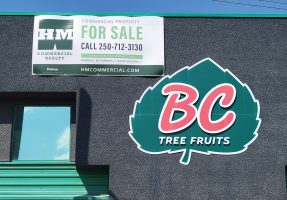
Overhead costs are a big issue. With that in mind, the co-op plans to close its Water Street office in downtown Kelowna, a block from Lake Okanagan. It could be sold, but a final decision hasn’t been made.

“I don’t like fire sales. We really have to understand what the market is doing,” says Sarafinchan.

A similar approach applies to the 85-acre turf farm within the Agricultural Land Reserve  near the airport, which the

co-op bought last year for $6.5 million to consolidate its packing operations.

“The idea of holding on to a non-performing asset does not sit well with me,” says Sarafinchan. “Still, we have to make sure we are selling assets at the appropriate value.”

Sale of the co-op’s Broken Ladder cider brand is under consideration, too. It lost $850,000 last year, and Sarafinchan says it needs to be fixed pronto.

“I am not opposed to diversification, and turning process-grade fruit into something of higher value makes sense,” says Sarafinchan. “But selling cider is different from selling apples.”

Selling assets will not directly improve grower returns; for that, quality fruit is needed.

But growers will be on their own this year with the retirement of long-time field person Charlotte Leaming. She’s the sole survivor of lay-offs last year that saw five other staff terminated.

“We will need to contract a certain amount of technical expertise to support the packing house with information from the orchards,” says Sarafinchan.

But he says the co-op can’t keep providing support to growers in the current environment, especially when they’re not obliged to follow the recommendations and continue to ship poor-quality fruit. This past year, for example, calcium levels in apples were the lowest in 20 years, negatively impacting storage life.

“With our current model, I could put 100 field services staff out there and it would not change the growing practices or the fruit quality of some growers,” says Sarafinchan. “If you are looking to increase your production, you are going to have to invest in the support you need like any other business.”

Sarafinchan says the co-op is assessing its target markets and considering where it can compete and be both profitable and sustainable.

“We are very focused now in Western Canada and I think there is an opportunity for us to focus on other markets,” he says. “I would rather take the top-quality fruit that we have and sell that into markets that want to do more business with us and who see the value, rather than play a lowest-price game.”

The co-op recognizes that grower returns have been down for several years and that could limit the financial resources growers may have to work the 2020 crop.

“The cooperative is moving quickly to present a plan that will provide some financial support to growers for the 2020 crop,” says Sarafinchan. “We expect to be communicating this plan to growers in the upcoming weeks.”


All content on this website is copyrighted, and cannot be republished or reproduced without permission.
Related Posts

You may be interested in these posts from the same category.

Cherry growers focus on labour

BC Tree Fruits relaunch

Algoma comes to BC

Growers Supply property sold

New fruit co-op discussed

Co-op assets on the block

Cherry growers face smaller crop

BC Tree Fruits sells packinghouse site

BC Tree Fruits board remains intact

Lake Country packing house sold

BC Tree CEO on leave

Orchard sector pilots new job-matching website

Previous Post: « Worker health in focus
Next Post: COVID-19 leads to oversupply of dairy »

© 2026 COUNTRY LIFE IN BC - ALL RIGHTS RESERVED