
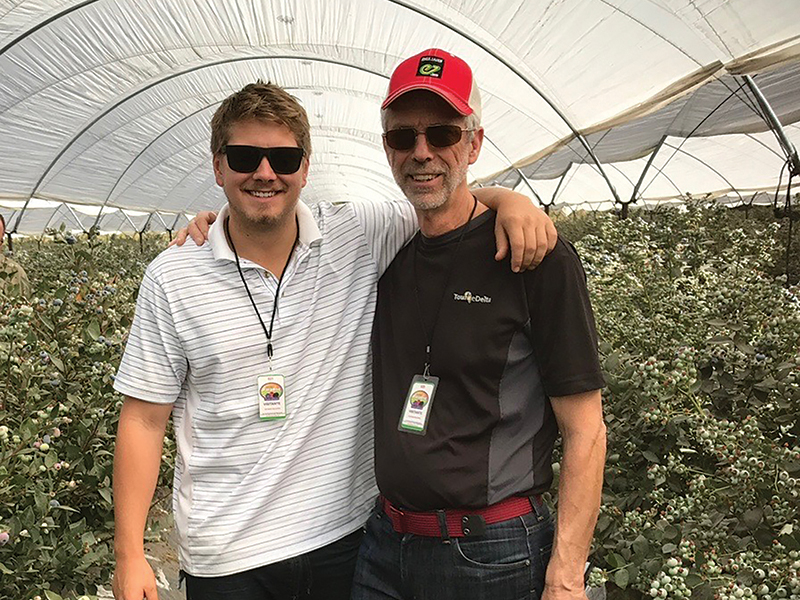
DELTA – A next-generation salad producer is growing his business with the help of some time-honoured BC expertise.
Growing up in Saskatoon, Jon Karwacki was schooled in the importance of delivering the freshest produce to consumers by his father, Star Produce Ltd. founder David Karwacki. After graduating from university, he joined the business and worked in finance and administration before being sent abroad to source the freshest produce for the company.
Joining him on his international travels was veteran BC greenhouse grower David Ryall, who joined Star as an advisor in 2011 after selling Delta’s Gipaanda Greenhouses to Eric Schlact.
“Our only job was to go find the best varieties for anything,” says Karacki.
The travels occurred alongside Ryall’s work at one of Star Produce’s key greenhouse growers in Alberta.
“David and I spent eight years working together,” Karwacki says. “We had the best lettuce in the world.”
The experience opened his eyes to what produce could be when all variables were tightly managed to ensure optimal conditions, and technology was deployed to scout crops for issues.
“We could really see how superior the product was, not only from a food safety perspective but from a freshness perspective and just the quality and the taste,” Karwacki says. “It just creates a much better experience for the consumers.”
Sharing his enthusiasm with Skip the Dishes co-founder Josh Simair, a childhood friend from Saskatoon, Karwacki was encouraged to take his greenhouse expertise directly to consumers via InspiredGo, a salad delivery company launched in 2018 that recently expanded to the US.
Ryall was critical to the venture’s launch, which offers consumers salads with up to 14 different greenhouse-grown ingredients. Star’s BC growers provide peppers, cucumbers and tomatoes; lettuce for orders in Western Canada is from Alberta, while a Toronto grower supplies the Ontario market.
“David was really the inspiration on the food side on how to actually execute this, how to design products that customers love and also set up the complex supply chains behind them to make it work,” says Karwacki, who worked with Ryall to deliver five different projects from concept to commercialization when they worked at Star’s Alberta greenhouse. “A thousand small details add up to a great customer experience … Lots of people shortcut, but he didn’t.”
Ryall’s experience as a grower, as well as his international contacts, opened doors for Karwacki.
“If you’ve got good varieties but you don’t manage the climate in the greenhouse correctly, then you’re not going to get the right production or flavour or shelf life,” Ryall notes. “Too high humidity, you’re going to end up with weak plants, because the plants won’t be taking up water and transpiring, and then you don’t get the right shelf life or flavour.”
With the background knowledge of what a plant requires to be at its best, Karwacki is able to tailor salads to consumers who expect the best.
It’s stuff Karwacki never learned in a corporate office, let alone in school.
“When I was growing up, in school, no one really talked about agriculture,” he says. “My own family’s operation in agriculture was much more on the buy-sell side and much less about the growing. I was a finance guy. I didn’t grow up thinking I’d be in greenhouses and running a salad company.”
But now, thanks to Ryall, he hopes others do.
“He showed me how interesting the industry is, how fast-paced it is on the innovation front, and how much fun it is to be a part of,” he says. “There’s a ton of interest in the industry, and for anybody starting, it’s a great career; it’s very fast-paced. It’s a lot of fun and, like anything, you need talented people because food is essential.”
Ryall, for his part, is glad to see the younger generation take agriculture in a new direction.
“In the last 10, 15 years, [the technology’s] really moved,” he says. “It’s good to see [Jon] moving on, grabbing and running with these kinds of projects.”
All content on this website is copyrighted, and cannot be republished or reproduced without permission.
 Traceability reprieve for livestock