
• Menu
  • Skip to primary navigation
  • Skip to main content
  • Skip to primary sidebar

Country Life In BC Logo

The agricultural news source in British Columbia since 1915

  • Headlines
  • Calendar
  • Subscribe
  • Advertise
  • About
  • Archives
  • Contact
  • Search
  • Headlines
  • Calendar
  • Subscribe
  • Advertise
  • About
  • Archives
  • Contact
  • Search

Primary Sidebar

Originally published:

AUGUST 2021
Vol. 107 Issue 8

Subscribe Now!

Sign up for free weekly FARM NEWS UPDATES

Loading form…

Your information will not be
shared or sold ever

Stories In This Edition

Heat Wave

Night moves

Record temps kill poultry

High heat, low moisture vexes ranchers

Editorial: Unprecedented

Back forty: Summer means being prepared for wildfires

Viewpoint: Overheated markets make farming harder

Province allows secondary homes in the ALR

National farm building code set for update

Grain producers refocus on advocacy, research

Ag Briefs: BC Blueberry Council gets new chair

Ag Briefs: Islands Trust defers policy statement

Ag Briefs: BCAC’s consumer research yields four key findings

Provincial meat licensing overhaul effective October

Farm fresh

New tech could build a better cattle fence

Buchler recognized for practices, generosity

First certified sustainable wine makes debut

Ag targetted to reduce emissions in Clean Air Plan

Helping cattle keep their cool in the heat

Free recycling of ag plastics for northern BC

Pesiticide colleciton returns to the southern interior

Indigienous farms plow new ground with funding

It’s easy being green

Flower farm meets growing demand

New resources support small-lot pork producers

BC going full boar against feral pigs

Cannabis grower has the ‘happiest worms’

AEMCoP updates take effect

Forging new successes with the family farm

Cutworm study looks at damage below ground

Beet growers see red over leaf miner

Armyworm pressure low

Research: Research explores scrapie resistance in goats

Sidebar: Scrapie eradication tips

Woodshed: Graduation plans sworn to secrecy

Cherry grower diversifies as orchard declines

Jude’s Kitchen: Eats for a hot summer day

Farm Story: Reaping more by sowing elss makes perfect sense

All content on this website is copyrighted, and cannot be republished or reproduced without permission.

More Headlines

Follow us on Facebook

Comments Box SVG iconsUsed for the like, share, comment, and reaction icons

2 hours ago

UBC's Wine Research Centre brought together a dozen graduate students at Tantalus Winery in Kelowna on April 30 to share their latest research on viticulture and winemaking. Topics ranged from heat and drought stress on vines to natural yeast classification and cover crop pairings. The day opened with a vineyard tour highlighting sustainable practices already underway at the wine#BCAg#BCAg ... See MoreSee Less

UBCs Wine Research Centre brought together a dozen graduate students at Tantalus Winery in Kelowna on April 30 to share their latest research on viticulture and winemaking. Topics ranged from heat and drought stress on vines to natural yeast classification and cover crop pairings. The day opened with a vineyard tour highlighting sustainable practices already underway at the winery.

#BCAg
View Comments
  • Likes: 0
  • Shares: 0
  • Comments: 0

Comment on Facebook

5 days ago

Saskatchewan's Monette Farms, with nearly $1.1 billion in liabilities, has been granted creditor protection under the CCAA while it restructures. Rapid expansion into produce and cattle dragged earnings well below projections. The farm's BC cattle operation — and a planned West Kelowna winery — hang in the b#BCAge.

#BCAg
... See MoreSee Less

Link thumbnail

Monette Farms wins creditor protection

www.countrylifeinbc.com

Monette Farms’ rapidly expanding produce business was a key factor in its decision to seek protection from creditors last week, according to court documents. Saskatchewan-based Monette Farms was…
View Comments
  • Likes: 1
  • Shares: 0
  • Comments: 0

Comment on Facebook

1 week ago

A new national beef code of practice is open for public comment until June 12. Developed by NFACC and the Canadian Cattle Association, the draft addresses pain management, weaning, nutrition, lameness and end-of-life care.

#BCAg
... See MoreSee Less

Link thumbnail

New beef practices open for comment

www.countrylifeinbc.com

A new national code of practice for beef producers is open for public comment. “The public comment period is an important opportunity for producers across Canada to review the draft code and provide...
View Comments
  • Likes: 1
  • Shares: 0
  • Comments: 0

Comment on Facebook

2 weeks ago

The BC Ministry of Health has approved $4.25 million for the BC Farmers Market Nutrition Coupon Program, administered by the BC Association of Farmers Markets, for 2026. The funding is even with last year, and follows on $12 million provided in 2022-24. The funding is a cornerstone of BCAFM, providing eligible low-income, pregnant and senior individuals with $27 a week for purchases of locally grown produce at more than 100 participating farmers markets in 92 communities across BC. Funding has increased seven-fold since the program launched in 2012.

#BCAg
... See MoreSee Less

The BC Ministry of Health has approved $4.25 million for the BC Farmers Market Nutrition Coupon Program, administered by the BC Association of Farmers Markets, for 2026. The funding is even with last year, and follows on $12 million provided in 2022-24. The funding is a cornerstone of BCAFM, providing eligible low-income, pregnant and senior individuals with $27 a week for purchases of locally grown produce at more than 100 participating farmers markets in 92 communities across BC. Funding has increased seven-fold since the program launched in 2012.

#BCAg
View Comments
  • Likes: 1052
  • Shares: 390
  • Comments: 133

Comment on Facebook

It provides for more than produce. It includes, eggs, meat and honey!

Good program. Additionally, I toured the Kelowna Food bank yesterday. They are serving about 12,000 people a month. Lots are working people.

I have seen people at the Saanichton markets asking if vendors take the coupons and being embarrassed when the vendor says no. Are there signs that are placed on the tables so people know who is part of the program and who is not?

You would have a slim choice of meat if you only get $27.00 .

“While it’s unfortunate that programs like this are necessary, I’m grateful they exist to support families and local farmers.”

Food stamps?

This should be made a little more accessible, especially for seniors

What exactly is this and how does it work? I've never heard of it before. How does this get applied to us who it's intended to help?

Christy Sakai its a week and if you to the markets you can get a small bag of carrots 5bucks, a few potatoes, usually a bag of apples are 5 bucks, and in summer you have fruit choices. Yes doesn't seem like alot but it could be stretched at the markets and remember its a week so really ypu going to use the whole bag of carrots in a week, probably not so you have something for the next week. Heads of lettuce 5 bucks. Every little bit does help when it comes to supporting local farmer and family.

This program has helped me afford local produce, as a senior. I am grateful for the assistance and eat a healthier diet.

I have been a working poor and 🙏👍for recognizing the people who deserve a bit of help as they are doing the best they can 😘👍

This sounds a little more complicated to enroll in than it needs to be. A lot of people probably never heard of it, I only did because I read this post.

It is illegal for me to grow a garden . We can all afford to eat if we can grow.

How does a senior apply?

On my smalltown the food bank puts your name in a lottery for this Seniors included in lottery

Here are the general qualifications: Income Threshold: Generally for lower-income households. Some specific, local programs have identified a threshold of $27,000 or less for a single person or under $50,000 per year for a household. Targeted Groups: Participants must be seniors/elders, pregnant individuals, or families with children under 19. Participant Requirements: In addition to income, participants must: Participate in a food literacy program (e.g., cooking, gardening, or food budgeting). Be able to travel to a participating market to shop for themselves. Allocation: Because demand is high, coupons are often prioritized for new participants each year. Important Information: Coupons are not handed out by the BC Farmers' Markets directly. You must connect with a local community partner (such as a food bank, community centre, or neighbourhood house) to apply.

Glad to see this continue. With the increase in cost of living, this program should be increasing, not staying even with last year. Our local food bank is inundated with need.

It’s a great program. Too bad they won’t extend it to Farmstands as well. Some producers can’t make it to market because of work schedules. And there is more than just vegetables out there.

Where do people apply? Thinking of those I know who need this program.

Have you got an email yet?

I wish a person on disability could get the help too :(

What cities have this

I didn’t know that the program existed

Please if you have these coupons do not be embarrassed to use them they are a good as anyone's money to a grower! I would agree it is a slippery slope to have people pay with government coupons but Remember large scale agriculture is subsidized in this country in way that dwarfs this little program. We are all in a sense are paying with coupons at the big supermarket. As a small scale grower grower I can tell you when you see the higher prices at the farmers market, no one is getting rich off you. That is the true cost of food. Yes that should scare you

Excellent work, BC Ministry of Health! 👍👍👍 An amazing program

View more comments

2 weeks ago

KPU researcher Naomi Robert is partnering with Oregon State University's Dry Farming Collaborative to test drought-resilient growing practices across Vancouver Island and the Gulf Islands. Working with three market gardeners, the study found tomatoes and zucchini thrived without irrigation. With droughts intensifying across the Pacific Northwest, dry farming offers BC growers practical tools to adapt to a changing climate. The full story appears in our April edition. tinyurl.com/d2fzs#BCAg#BCAg ... See MoreSee Less

KPU researcher Naomi Robert is partnering with Oregon State Universitys Dry Farming Collaborative to test drought-resilient growing practices across Vancouver Island and the Gulf Islands. Working with three market gardeners, the study found tomatoes and zucchini thrived without irrigation. With droughts intensifying across the Pacific Northwest, dry farming offers BC growers practical tools to adapt to a changing climate. The full story appears in our April edition. https://tinyurl.com/d2fzs9x6

#BCAg
View Comments
  • Likes: 22
  • Shares: 5
  • Comments: 0

Comment on Facebook

Subscribe | Advertise

The agricultural news source in British Columbia since 1915
  • Email
  • Facebook

Forging new successes with the family farm

Siblings continue parents’ legacy with their partners

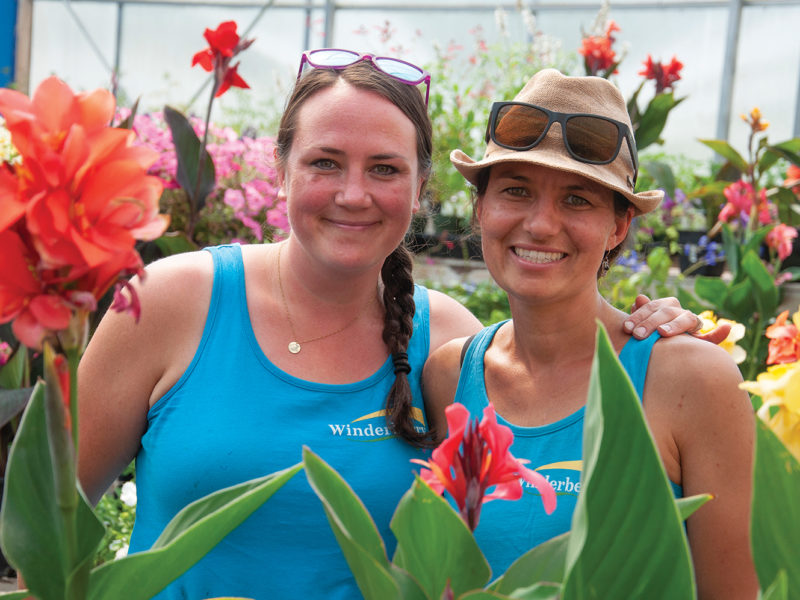
Sisters Anna Steedman, left, and Lin Egan, right, co-own Winderberry Nursery and Edible Acres Farm, Cafe and Catering in Windermere, having taken ownership of the business their parents bought in 1984. Brian Lawrence

August 1, 2021 byBrian Lawrence

WINDERMERE – Taking on the business of your parents isn’t for everyone, but for Winderberry Nursery and Edible Acres Farm, Cafe and Catering co-owners Lin Egan and Anna Steedman, it was the perfect fit.

“I love growing things – I love growing flowers and I love growing food,” says Egan. “It’s exciting and also stressful owning your own business. But there are moments of adventure in that. I love being able to raise our kids here on the farms, and around plants and flowers.”

“I can definitely second the growing thing,” adds Steedman. “There’s a feeling you get when you walk into a greenhouse that’s full of growing things.”

Their parents, Jack Steedman and Glenda Wah, bought the nursery in 1984 when it had just 2,500 square feet of greenhouse space. The sisters started working at the nursery with summer jobs fresh out of high school, Anna more begrudgingly than Lin. Both eventually attended college before returning to Winderberry – Egan with her husband Oliver and Steedman with her partner Randy MacSteven – to carry on and expand their parents’ operation.

“It was a bit of a succession plan,” says Egan. “Oliver and I bought the property from them several years before we purchased the business from them. We had made the decision many years before; it just took a long time to actually do it.”

They began expanding the retail greenhouses in 2008 and now have 25,000 square feet, 10 times the space in 1984. In addition to flowers and bedding plants, it also offers tree and shrubs.

“They were operating a level they were comfortable operating at,” says Egan. “When we came in and took over managerial roles, we expanded how much we were growing. Our mom said, ‘If you’re coming into the business, you have to bring a stream of income.’”

Lin had earned a degree in sustainable agriculture at UBC, eventually working on the UBC farm, while Oliver had studied economics, worked in landscape irrigation and construction, and drove a forklift. Their combined skill sets suited their new endeavour at Winderberry, as well as the creation of Edible Acres.

“When we moved back from Vancouver, Oliver and I started a little farm garden plot,” says Egan. “We grew too much.”

That led the couple to develop a CSA program, which now offers weekly produce boxes to up to 40 members during the height of the growing season. The farm now has about five acres set to produce, and having water rights to Windermere Creek ensures irrigation is always available.

“This is kind of our saviour,” says Egan.

The cafe, now in its sixth year, came later, a logical pairing of the abundance that Lin and Oliver were growing and the catering company run by Steedman and MacSteven.

“We had this vision of combining the two because we were growing all this food,” says Lin.

Steedman had her sights set on veterinary medicine, but an unexpected pregnancy changed her plans, and she stayed with the farm, working in the greenhouse in the spring and catering with MacSteven in the summer. The couple eventually joined Lin and Oliver as co-owners, and the partnership is now in its third year.

MacSteven attended George Brown College, and later cooked at Fairmont Château Laurier and the Fairmont Banff Springs before becoming the executive chef at Panorama Mountain Resort. His passion for cooking developed early in life, with a desire to expand his palate beyond his mother’s cooking.

“I was tired of her food,” he says. “I love my mom, and I love her food. My brother and I started making our lunches in Grade 5. In high school, I started taking home ec, and just started cooking and baking.”

At Edible Acres Cafe, MacSteven uses as much seasonal farm-fresh produce as possible in his breakfast and lunch menus. The 50,000 garlic bulbs planted each fall, comprising 20 varieties, inspired him to save the often discarded scapes from the compost heap, creating the Great Scape garlic dip line, sold in eight Kootenay grocery stores. The dips proved so successful that Edible Acres’ scapes are now supplemented with those from other growers.

Prior to the pandemic, the owners enjoyed planning events so that customers could experience the farm’s bounty in a fun and lively atmosphere. These have included live music and dancing in the greenhouse, Scotch tasting with a paired menu, and “field dinners” in tents set up among the crops.

“We got meat locally, but they were very veggie heavy,” says Steedman of the dinners.

Edible Acres Farm is certified organic, the only one in the Columbia Valley, as are the farms that supply it. Certification required little change in growing practices, but allows the farm to verify its products.

“My parents never used any pesticides or chemicals,” says Lin. “We wanted to have some sort of verification. At that time, everyone would say ‘organic’, and as a consumer, I would question it. If you’re certified, then yes, you are.”

The certification is almost necessary when interacting with dozens of customers each time Edible Acres attends one of the several farmers’ markets in the region, including Invermere and Kimberley.

“We wanted to stand out,” says Oliver. “Not everyone knew who we were. To the new person who arrives to our booth, it means something. If you’re selling to local people that know you, it’s not as important.

“One lady asked today, ‘How organic are you?’ Right there, that was kind of a reason. We don’t have to explain every time. We’ve spent a lot of time educating people what organic is.”

“We’ve ‘veg-umacated’ a lot of people,” jokes MacSteven.

That education doesn’t apply only to the end result. They also promote soil health when customers pick up new plants and shrubs.

“We encourage people to start from the ground up, and invest in their soil,” says Oliver. “We make our own soil. That’s unique. A lot of greenhouses just use pre-mix. That works the same as the cafe – everything is made from scratch.”

Their soil even includes certified organic coffee bean chaff from Kicking Horse Coffee.

“That’s a cool little symbiosis,” says Oliver.

That high-quality soil ensures a good start for the farm’s bedding plants, all grown from seed, both for walk-in customers, as well as commercial clients including towns, golf courses and hotels.

“One of our popular crops is non-stop begonias, and we start those in the first week of December,” says Lin. “That’s one of our baby crops. We could easily order in from suppliers. Some years, if we lose a crop, we order from suppliers. But they’re not as good a quality. When we start 10 seed trays of begonias in the basement, we have more control.”

Customers appreciate that dedication to quality, which builds on the tradition of service started over 35 years ago.

“Because our parents held out for us, it’s kind of a legacy,” says Lin.

“We definitely want to continue the feeling they created,” says Steedman. “We’ve started to see a change. People used to walk through the door and ask for Jack or Glenda. Now they’re asking for us. That’s kind of cool.”

All content on this website is copyrighted, and cannot be republished or reproduced without permission.

Related Posts

You may be interested in these posts from the same category.

BC Milk opens organic stream

Previous Post: « Flower farm meets growing demand
Next Post: COVID influences food demand »

© 2026 COUNTRY LIFE IN BC - ALL RIGHTS RESERVED