• Menu
  • Skip to primary navigation
  • Skip to main content
  • Skip to primary sidebar

Country Life In BC Logo

The agricultural news source in British Columbia since 1915

  • Headlines
  • Calendar
  • Subscribe
  • Advertise
  • About
  • Archives
  • Contact
  • Search
  • Cart
  • Checkout
  • Headlines
  • Calendar
  • Subscribe
  • Advertise
  • About
  • Archives
  • Contact
  • Search
  • Cart
  • Checkout

Primary Sidebar

Originally published:

MAY 2023
Vol. 109 Issue 5

Subscribe Now!

Sign up for free weekly FARM NEWS UPDATES

Loading form…

Your information will not be
shared or sold ever

Stories In This Edition

Province revamps replant program

Groundwater penalties coming

Steady hand

Hopcotts named Outstanding Young Farmers

Editorial: Freedom to grow

Back 40: Demographic shifts underpin farm labour crisis

Viewpoint: Bridging the information gap in agriculture

Tulip grower makes the shift to agritourism

Insurer steps up to cover farmgate abattoirs

Straight and narrow

Ag Briefs: AgSafe board puts mental wellness front and centre

Ag Briefs: AgSafe board puts mental wellness front and centre

Ag Briefs: Wage pressures increase

Ag Briefs: Raspberry growers hopeful

Lucas marks 25-year milestone with fruit growers

Climate change spurs call for new wine rules

Pilot proposed to address worker shortfall

Guatemalans boost foreign farm workforce

Island farmer fined for environmental infractions

Leadership changes herald a year of transition

Colony losses top agenda for beekeepers

Western Milk Pool will benefit BC dairy farmers

Farmers urged to lobby for flood mitigation

BC steps up to permanently double vet seats

Sidebar: AI pause

Persisten drought points to risks ahead

Armstrong greens grower targets local niche

Fish habitat compromised by ranch operation

Ranchers honoured

Veteran cattle seller Al Smith retires

Angus bull tops Williams Lake Bull Sale

Okanagan food hub a step closer to reality

Baling ag plastics key to efficient recycling

Upright fruiting system makes orchards future-friendly

Lack of wool processing capacity limits revenue

Sweet business, small profits for honey producers

A fading art

Farm story: Spring is sprouting – as are the potatoes

Sugar alcohol a sweet solution for SWD control

Woodshed Chronicles: One step forward; two smelly steps back

Invermere market garden thrives by putting soil first

Jude’s Kitchen: Baby veggies are a taste of spring

All content on this website is copyrighted, and cannot be republished or reproduced without permission.
More Headlines

Follow us on Facebook

Comments Box SVG iconsUsed for the like, share, comment, and reaction icons

1 day ago

The committee of MLAs charged with setting priorities for the next provincial budget is recommending regular, annual funding for water storage infrastructure associated with food production, including for engineering inspections, maintenance and upgrades. The recommendation builds on the BC Cattlemen's Association's recommendation of an annual allocation of $5 million for water storage infrastructure related to food production, noting that it could also support resilience in the face of climate-related events. While the province has allocated $120 million for agricultural water infrastructure, agriculture minister Lana Popham told Country Life in BC this week that other ministries and the federal government will need to be involved in funding future p#BCAgts#BCAgCAg

#BCAg
... See MoreSee Less

The committee of MLAs charged with setting priorities for the next provincial budget is recommending regular, annual funding for water storage infrastructure associated with food production, including for engineering inspections, maintenance and upgrades. The recommendation builds on the BC Cattlemens Associations recommendation of an annual allocation of $5 million for water storage infrastructure related to food production, noting that it could also support resilience in the face of climate-related events. While the province has allocated $120 million for agricultural water infrastructure, agriculture minister Lana Popham told Country Life in BC this week that other ministries and the federal government will need to be involved in funding future projects.

#BCAg

#BCAg
View Comments
  • Likes: 22
  • Shares: 5
  • Comments: 3

Comment on Facebook

A typical small-to-medium farming operation featuring a house, main barn, and machine shed generally has around 8,000 to 12,000 square feet of total roof surface. The Okanagan Valley is one of the driest regions in Canada, averaging roughly 300 millimetres (11.8 inches) of annual precipitation. Storing a full year's collected rainwater from those roofs yields roughly 262,500 litres. In the three regional districts that make up the Okanagan valley proper (North Okanagan, Central Okanagan, and Okanagan-Similkameen), the 2021 Statistics Canada Census of Agriculture records roughly 3,100 total farms. Multiply that number by 262,500 litres of harvested rainwater equals 813.75 million litres of water saved per year. Capturing that volume of water across every farm roof in the region would significantly ease peak summer pumping pressure on local groundwater aquifers and Okanagan Lake.

Fantastic!! We will work hard to be involved and do what we can as well as a collective group on the Salmon River!

Absolutely! Long over due and very welcomed. Let's make this happen.

1 day ago

... See MoreSee Less

View Comments
  • Likes: 2
  • Shares: 0
  • Comments: 0

Comment on Facebook

2 days ago

About 40 community members gathered at Silver Creek Community Hall near Salmon Arm last Thursday to discuss ways to improve water availability for both farms and spawning salmon. While the province has since rescinded a fish protection order for the watershed that shut down irrigation, future risks to water access remain top of mind. "We are here because water matters to each of us," says rancher and organizer Trudy Schweb. Farmland Riparian Interface Stewardship Program manager Lee Hesketh outlined the potential for upland water storage while Rob Dinwoodie highlighted cost-shared funding opportunities through the Environmental Farm Plan program for riparian assessments, irrigation efficiency upgrades and other water-related projects available to producers. Photo credit | Facebook/Trudy Schweb

#BCAg
... See MoreSee Less

About 40 community members gathered at Silver Creek Community Hall near Salmon Arm last Thursday to discuss ways to improve water availability for both farms and spawning salmon. While the province has since rescinded a fish protection order for the watershed that shut down irrigation, future risks to water access remain top of mind. We are here because water matters to each of us, says rancher and organizer Trudy Schweb. Farmland Riparian Interface Stewardship Program manager Lee Hesketh outlined the potential for upland water storage while Rob Dinwoodie highlighted cost-shared funding opportunities through the Environmental Farm Plan program for riparian assessments, irrigation efficiency upgrades and other water-related projects available to producers. Photo credit | Facebook/Trudy Schweb

#BCAg
View Comments
  • Likes: 35
  • Shares: 3
  • Comments: 4

Comment on Facebook

Salmon River Watershed Roundtable should be looked into again.

Well done my girl,the voice of Silver Creek ranchers and more

Thanks for covering this🌟

2 days ago

The BC Fruit Growers Association is urging Greater Vernon Water and the Regional District of North Okanagan to halt water shut-offs hitting 2,100+ acres of Okanagan orchards mid-season. With losses potentially topping $250 million, fruit growers say decisions of this scale demand a coordinated plan with farmers and the province — not one-sided cuts. They’re not the only producers affected by this year’s dry conditions.

#BCAg
... See MoreSee Less

Cash Flows

www.countrylifeinbc.com

VERNON – Water restrictions intensified across the southern Interior in late July, with record low stream flows clouding the cash outlook for ranches and orchards. Fourteen agricultural water users...
View Comments
  • Likes: 5
  • Shares: 3
  • Comments: 1

Comment on Facebook

Food should ALWAYS come first. Allow the farmers their water. My grandad watered the apples by flume from the mountain. Let’s get on with AG and get out of the way!

3 days ago

The BC Fruit Growers Association has joined Apples Canada, a new national voice for provincial apple organizations in BC, Ontario, Quebec, New Brunswick and Nova Scotia. Charles Stevens of Ontario chairs the new group, an evolution of the apple working group within Fruit & Vegetable Growers Canada (FVGC), the new group will tackle production, sustainability, research and policy issues as well as advocate for market access in partnership with FVGC. It follows the creation of the Greenhouse Produce Alliance of Canada earlier this year, which replaced the former greenhouse vegetable working group. The berry and field vegetable sectors will continue to maintain working groups with FVGC, while the long-estblished Canadian Potato Council serves the interests of potato growers under the FVGC umbrella.

#BCAg
... See MoreSee Less

The BC Fruit Growers Association has joined Apples Canada, a new national voice for provincial apple organizations in BC, Ontario, Quebec, New Brunswick and Nova Scotia. Charles Stevens of Ontario chairs the new group, an evolution of the apple working group within Fruit & Vegetable Growers Canada (FVGC), the new group will tackle production, sustainability, research and policy issues as well as advocate for market access in partnership with FVGC. It follows the creation of the Greenhouse Produce Alliance of Canada earlier this year, which replaced the former greenhouse vegetable working group. The berry and field vegetable sectors will continue to maintain working groups with FVGC, while the long-estblished Canadian Potato Council serves the interests of potato growers under the FVGC umbrella.

#BCAg
View Comments
  • Likes: 4
  • Shares: 0
  • Comments: 0

Comment on Facebook

Subscribe | Advertise

The agricultural news source in British Columbia since 1915
  • Email
  • Facebook

Insurer steps up to cover farmgate abattoirs

Change sets the stage for the sector’s growth

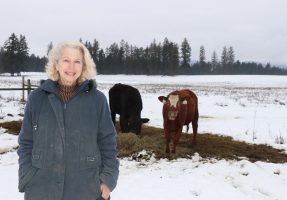
Small-Scale Meat Producers Association executive director Julia Smith

May 3, 2023 byTom Walker

MERRITT – Small-scale meat producers across the province are resting easier following Peace Hills General Insurance’s announcement in April that it will cover farmgate abattoirs.

“It’s very good news. We’ve been working on this for over two years,” says Julia Smith, executive director of the Small-Scale Meat Producers Association. “We had been back and forth with other insurance companies and were really getting nowhere.”

The shift came when SSMPA contacted Crystal Piggott, a client executive with BFL Canada in Salmon Arm.

“She approached Peace Hills and we have been able to put together a package,” Smith says. “Knowledge was a key hurdle. People don’t understand what is going on in our industry.”

But Crystal Piggott, whose father was a butcher for 30 years, did understand.

“When Julia approached me, I knew what she was talking about,” says Piggott, who received the additional background from SSMPA she needed regarding current farmgate slaughter regulations.

“When I learned that all licence holders must take a SlaughterRight course and that they are subject to yearly inspections, I was able to have a company agree to add a small liability onto a farm policy to accommodate those small farms that do their own slaughter, cutting and processing,” Piggott says.

Piggott has been insuring farms for 25 years, but she says there have always been two obstacles: no on-farm slaughter and no meat sales direct to consumers.

But Edmonton-based Peace Hills was prepared to listen, and take into account the small number of animals on-farm processors are handling.

“They agreed to insure

on-farm slaughter with a farmgate licence and we developed a second farm and liability policy to accommodate farmers that want to sell their own meat,” Piggott says.

Piggott is now working with an inspected poultry abattoir that saw their premiums skyrocket this year.

“We have a better solution for abattoir businesses as well,” she says.

Piggott says she wanted to make sure there weren’t any gaps in the coverage package.

“The problem is if you are doing meat sales, for example, and it’s not listed in your policy, that invalidates your entire coverage,” she explains.

SSMPA members get a discount.

“I’ve already been able to send a number of our members over to Crystal and it more than covers your membership fees,” says Smith. “I think this will lead to more farmgate licences when producers realize they can be insured.”

The change will help a restructuring of the province’s meat inspection regime in October 2021 deliver on its promise of greater slaughter capacity in the province.

Prior to the deal with Peace Hills, insurance companies had declined coverage or charged exorbitant premiums that outstripped returns from on-farm processing. (The most generous class of farmgate licences allows farmers to process no more than 25,000 lbs of live weight.)

“Unfortunately, producers quickly discovered that this legal activity was virtually uninsurable,” says Smith. “And if they wished to continue

on-farm slaughter, they would be in the untenable position of not having insurance.”

SSMPA asked the BC Ministry of Agriculture and Food to conduct a survey of producers regarding the problem which could be used to approach insurance companies but were told it didn’t have the resources. Instead, the province provided $2,600 to support an SSMPA survey.

It attracted 114 respondents, of which 88% identified as meat producers who were selling direct to consumers.

“We found that 35% of those surveyed had no insurance at all,” says Smith. “Affordability was the biggest obstacle, followed by finding a provider and obtaining the desired coverage.”

Now that Peace Hills has stepped up to the plate, those numbers are improving and she expects slaughter capacity to grow.

All content on this website is copyrighted, and cannot be republished or reproduced without permission.

Related Posts

You may be interested in these posts from the same category.

Spallumcheen cuts, wraps deal for butcher hub

Farmgate abattoirs shut out of insurance

Poultry gatherings banned

Abattoir closure leaves producers scrambling

Avian influenza returns

Salmon Arm abattoir closes

Second high-path AI case

Small-scale producers voice concerns

Historic relief package delivered

Challenges linger for meat plants

SlaughterRight training launched by ag ministry

New executive director for Small-Scale Meat Producers

Previous Post: « FCC supports wine sector
Next Post: Wildfire, flood risks rise »

© 2026 COUNTRY LIFE IN BC - ALL RIGHTS RESERVED