• Menu
  • Skip to primary navigation
  • Skip to main content
  • Skip to primary sidebar

Country Life In BC Logo

The agricultural news source in British Columbia since 1915

  • Headlines
  • Calendar
  • Subscribe
  • Advertise
  • About
  • Archives
  • Contact
  • Search
  • Headlines
  • Calendar
  • Subscribe
  • Advertise
  • About
  • Archives
  • Contact
  • Search

Primary Sidebar

Originally published:

September 2023
Vol. 109 Issue 9

Subscribe Now!

Sign up for free weekly FARM NEWS UPDATES

Loading form…

Your information will not be
shared or sold ever

Stories In This Edition

Breaking point

Summer lovin’

International exports climb

Moon shines among BC grape growers

Exodus

Back 40: The line of fire raises burning questions

Viewpoint: Targeted grazing could help FireSmart communities

Water curtailments squeeze forage production

Committee report recommends apple commission

Ag Briefs: BC Tree CEO takes leave of absence

Ag Briefs: Hargreaves to lead cranberries

Ag Briefs: New federal minister

Starling control program meets expectations

New society looks to protect property rights

Marketing board chooses new entrant finalists

New funding for First Nations agriculture

Grape growers strategize for recovery

Nex gen’ hops for today’s brewers

Grasslands take carbon storage underground

Farm Story: Crop flops admid potato perfection

Off-the-grid organic farm thrives on efficiency

XY Ranch celebrates 100 years in Peace

Too close for comfort

Ranchers get the backstory on public perception

Sidebar: Build on the public’s trust, not its criticism

Small-scale goat, sheep dairies approved

Wytincks honoured at national show

Sidebar: Best in Show goes to BC producer

Sustainable practices attract a following

Fungicide resistance of botrytis studied

Farmers urge a coordinated drought response

Peary-y nice

Woodshed: Water finds its level for Gladdie, and Kenneth

Cidery harvest opportunity from old orchard

New flavours for fall

All content on this website is copyrighted, and cannot be republished or reproduced without permission.
More Headlines

Follow us on Facebook

Comments Box SVG iconsUsed for the like, share, comment, and reaction icons

3 hours ago

A draft update to the Code of Practice for the Care and Handling of Beef Cattle is now open for public comment until June 12. The code, one of 14 animal care codes developed and maintained by the National Farm Animal Care Council, is undergoing a routine 10-year review. "Your feedback will help shape the industry's guide to cattle welfare for the next decade," says Canadian Cattle Association policy manager Jessica Radau, urging producers to weigh in. For more information, visit tinyurl.com/58a3u9fz.

#BCAg
... See MoreSee Less

A draft update to the Code of Practice for the Care and Handling of Beef Cattle is now open for public comment until June 12. The code, one of 14 animal care codes developed and maintained by the National Farm Animal Care Council, is undergoing a routine 10-year review.  Your feedback will help shape the industrys guide to cattle welfare for the next decade, says Canadian Cattle Association policy manager Jessica Radau, urging producers to weigh in. For more information, visit https://tinyurl.com/58a3u9fz.

#BCAg
View Comments
  • Likes: 2
  • Shares: 0
  • Comments: 1

Comment on Facebook

I sat in the webinar yesterday by the Canadian Cattle Association. My initial concern was that this would be another "play" into the government's hands. It has been worked on by people that are actually in the Beef industry from Cow calf to feedlot. The thrust is an update of the 2013 Code of Practice which was reviewed in 2018. The changes are more a move from "left to the producers discretion" to clearer directions regarding pain management, proper transport of animals which are impaired and keeping cattle in in good condition. Much of what is recommended is what producers who care about animal husbandry already do. The important part is to GIVE THEM FEEDBACK good, bad or otherwise. The document is about 60 pages long, and I ran it through CHAT to see what had been changed. It is important to understand that the PUBLIC is invited to comment on the draft not just producers. Think about it... do you really want the public influencing how you manage your cattle. If you think that this is just one of those things, I have been following Bill 22 in Alberta which will grant the SPCA a proactive roll in entering farms and checking on animals. When I asked CHAT how the new bill relates to the Cattle Code, it came back that the Code although not a regulation will be able to be used as a guide by producers for backup in dealing with the SPCA regarding cattle conditions, sick animal handling etc. Take the time.... Go onto the Canadian Cattle Association website and speak to those parts that you wish to input.

1 day ago

According to the BC River Forecast Centre, the Okanagan snowpack stood at just 58% of normal on April 1 — the lowest reading since measurements began in 1980 — raising concerns about drought conditions in the region this summer. The rest of the province sits at 92% of normal.

#BCAg
... See MoreSee Less

According to the BC River Forecast Centre, the Okanagan snowpack stood at just 58% of normal on April 1 — the lowest reading since measurements began in 1980 — raising concerns about drought conditions in the region this summer. The rest of the province sits at 92% of normal.

#BCAg
View Comments
  • Likes: 3
  • Shares: 0
  • Comments: 0

Comment on Facebook

2 days ago

At her first AGM as executive director of BC Meats, held Saturday in Abbotsford, Jennifer Busmann spoke about her strong ties to agriculture and her optimism for the organization's future. Busmann has cattle of her own and came to the role with existing relationships with members and the board of directors that helped her feel integrated from the start. She stepped into the position in Februa#BCAg#BCAg ... See MoreSee Less

At her first AGM as executive director of BC Meats, held Saturday in Abbotsford, Jennifer Busmann spoke about her strong ties to agriculture and her optimism for the organizations future. Busmann has cattle of her own and came to the role with existing relationships with members and the board of directors that helped her feel integrated from the start. She stepped into the position in February.

#BCAg
View Comments
  • Likes: 6
  • Shares: 0
  • Comments: 0

Comment on Facebook

4 days ago

Shannon Wiggins of Headwind Farm in North Saanich is this year's Mary Forstbauer Grant recipient from the BC Association of Farmers Markets. The $500 grant will help Wiggins expand her plot at Sandown Centre for Regenerative Agriculture, growing more storage crops to extend her harvest season. Wiggins credits farmers markets with inspiring her own farming journey and commitment to building community through food. Congratulations!

tinyurl.com/45bdd#BCAg#BCAg
... See MoreSee Less

Shannon Wiggins of Headwind Farm in North Saanich is this years Mary Forstbauer Grant recipient from the BC Association of Farmers Markets. The $500 grant will help Wiggins expand her plot at Sandown Centre for Regenerative Agriculture, growing more storage crops to extend her harvest season. Wiggins credits farmers markets with inspiring her own farming journey and commitment to building community through food. Congratulations!

https://tinyurl.com/45bddtw8

#BCAg
View Comments
  • Likes: 46
  • Shares: 2
  • Comments: 3

Comment on Facebook

Wahoo! Congrats Shannon! I love your produce. Can’t wait for the radishes 🫜

Congratulations!

Well done!! 🩷🩷🩷

6 days ago

New farmers can avoid costly mistakes by learning from those who've been there. At a Young Agrarians mixer in Penticton, five BC farmers shared hard-won lessons on pricing, pivoting, relationships and burnout. From coyote losses to business burnout, their message was clear: set prices that reflect true costs, make decisions quickly and don't let farming define your worth. Myrna Stark Leader's story appears in our April e-edition, now available to view online at: tinyurl#BCAg2uw53vvm

#BCAg
... See MoreSee Less

New farmers can avoid costly mistakes by learning from those whove been there. At a Young Agrarians mixer in Penticton, five BC farmers shared hard-won lessons on pricing, pivoting, relationships and burnout. From coyote losses to business burnout, their message was clear: set prices that reflect true costs, make decisions quickly and dont let farming define your worth. Myrna Stark Leaders story appears in our April e-edition, now available to view online at: https://tinyurl.com/2uw53vvm

#BCAg
View Comments
  • Likes: 15
  • Shares: 0
  • Comments: 0

Comment on Facebook

Subscribe | Advertise

The agricultural news source in British Columbia since 1915
  • Email
  • Facebook

Marketing board chooses new entrant finalists

Organic stream added to meet growing consumer demand

Adrian and Kelsey Oosterhoff of Telkwa are among five producers shortlisted from a host of applications for the BC Milk Marketing Board’s New Entrant Program. SUBMITTED

September 13, 2023 byKate Ayers And Peter Mitham

ABBOTSFORD – The BC Milk Marketing Board has selected five producers to participate in this year’s New Entrant Program.

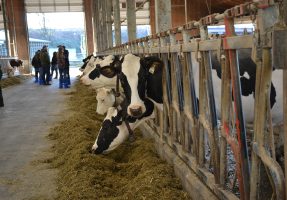
The board chose four producers from a shortlist of seven candidates selected by random draw earlier this year to enter conventional production. One producer was chosen to meet the demand for organic production out of a pool of 10 applicants, with a further three placed on a three-year waitlist.

“It was good to see such strong interest from potential new dairy entrants during these challenging times in the sector, as we grapple with rising costs and weather conditions. We are seeing moderate growth in organic dairy, so opened up a dedicated stream for the first time this year,” says BC Milk general manager Rob Delage. “The review committee identified one farm that can start right away and three others it recommended for a waitlist in the event additional organic production is needed in the coming years. We don’t have any immediate plans on that front but will wait to see how the market evolves.”

The successful candidates, who formally accepted the opportunity August 18, include conventional producers Adrian and Kelsey Oosterhoff of Telkwa; Jessie Weststrate of Delta; Melissa Schalin of Armstrong; Peter and Hertha Muller of Langley; and organic producer Brad Bennik of Langley.

The organic waitlist includes Scott Syme, Andrew Johnson and Jeremy Goosen.

Conventional producers will have until December 31, 2024, to start production and meet the requirements to receive incentive quota from BC Milk. The new entrant in the organic stream will have until September 1, 2026, to commence production.

Conventional producers receive 15 kg of Continuous Daily Quota (CDQ) at startup, plus up to 8 kg of matching CDQ provided on a 1:1 ratio basis during the 10 years of the program.

New entrants under the organic stream will receive an initial 19.5 kg Specialty Continuous Daily Quota (SCDQ) as well as up to 8 kg of matching SCDQ on a 1:1 ratio over the 10-year program. Additionally, organic candidates receive a 30% organic bonus on first-year matching quota purchases, bringing their total potential quota to 40.3 kg.

Family legacy

As a third-generation farmer, Adrian Oosterhoff and his wife Kelsey look forward to diversifying their operation and continuing the legacy of dairy farming in the family as new producers.

The path towards milking cows full-time has been more like a roller coaster, Oosterhoff says. He was raised on a dairy farm on Round Lake, about 10 kilometres southeast of Telkwa, but his father sold the farm in 2000, when Oosterhoff was 12. But then in 2012, his father started up the family dairy farm again and Oosterhoff came home to help with operations.

“For probably about five years, I was much more involved. I was taking on the cow nutrition part of it, did a lot of field work and milking,” Oosterhoff says. Then, his father was ready to retire from milking but Oosterhoff was not in a position to buy the cows and quota and they were sold.

A year later, in 2017, Oosterhoff bought the family farm and started a beef operation which now has about 120 cows under the name Lacroix Ranch, a slight change from his father’s Lacroix Acres. Returning to dairy was a long-term plan, but an initial bid in 2021 wasn’t successful.

This year’s success gives Oosterhoff a chance to continue work his grandfather started after World War II, originally raising broilers on the family homestead before entering dairy production.

Kelsey also comes from a farming family. She grew up on a beef and cash crop operation in the Bulkley Valley. She completed a degree in environmental science at UNBC and now works in the BC Ministry of Energy, Mines and Low Carbon Innovation.

“She had her own beef herd along with her dad’s and she always came back every summer [during university] and was very passionate about being involved,” Oosterhoff says. “That was kind of the start of our beef herd when we got married.”

The couple plan to run the beef and dairy operations side by side.

“We feel in our location that they complement each other quite well. We have a lot of non-arable land up here in the north,” Oosterhoff says, “and so we have access to a fair amount of grazing which works well for the beef and the dairy then would take most of the arable land right around the house here and the barnyard.”

However, the drought has greatly reduced forage production this year. In anticipation of being chosen as a finalist, the Oosterhoffs started securing feed early this year.

“We pretty much realized as soon as we started cutting our own crops that the yields were way down,” Oosterhoff says.

While the couple didn’t know for sure if they would eventually need to feed two herds, they were confident in their application and planned for success and reached out to forage producers from Telkwa to Prince George.

“We don’t want to go backwards on the hard work we’ve done in our growth so far,” Oosterhoff says. “It may be tough but we’re committed to growing and doing this for the long term.”

The Oosterhoffs plan to purchase the full 23 kilograms of quota and hope to be up and running by the end of November.

Oosterhoff has kept the dairy barn in good shape and has secured a new herd from a retiring dairy farmer in the region.

“What we’re looking forward to most is simply being at home and working with animals. We both absolutely love agriculture and we’re quite passionate about it,” he says.

Mullers come with dairy background

Finalists Peter Muller and his wife Hertha of Langley also grew up in the industry.

Peter’s parents had beef cows and horses in Cloverdale, and he often worked on his uncle’s dairy farm in Maple Ridge and aunt’s farm in Duncan. Hertha is from a dairy farm in Agassiz.

Muller is renting a dairy facility in Fort Langley, which he hopes to fill with 30 cows in the first year and work up to between 40 and 50 animals in the second year of operations. The couple, along with their three adult children and grandchildren, look forward to getting started in the dairy sector. Muller plans to be milking by the end of January 2024.

Bennik transitions from water buffalo to Jerseys

Organic stream finalist Brad Bennik is shifting from milking water buffalo to Jerseys, thanks to the New Entrant Program. The absence of supply management drew him towards water buffalo over a decade ago but supply management has drawn him back to dairy cattle.

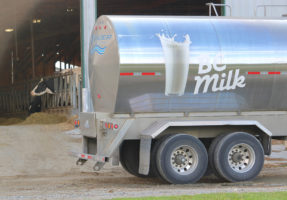
With water buffalo, Bennik needed to do everything from scratch, including marketing and securing retailers. Now, he looks forward to a milk truck showing up, taking away not only his milk but his responsibility for marketing and selling the product.

Bennik milked water buffalo in Langley Township for 11 years but has now sold most of the milking herd and is renting a dairy barn on Barnston Island. Bennik is ready to start organic production by September 1, pending milk inspector approval.

“We hope to get the total 40.3 kilograms,” Bennik says. “I’m going to be milking mostly Jerseys because the facility I have secured is designed for 1960 Holsteins, not 2023 Holsteins.” The Jerseys’ smaller stature is a better fit for his barn.

Conventional finalists Schalin and Weststrate and were not available before deadline. Schalin mentioned that she was busy with barn renovations.

On Facebook, Weststrate wrote, “Well, my dreams just became reality. I was accepted into the New Entrant Program through the BC Milk Board. I’m so thankful to be able to start farming next year, and I’m even more thankful for everyone who’s helped guide me here.”

All content on this website is copyrighted, and cannot be republished or reproduced without permission.
Related Posts

You may be interested in these posts from the same category.

Greater interest in dairy

Comeau reappointed to milk board

Milk board undertakes review

Demand for milk, lower input costs good for dairy

Dairy quota rules change

Interior egg production set to rise

Dairy quota increases

Dairy NEP picks announced

BC Milk caught out

BC FIRB challenges WMP plans

Dairy demand prompts quota increase

Province funds Vitalus plant expansion

Previous Post: « SAWP points to reforms
Next Post: Lake Country packing house sold »

© 2026 COUNTRY LIFE IN BC - ALL RIGHTS RESERVED