• Menu
  • Skip to primary navigation
  • Skip to main content
  • Skip to primary sidebar

Country Life In BC Logo

The agricultural news source in British Columbia since 1915

  • Headlines
  • Calendar
  • Subscribe
  • Advertise
  • About
  • Archives
  • Contact
  • Search
  • Cart
  • Checkout
  • Headlines
  • Calendar
  • Subscribe
  • Advertise
  • About
  • Archives
  • Contact
  • Search
  • Cart
  • Checkout

Primary Sidebar

Originally published:

DECEMBER 2020
Vol. 106 Issue 12

Subscribe Now!

Sign up for free weekly FARM NEWS UPDATES

Loading form…

Your information will not be
shared or sold ever

Stories In This Edition

Abattoirs eye pandemic funding

Water fight

Turkey sales strengthen

Orchardists forge ahead following late-season freeze

Editorial: Back to the future

Back 40: Pandemic gives leaders a bosst, but what about farmers

Viewpoint: BC agriculture set to ead food conversations

Kamloops farmers push back on irrigation plan

Sidebar: A new tool for municipalities

ILT puts broiler farms on the defensive

Snowed under

Antimicrobial phase-out delayed

BC Tree Fruits makeover gets green light

Keremeos supply store closes

Province rethinks land matching pitch

Ag Briefs: Land commission appts announced

Ag Briefs: Blueberry council set for elections

Ag Briefs: Award honours young agrologist

Ag Briefs: Horticultural loss

Ag in the Classroom prepares for change

Beekeepers go virtual for 100th anniversary

Sidebar: Pandemic puts pause on bee research

Island farmers frustrated by ferry waits

Slaughter limitations forcing producers out

Livestock specialist has close ties to ranching

Cattle take lead in fire prevention efforts

New food hub planned for Salmon Arm

Passion and schooling pay off for young grower

Cleanfarms looks into ag plastic recycling program

Robotic strawberry picker on the horizon

Agritech venture aims to unite data management

Sidebar: Microsoft moves in

Up in smoke

New tool helps farmers avoid nutrient runoff

Peace region weather network expanded

Sidebar: Adaption network hosts webinar series

Tarps provide targeted alternative to cover crops

Orchardists making greater use of decisionaid system

Asian parasitoids come to the rescue of berry growers

Research: Keeping cows’ reproductive cycle on track

Agroforestry project makes farm viable

Young farmers encouraged to cultivate resilience

Farm Story: A change of season brings a change of mind

Universal broadband fund cheers farmers

Woodshed: New beginnings for Deborah and Susan

4-H members finish season at virtual Ag Expo

Jude’s Kitchen: Classic festive appies for the holidays

All content on this website is copyrighted, and cannot be republished or reproduced without permission.
More Headlines

Follow us on Facebook

Comments Box SVG iconsUsed for the like, share, comment, and reaction icons

2 days ago

The province has extended its provincial state of emergency until August 29 as wildfire risk remains elevated across much of the province, particularly in the Okanagan. While thousands have returned home since the August 8 declaration, evacuation alerts and orders remain in effect in several areas. Government urges residents to stay prepared, review emergency plans and check EmergencyInfoBC.ca for updates.

#BCAg
... See MoreSee Less

The province has extended its provincial state of emergency until August 29 as wildfire risk remains elevated across much of the province, particularly in the Okanagan. While thousands have returned home since the August 8 declaration, evacuation alerts and orders remain in effect in several areas. Government urges residents to stay prepared, review emergency plans and check EmergencyInfoBC.ca for updates.

#BCAg
View Comments
  • Likes: 2
  • Shares: 0
  • Comments: 0

Comment on Facebook

3 days ago

Chilco Ranch–Miller Ranches of Hanceville received the national environmental stewardship award from the Canadian Cattle Association at this week's Canadian Beef Industry Conference in Winnipeg. The fourth-generation ranch blends traditional values with modern innovation as it manages 1,000 cow-calf pairs of Hereford cattle across 170,000 acres. Rotational grazing, soil health improvement and careful land stewardship as well as advanced water-monitoring technology ensures sustainable ranch operations, while deep community involvement through 4-H and other organizations support future generations. You can read more of their story in the September issue of Country Life in BC, which goes to press next week. Photo | Facebook/Canadian Cattle Associat#BCAg#BCAg ... See MoreSee Less

Chilco Ranch–Miller Ranches of Hanceville received the national environmental stewardship award from the Canadian Cattle Association at this weeks Canadian Beef Industry Conference in Winnipeg. The fourth-generation ranch blends traditional values with modern innovation as it manages 1,000 cow-calf pairs of Hereford cattle across 170,000 acres. Rotational grazing, soil health improvement and careful land stewardship as well as advanced water-monitoring technology ensures sustainable ranch operations, while deep community involvement through 4-H and other organizations support future generations. You can read more of their story in the September issue of Country Life in BC, which goes to press next week. Photo | Facebook/Canadian Cattle Association

#BCAg
View Comments
  • Likes: 47
  • Shares: 5
  • Comments: 0

Comment on Facebook

3 days ago

The deadline to weigh in on BC's proposed food-processing rules in the Agricultural Land Reserve has been extended to September 18. Proposed changes would open nearly 1.3 million acres of protected farmland to food processors by allowing processors to build plants on Class 5-7 soil (and Class 4, in some cases) as long as 5% of inputs are grown in BC. Currently, all processors must source at least 50% of inputs from BC. The existing 50% rule would stay in place for Class 1-3 soils. The BC Agriculture Council, which has previously raised concerns that the proposal reflects a narrow set of interests, says it's still reviewing the details with its #BCAgrs.

#BCAg
... See MoreSee Less

The deadline to weigh in on BCs proposed food-processing rules in the Agricultural Land Reserve has been extended to September 18. Proposed changes would open nearly 1.3 million acres of protected farmland to food processors by allowing processors to build plants on Class 5-7 soil (and Class 4, in some cases) as long as 5% of inputs are grown in BC. Currently, all processors must source at least 50% of inputs from BC. The existing 50% rule would stay in place for Class 1-3 soils. The BC Agriculture Council, which has previously raised concerns that the proposal reflects a narrow set of interests, says its still reviewing the details with its members.

#BCAg
View Comments
  • Likes: 18
  • Shares: 24
  • Comments: 11

Comment on Facebook

Funny how they always release these proposals in August when most farms are working overtime.

Let’s use our brains for a moment and think about this. Let’s say I’ve got a farm in bc, where i grow a crop that I then turn into jam. I have a small window each year where my produce is ready. I turn it into jam. Now my jam becomes a big hit and people want it year round. The only way for me to produce outside of my fruit bearing window is to bring in fruit from other places. I’m supposed to let my investment sit idle for most of the year? You can extrapolate this to many things we grow in bc and have short windows where it is ready. Our goal shouldn’t be to make it harder for people to succeed. Maybe 5% is too low, but 50% means it’s going to sit idle.

The current rules actually say 50% from the farm or related farms (ie. in the same producer group). The new rule is 5% from BC. This would likely be good for abattoirs, and I'm sure wineries would be excited too. However, both thise enterprises can be located away from ALR land. The proposed regulations will do the opposite of supporting agriculture. They will foster the removal of farmland from protection, and the increased impoverishment of our food system.

emails can be sent here: AF.Minister@gov.bc.ca

5%? Yeah, that’s a big “no” from me… the whole point of allowing processing on farmland is to make farms more economically viable by increasing the market for their product.

Where is the link for input?

5% that’s nothing and how long what happens then after 5 years it is 0% they are not going to say oh you need to shut down.

I find that 5% vs 50 % equation very unsettling. In this situation it is not 5% from the farm it is 5% from bc. The rest can come from anywhere else. This is fine for industry standards but does not help agriculture in bc. So if we are going to give up limited agricultural land for this endeavour it had should help farming in bc. Farmers are expected to use 50% of their own on farm product on alr. Farmers would continue to be expected to use 50% while processors need not grow anything nor support bc farms. This doesn’t pass the sniff test to me

I am by far, no expert, but why would you even propose to build a plant on good farmland, isn’t that for growing a plant? You can build a plant on any ground. Reminds me of all the greenhouses built on prime soil, to me it reduces capacity and takes away from local farmers so big business can come in and take over.

Here is the link: news.gov.bc.ca/files/FoodProcessingALR_DiscussionPaperAug18_2026.pdf Taking input until September 18th. In my opinion, lowering the sources to just 5% does nothing to build food sovereignty which is what we desperately need.

This is such bs

View more comments

4 days ago

The province has just issued a new temporary protection order for the Salmon River, effective immediately, restricting irrigation water for forage crops such as hay, alfalfa, and corn. A previous order was issued on July 28 and rescinded on August 8 due to wildfire risk, but low stream flows persist, threatening over 200 spawning Chinook salmon in the watershed. Affected licence holders will be contacted directly. Drought support is available to farmers through the Ministry of Agriculture and Food. The province has invested $120 million in the Agriculture Water Infrastructure Program to support farmers facing water scarcity.

#BCAg
... See MoreSee Less

The province has just issued a new temporary protection order for the Salmon River, effective immediately, restricting irrigation water for forage crops such as hay, alfalfa, and corn. A previous order was issued on July 28 and rescinded on August 8 due to wildfire risk, but low stream flows persist, threatening over 200 spawning Chinook salmon in the watershed. Affected licence holders will be contacted directly. Drought support is available to farmers through the Ministry of Agriculture and Food. The province has invested $120 million in the Agriculture Water Infrastructure Program to support farmers facing water scarcity.

#BCAg
View Comments
  • Likes: 14
  • Shares: 9
  • Comments: 7

Comment on Facebook

Can someone explain why they irrigate during the day in the blistering heat. Would it be better to water early morning and at sunset?

This is just an exceptionally dry year from low snow cap. It does happen!

200 fish over all the feed that grows in this valley wow that some expensive fish

Time to start new methods of agriculture, ive watched our ecosystem take a beating in my lifetime, iym not against any productivity of our economic development within our structures, really its not rocket science. Its just going to cost alot to change to a better, more viable solution. Banks and your intellectuals, wanna run this country with money, then quit, wasting it on ignorance. The solutions are all easy, just how much money, do we waste, and how much are we going to spend, on actually fixing the issues.

Get your water off fly hills two big lakes off there Spa and author

And they continue to ignore CHASE CREEK....

The methods we have now are because settlers always saw what was excess resources in their eyes - the riches of the ‘New World’ have been used and abused and as the limits have been reached are in disbelief and still trying to push for more….when the problem is US and how settlers have always been about extraction and not living with and much less understanding the landscapes in their integration because the next crop is the horizon and there is no compassion for the land its flora and fauna because it needs to be remade in the settler image and naive ideal

View more comments

6 days ago

Kwantlen Polytechnic University has established a one-acre research hopyard at Molson Coors' Chilliwack plant, housing 10 experimental selections and 40 heritage varieties. The multi-year partnership supports new hop variety development and breeding decisions for BC growers, building on Chilliwack's history as Canada's former largest hop-producing region. www.countrylifeinbc.com/kpu-sets-up-rese#BCAgh#kwantlenpolytechnicuniversityc#MolsonCoorsty #MolsonCoors ... See MoreSee Less

Kwantlen Polytechnic University has established a one-acre research hopyard at Molson Coors Chilliwack plant, housing 10 experimental selections and 40 heritage varieties. The multi-year partnership supports new hop variety development and breeding decisions for BC growers, building on Chilliwacks history as Canadas former largest hop-producing region. https://www.countrylifeinbc.com/kpu-sets-up-research-hopyard/

#BCAg #kwantlenpolytechnicuniversity #MolsonCoors
View Comments
  • Likes: 27
  • Shares: 2
  • Comments: 1

Comment on Facebook

What is old is new again in Chilliwack.

Subscribe | Advertise

The agricultural news source in British Columbia since 1915
  • Email
  • Facebook

New food hub planned for Salmon Arm

Project will give local producers an opportunity to expand

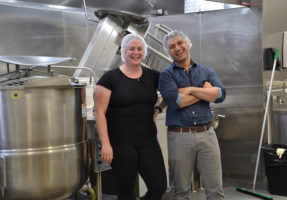
Former COABC executive director Jen Gamble has created a business plan and is expected to follow through on the creation of a province-backed food hub in Salmon Arm which would allow local producers to expand and add value to their products. PHOTO / SUBMITTED

December 1, 2020 byJackie Pearase

SALMON ARM – A food hub in Salmon Arm will provide much-needed processing opportunities to producers in the Shuswap-Okanagan.

In mid-September, the BC Ministry of Agriculture announced $500,000 toward the creation of a food hub in the community.

“The province’s processing sector is seeing success all over BC and we are supporting farmers and food and beverage producers who want to take their products to the next level,” says BC Minister of Agriculture Lana Popham.

The idea for a food hub started two years ago with a feasibility study done by the Salmon Arm Economic Development Society. The study included consultation with local producers and processors to determine the need and demand for such a facility.

SAEDS economic development manager Lana Fitt says they are well aware gaps in the local food processing infrastructure are a barrier to new business development and expansion of existing food producers.

“The ability for them to access shared equipment and shared knowledge and shared space for that initial food production was definitely on our radar for some time before we proceeded with the food hub feasibility project,” she notes.

Salmon Arm mayor Alan Harrison says the facility fits nicely with the city’s efforts around food security.

“This is exactly one of the ingredients that you need in order to process local foods and be able to look after your own area,” Harrison says. “That’s our goal, to have that anchor, the food hub, and then have smaller producers be able to process their products and serve them locally.”

Jen Gamble was the consultant for the food hub’s subsequent business plan and is scheduled to be hired as the food hub’s executive director.

She says providing producers with the means to scale up production and build their businesses will certainly enhance local food security.

“It will allow people that, right now, are creating solutions for themselves that are maybe not the most convenient to adjust and hopefully have something that works very well for them,” she says.

Elderberry Grove owners Jed Wiebe and Louise Lecouffe currently process their syrup, juice and shrub – a beverage made with the syrup, apple cider vinegar and honey – in a small rented kitchen.

Wiebe says the current arrangement is working for now.

“If the scale of our production gets any bigger, it will be too small. And that’s the plan; we grow every year,” he says.

The recent announcement halted their plans to construct a commercial kitchen.

“This is a lot smarter economically and also for the environment: why make two facilities when one can be shared?” asks Wiebe. “If it opens next year, we want to at least try it out and see if it works for us.”

Fitt expects a wide variety of foods, beverages and value-added products to be processed at the facility.

“It’s definitely a multi-use facility so we’ve all kinds of ideas and opportunities coming from this,” she says. “It’s quite diverse in terms of what could be offered in the space.”

Selection of a site was expected in late October. Fitt says the site needs to have the potential to expand.

“We’re hopefully looking to grow the space and offer more services and more activities, more support programs in the space over time,” explains Fitt.

Business development services will be provided through local partnerships with the Salmon Arm Innovation Centre, Shuswap Launch-a-Preneur Program, Community Futures Shuswap and Okanagan College.

“We see that as being a key component of the food hub going forward. Not just the physical space and the equipment but actually the training and support to get that new product to market successfully,” notes Fitt. “Those partners we see as playing a very important role in providing that ongoing support service to businesses either as they’re launching or through growth phases.”

Once space is leased, Gamble will get to work on sourcing equipment, engaging and educating potential food hub users and the public, communicating with the BC Ministry of Agriculture and Interior Health Authority, and monitoring construction.

Gamble says the hub will serve the entire Columbia Shuswap Regional District as well as some neighbouring communities within the Okanagan.

“It’s such a great area for agriculture that it’s a really solid base to build on.”

The goal is to secure an anchor tenant that will ensure year-round operation of the facility to make it financially viable within a two-year timeframe.

“That anchor tenant will help secure and provide stability for the hub and smaller people coming in,” she adds.

Gamble doesn’t expect to have the capacity immediately to serve large dairies in the area but there are many small to medium producers and processors that could benefit from the food hub.

“People like that will hopefully be able to hop right in and make this a piece of their operation that facilitates the business functioning better and allows them to stay a little more local,” she says. “In the end, I think it will build a really strong network and community around our food system here in the Shuswap.”

This is the fifth food hub established in BC supported by the BC Food Hub Network and Ministry of Agriculture. There are operating food hubs in Vancouver, Surrey and Port Alberni. A food hub is scheduled to open soon in Quesnel. The Salmon Arm food hub is scheduled to open in 2021.

All content on this website is copyrighted, and cannot be republished or reproduced without permission.
Related Posts

You may be interested in these posts from the same category.

Butcher hub moves ahead after three years

Creston food hub opens

Food hub network expands

Victoria food hub gets funding

Previous Post: « Dairy raises US ire
Next Post: BC leads food price increases »

© 2026 COUNTRY LIFE IN BC - ALL RIGHTS RESERVED