
• Menu
  • Skip to primary navigation
  • Skip to main content
  • Skip to primary sidebar

Country Life In BC Logo

The agricultural news source in British Columbia since 1915

  • Headlines
  • Calendar
  • Subscribe
  • Advertise
  • About
  • Archives
  • Contact
  • Search
  • Cart
  • Checkout
  • Headlines
  • Calendar
  • Subscribe
  • Advertise
  • About
  • Archives
  • Contact
  • Search
  • Cart
  • Checkout

Primary Sidebar

Originally published:

JUNE 2022
Vol. 108 Issue 6

Subscribe Now!

Sign up for free weekly FARM NEWS UPDATES

Loading form…

Your information will not be
shared or sold ever

Stories In This Edition

Bird flu in FV

Birds of a feather

BC farm count shrinks

Fast turnaround nabs new grower high praise

Editorial: Growing old quickly

Back 40: War puts perspective on delayed spring in BC

Op-ed: Panel frames a vision for the future of BC ag

Cool spring has delayed crops province-wide

Sidebar: Low termperatures impact fruit

Nicola Valley secures funding for new abattoir

Ranchers feel margin squeeze

IAFBC expands its reach despite challenging year

Good job

Growers must focus on quality to grow market

Task force works to implement UNDRIP goals

Packers say they’ll work together to fix industry

New president aims to motivate farmers institutes

Irrigation shouldn’t be an afterthought

Project provides peace of mind for Oliver growers

Seaweed shows promise as feed additive

Forage field days showcase new tools, concepts

Sidebar: Pest management plot

Women offer ‘cutting-edge’ skills

Irrigation planning critical for hazelnuts

Nip and tuck

Off-season sales boosted by new vending machine

New pest jeopardizes strawberry production

Big expansion plans for Terrace poultry farm

BCAITC celebrates 30 years

Farm Story: There’s always one field that’s “special”

Shape-shifting dahlias drawing in growers

Woodshed Chronicles: Rescue comes for Kenneth

Jude’s Kitchen: Cake to celebrate summer and dads

All content on this website is copyrighted, and cannot be republished or reproduced without permission.

More Headlines

Follow us on Facebook

Comments Box SVG iconsUsed for the like, share, comment, and reaction icons

1 day ago

The committee of MLAs charged with setting priorities for the next provincial budget is recommending regular, annual funding for water storage infrastructure associated with food production, including for engineering inspections, maintenance and upgrades. The recommendation builds on the BC Cattlemen's Association's recommendation of an annual allocation of $5 million for water storage infrastructure related to food production, noting that it could also support resilience in the face of climate-related events. While the province has allocated $120 million for agricultural water infrastructure, agriculture minister Lana Popham told Country Life in BC this week that other ministries and the federal government will need to be involved in funding future p#BCAgts#BCAgCAg

#BCAg
... See MoreSee Less

The committee of MLAs charged with setting priorities for the next provincial budget is recommending regular, annual funding for water storage infrastructure associated with food production, including for engineering inspections, maintenance and upgrades. The recommendation builds on the BC Cattlemens Associations recommendation of an annual allocation of $5 million for water storage infrastructure related to food production, noting that it could also support resilience in the face of climate-related events. While the province has allocated $120 million for agricultural water infrastructure, agriculture minister Lana Popham told Country Life in BC this week that other ministries and the federal government will need to be involved in funding future projects.

#BCAg

#BCAg
View Comments
  • Likes: 23
  • Shares: 6
  • Comments: 3

Comment on Facebook

A typical small-to-medium farming operation featuring a house, main barn, and machine shed generally has around 8,000 to 12,000 square feet of total roof surface. The Okanagan Valley is one of the driest regions in Canada, averaging roughly 300 millimetres (11.8 inches) of annual precipitation. Storing a full year's collected rainwater from those roofs yields roughly 262,500 litres. In the three regional districts that make up the Okanagan valley proper (North Okanagan, Central Okanagan, and Okanagan-Similkameen), the 2021 Statistics Canada Census of Agriculture records roughly 3,100 total farms. Multiply that number by 262,500 litres of harvested rainwater equals 813.75 million litres of water saved per year. Capturing that volume of water across every farm roof in the region would significantly ease peak summer pumping pressure on local groundwater aquifers and Okanagan Lake.

Fantastic!! We will work hard to be involved and do what we can as well as a collective group on the Salmon River!

Absolutely! Long over due and very welcomed. Let's make this happen.

1 day ago

... See MoreSee Less

View Comments
  • Likes: 2
  • Shares: 0
  • Comments: 0

Comment on Facebook

2 days ago

About 40 community members gathered at Silver Creek Community Hall near Salmon Arm last Thursday to discuss ways to improve water availability for both farms and spawning salmon. While the province has since rescinded a fish protection order for the watershed that shut down irrigation, future risks to water access remain top of mind. "We are here because water matters to each of us," says rancher and organizer Trudy Schweb. Farmland Riparian Interface Stewardship Program manager Lee Hesketh outlined the potential for upland water storage while Rob Dinwoodie highlighted cost-shared funding opportunities through the Environmental Farm Plan program for riparian assessments, irrigation efficiency upgrades and other water-related projects available to producers. Photo credit | Facebook/Trudy Schweb

#BCAg
... See MoreSee Less

About 40 community members gathered at Silver Creek Community Hall near Salmon Arm last Thursday to discuss ways to improve water availability for both farms and spawning salmon. While the province has since rescinded a fish protection order for the watershed that shut down irrigation, future risks to water access remain top of mind. We are here because water matters to each of us, says rancher and organizer Trudy Schweb. Farmland Riparian Interface Stewardship Program manager Lee Hesketh outlined the potential for upland water storage while Rob Dinwoodie highlighted cost-shared funding opportunities through the Environmental Farm Plan program for riparian assessments, irrigation efficiency upgrades and other water-related projects available to producers. Photo credit | Facebook/Trudy Schweb

#BCAg
View Comments
  • Likes: 36
  • Shares: 4
  • Comments: 4

Comment on Facebook

Salmon River Watershed Roundtable should be looked into again.

Well done my girl,the voice of Silver Creek ranchers and more

Thanks for covering this🌟

2 days ago

The BC Fruit Growers Association is urging Greater Vernon Water and the Regional District of North Okanagan to halt water shut-offs hitting 2,100+ acres of Okanagan orchards mid-season. With losses potentially topping $250 million, fruit growers say decisions of this scale demand a coordinated plan with farmers and the province — not one-sided cuts. They’re not the only producers affected by this year’s dry conditions.

#BCAg
... See MoreSee Less

Cash Flows

www.countrylifeinbc.com

VERNON – Water restrictions intensified across the southern Interior in late July, with record low stream flows clouding the cash outlook for ranches and orchards. Fourteen agricultural water users...
View Comments
  • Likes: 5
  • Shares: 3
  • Comments: 1

Comment on Facebook

Food should ALWAYS come first. Allow the farmers their water. My grandad watered the apples by flume from the mountain. Let’s get on with AG and get out of the way!

3 days ago

The BC Fruit Growers Association has joined Apples Canada, a new national voice for provincial apple organizations in BC, Ontario, Quebec, New Brunswick and Nova Scotia. Charles Stevens of Ontario chairs the new group, an evolution of the apple working group within Fruit & Vegetable Growers Canada (FVGC), the new group will tackle production, sustainability, research and policy issues as well as advocate for market access in partnership with FVGC. It follows the creation of the Greenhouse Produce Alliance of Canada earlier this year, which replaced the former greenhouse vegetable working group. The berry and field vegetable sectors will continue to maintain working groups with FVGC, while the long-estblished Canadian Potato Council serves the interests of potato growers under the FVGC umbrella.

#BCAg
... See MoreSee Less

The BC Fruit Growers Association has joined Apples Canada, a new national voice for provincial apple organizations in BC, Ontario, Quebec, New Brunswick and Nova Scotia. Charles Stevens of Ontario chairs the new group, an evolution of the apple working group within Fruit & Vegetable Growers Canada (FVGC), the new group will tackle production, sustainability, research and policy issues as well as advocate for market access in partnership with FVGC. It follows the creation of the Greenhouse Produce Alliance of Canada earlier this year, which replaced the former greenhouse vegetable working group. The berry and field vegetable sectors will continue to maintain working groups with FVGC, while the long-estblished Canadian Potato Council serves the interests of potato growers under the FVGC umbrella.

#BCAg
View Comments
  • Likes: 4
  • Shares: 0
  • Comments: 0

Comment on Facebook

Subscribe | Advertise

The agricultural news source in British Columbia since 1915
  • Email
  • Facebook

Off-season sales boosted by new vending machine

System supports stable revenues

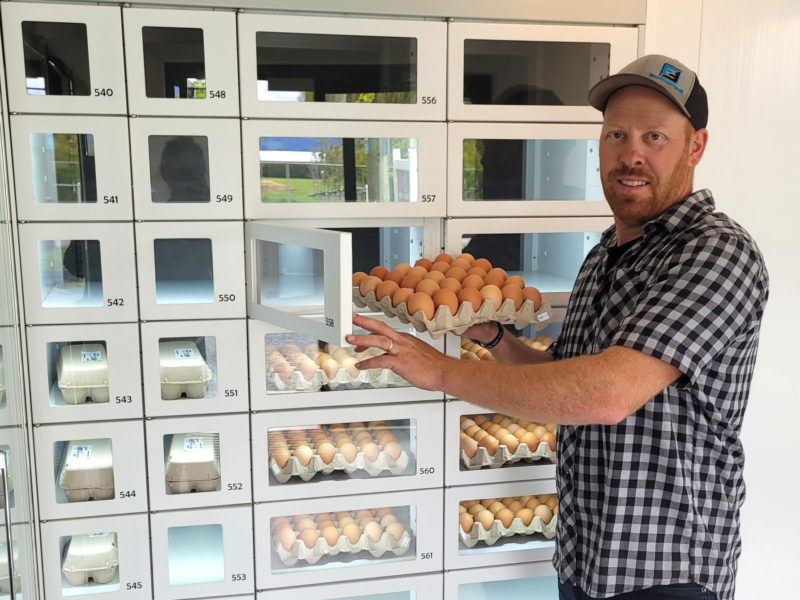
Brian Maljaars likes efficiency – and a state-of-the-art vending machine to market Berry Bounty Farms’ eggs, berries and honey year-round checks all the boxes. Leanne Maljaars

June 1, 2022 byMyrna Stark Leader

CHILLIWACK – A vending machine from the Netherlands has improved winter sales on a Chilliwack farm.

Berry Bounty Farms installed the Innovend machine last July, allowing it to display more than a dozen products from berries to eggs and honey in individual climate-controlled compartments with see-through doors.

An increasingly common sight in Europe, the installation in Chilliwack is the first in North America and represents a major development for Berry Bounty, a 37-acre mixed farm producing blueberries, raspberries, eggs and honey as well as jams and juices.

Dave and Janna Maljaars purchased the former dairy farm in the 1990s and leased it to others for forage crops. About 12 years ago, the Maljaars with their son Brian and his brothers-in-law Les and Steve decided the land should be more productive and planted berries.

Large fluctuations in the prices received from local packers prompted them to pursue direct farmgate sales to obtain more stable returns. They started with a fridge full of products and a cash box outside their garage door. With everyone working full-time off-farm, they found farmers markets took more effort than the revenue they generated.

“I’m a builder by trade and still work but I want the farm to be more than a hobby as I take it over, hopefully, to be a primary source of income,” says Brian Maljaars. “That means we need to do things differently to become the most efficient.”

This is where the Innovend began to make sense.

Originally, Maljaars’ wife Leanne (a teacher and also the farm’s social media marketer), noticed another local farm using a different vending system. They researched a few options and realized that climate-controlled vending compartments could boost berry sales in the winter and increase revenues.

It would also expand shopping hours, increase customer convenience and save time. There would be no more need to set appointments for customers to pick up products, especially frozen berries.

The machine arrived just as berry season was starting last summer. Hoping for strong demand for frozen berries throughout the winter, in addition to fresh market sales during the summer, the farm doubled its frozen berry inventory. Blueberries are packaged in four-pound bags and raspberries in three-pound packages.

“Sales in general have been absolutely phenomenal on the machine through December, January and now March and April,” says Maljaars. “We estimated about $7,000 a month and are now exceeding $10,000. We are going to run out of inventory so it might see a drop now but it’s given us marketing direction for 2022.”

The version of the Innovend machine installed in Chilliwack cost $60,000. The Maljaars liked that it had been in development for 15 years and could be operated by phone from their day jobs. Customers can pay by credit card, enabling self-serve shopping at their farm 13 hours a day, six days a week.

Typically, they’ve had 20 to 30 customers of all ages visit the farm daily, and not just from Chilliwack. Many are curious, though vending machines are being adopted by a growing number of farms for a range of perishable products including milk and eggs.

Maljaars credits a Dale Carnegie training course he attended a couple years ago with encouraging him to find new and better ways of doing things, from new technologies to building a better berry packing line.

One plus of the Innovend is that the machine is connected to the manufacturer via the Internet, allowing software updates to occur with ease.

“We have sold two other machines in BC in addition to the one at Berry Bounty within the last 16 months,” says Gene Keenan of AgPro West Supply Ltd., the Abbotsford dealer. “We have had farmers interested from Victoria, Terrace and the Fraser Valley. We’ve also been in contact with farmers from Alberta and Nova Scotia.”

Maljaars says vending machines could be a viable marketing tool for BC producers, particularly niche growers of meat, flowers and vegetables – all products that can be accommodated in a climate-controlled machine.

All content on this website is copyrighted, and cannot be republished or reproduced without permission.

Related Posts

You may be interested in these posts from the same category.

Previous Post: « Indigenizing agriculture, ensuring food supply resiliency
Next Post: Abbotsford approves flood mitigation option »

© 2026 COUNTRY LIFE IN BC - ALL RIGHTS RESERVED