
OLIVER – Convincing farmers and others of the potential of harvesting solar power alongside agricultural crops was front and centre at an in-person/online learning townhall in Oliver,
November 14.
A handful of growers, as well as municipal staff and consultants, attended in person to learn how agrivoltaics – solar panels incorporated into agricultural operations – could work in BC.
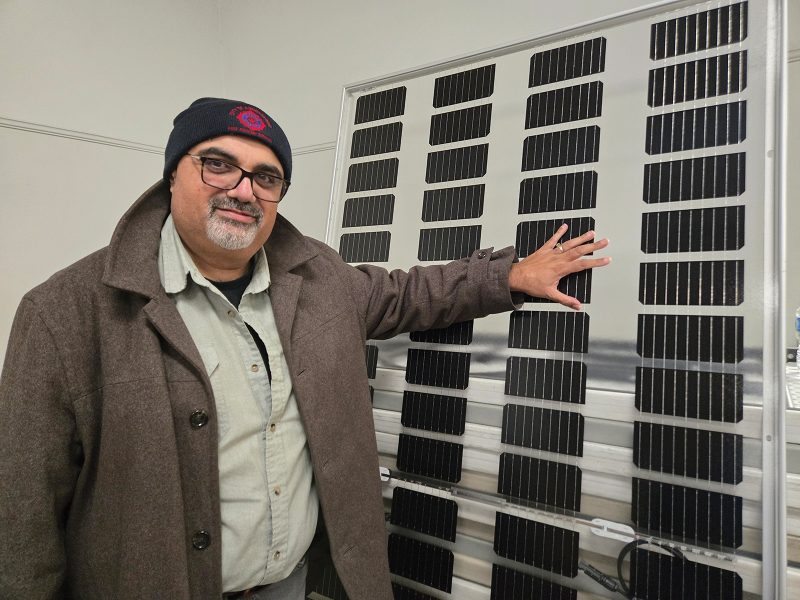
While the idea of covering arable land with traditional solar panels can elicit negative responses, SFU Sustainable Energy Engineering associate professor Vincenzo Pecunia says solar technology is changing fast, increasing the compatibility of solar capture and farming.
With new technology, panels could be incorporated within orchards, vineyards, livestock operations and annual row crops like grains or vegetables.
“Semi-transparent organic solar cells are already commercially available in Europe, so they could be piloted here,” Pecunia says.
The next generation of solar cells are more efficient to produce, are more scalable and flexible and allow sunlight to pass through, creating an environment for crops underneath to thrive.
Because plants only require certain parts of the light spectrum in sunlight and only require a certain number of hours of light per day for optimum growth, he says solar panels can collect energy from the light spectrum the plants don’t require.
Removing some of the rigidity of solar capturing materials now enables more unique configurations of cells and panel placement, like on top of a greenhouse, placed over vines or fruit trees, or in vertical configurations within grain fields.
If all goes according to plan, a pilot installation could take place at Double Barrel Vineyards south of Oliver next spring.
New approaches
Jesse Gill, president and CEO of Okanagan Hills Estate Winery Corp., which farms the vineyard, says past climate change challenges call for new approaches.
“The project demonstrates that the BC wine industry and the BC grape growers won’t just roll over and wither away,” he says. “We’re going to innovate, get creative, use technology, AI, robotics, and we’re going to push back on climate change.”
Speakers at the Oliver town hall emphasized the benefits of agrivoltaics, from reduced water evaporation to creation of a microclimate underneath or beside panels. Power generated from solar could be used to reduce on-farm reliance on fossil fuels or sold into the power grid.
The pilot solar array is slated to include blowers to help circulate air around the panels to benefit the crop. Curtains around the structure will allow plants beneath to be quickly enclosed during extreme weather.
Since new-generation solar panels can be elevated up to five metres, they can be a source of shade for farm workers and enable some farm equipment to operate underneath.
Speakers said more solar energy production would reduce BC’s overall reliance on hydro, which may be limited in a hotter, drier climate.
Jeremy Dresner of Pace Canada LP, a joint venture of Pathfinder Clean Energy and Germany’s Goldbeck Solar, is one of the leads on the Oliver pilot project. He says agrivoltaics are in place in Italian vineyards, bench strawberry operations in the Netherlands and Spanish olive groves.
“It’s out there and happening. It’s not pie in the sky,” he says. “When people think about solar, they think about ugly black panels, and these aren’t that.”
By combining agricultural production with energy production, rather than focussing on each individually, an economic payoff awaits.
“If just 1% of the agricultural land in Canada had this kind of solar, agrivoltaics would decarbonise the entire electrical grid in Canada,” he said.
ALR challenges
Pace Canada development director Claude Mindorff, also a founding board member of Agrivoltaics Canada, says challenges to agrivoltaics in BC include rules governing the Agricultural Land Reserve, having banks recognize renewable energy as a capital improvement, as well as establishing partnerships with power grid operators like BC Hydro and FortisBC.
“In 30 years, I’ve never met a utility that makes it easy (to work with them to generate and buy power) because this is encroaching on their territory,” he said.
Mindorff says BC farmers are conservative adopters, like farmers across Canada, generally wanting to be second, but added “either that thinking and policies change, or we go in reverse.”
Farmers have told Dresner, “I don’t even know if I’m going to be in business in two or three years, so why would I invest?”
Mindorff says return on investment will depend on how an agrivoltaics system is set up: full landowner ownership, leasing or partnerships with local municipalities, among other arrangements. However, he said five to seven years seems like a reasonable timeline for recouping start-up costs. This is favourable next to a 20- or 30-year home mortgage.
Participants were encouraged to voice their support for agrivoltaics to their local governments and MLAs to help make it a political priority.
A recent BC Ministry of Agriculture and Food call for proposals for a feasibility study on agrivoltaics shows that the topic is already on the province’s radar.
The event in Oliver was hosted by the Clean Energy Research Group (CERG) at SFU in partnership with Double Barrel Vineyards/Okanagan Hills Estate Winery.
It kicked off with a 95-year-old local First Nations Elder who said, “I’m so glad to see so many of you here – with solar, because the day will come when there is no power here.”
All content on this website is copyrighted, and cannot be republished or reproduced without permission.
 Sumas flooding spurs call for action