• Menu
  • Skip to primary navigation
  • Skip to main content
  • Skip to primary sidebar

Country Life In BC Logo

The agricultural news source in British Columbia since 1915

  • Headlines
  • Calendar
  • Subscribe
  • Advertise
  • About
  • Archives
  • Contact
  • Search
  • Headlines
  • Calendar
  • Subscribe
  • Advertise
  • About
  • Archives
  • Contact
  • Search

Primary Sidebar

Originally published:

NOVEMBER 2023
Vol. 109 Issue 11

Subscribe Now!

Sign up for free weekly FARM NEWS UPDATES

Select list(s) to subscribe to


By submitting this form, you are consenting to receive marketing emails from: Country Life in BC. You can revoke your consent to receive emails at any time by using the SafeUnsubscribe® link, found at the bottom of every email. Emails are serviced by Constant Contact
Your information will not be
shared or sold ever

Stories In This Edition

Ottawa delivers disaster support

Make ’em shine

Avian influenza returns

Okanagan egg producers eye expansion

Editorial: A sense of purpose

Back 40: Hayride reality is a head-shaker for visitors

Viewpoint: Narrow margins an industry-wide concern

Water license fight highlights need for change

Dairy producers not making from milk sales

Ag Briefs: Country Life in BC team wins national awards

Ag Briefs: BC farmland values flat

Ag Briefs: Poultry farm loses appeal

Letter: Thumbs up

Nursery sector pays tribute to Hedy Dyck

Beekeepers keep the emphasis on loal stock

Pollination blues discussed by beekeepers

Apple crop down, but quality up

KPU pursues year-round berry production

Record sale volumes shrink BC beef herd

Grizzly mitigation strategy in the works

Creston field day offers ‘bragging rights’

Sidebar: George Kepke Memorial Trophy honours farming history

Hazelnuts are an opportunity for Kootenay growers

Biocontrol for blight in blueberries promising

Aphids in cranberries under the microscope

Education program in Kootenays gets funding boost

Farm Story: Winter can’t come soon enough

BC pumpkins weigh in

Woodshed: Digger Dan(i) draws a winner in the water bet

Bursary open for journalism & ag related students

Jude’s Kitchen: Fresh bread tops the list of comfort food

More Headlines

Follow us on Facebook

Comments Box SVG iconsUsed for the like, share, comment, and reaction icons

2 weeks ago

FarmFolk CItyFolk is hosting its biennial BC Seed Gathering in Harrison Hot Springs November 27 and 28. Farmers, gardeners and seed advocates are invited to learn more about seed through topics like growing perennial vegetables for seed, advances in seed breeding for crop resilience, seed production as a whole and much more. David Catzel, BC Seed Security program manager with FF/CF will talk about how the Citizen Seed Trail program is helping advance seed development in BC. Expect newcomers, experts and seed-curious individuals to talk about how seed saving is a necessity for food security. ... See MoreSee Less

Link thumbnail

BC Seed Gathering - FarmFolk CityFolk

farmfolkcityfolk.ca

Save the date for our upcoming 2023 BC Seed Gathering happening this November 3rd and 4th at the Richmond Kwantlen Polytechnic University campus.
View Comments
  • Likes: 1
  • Shares: 0
  • Comments: 0

Comment on Facebook

4 weeks ago

BC has reported its first case of highly pathogenic avian influenza (HPAI) in the eighth wave of the disease since 2021. Canadian Food Inspection Agency officials confirmed October 13 that a premises in Abbotsford tested positive for the disease, the first infected premise in BC during this fall's migration. The farm is the 240th premises infected in BC since the current national outbreak began four years ago with a detection in Newfoundla#BCAg#BCAg ... See MoreSee Less

BC has reported its first case of highly pathogenic avian influenza (HPAI) in the eighth wave of the disease since 2021. Canadian Food Inspection Agency officials confirmed October 13 that a premises in Abbotsford tested positive for the disease, the first infected premise in BC during this falls migration. The farm is the 240th premises infected in BC since the current national outbreak began four years ago with a detection in Newfoundland.

#BCAg
View Comments
  • Likes: 50
  • Shares: 195
  • Comments: 444

Comment on Facebook

But the ostrich’s have the cure ….

I don't believe anything the CfIA says, like saying ostriches are chickens so that's why everything has to get culled.

Who in BC has reported this, not a word in the news. Why are you spreading fear propaganda? If you cannot add a source do not post this crap! It appears your page knows absolutely nothing about COUNTRY LIFE IN BC OR ELSEWHERE!

Just put one-way arrows on the floor of the chicken coop, keep them 6ft apart from each other and stock up on toiletpaper for them. 😉

Source? I can't find anything to corroborate this story.

Perhaps if they had allowed the ostrich to be tested and discovered how they developed antibodies we could quit culling our food supplies. Yes I know ostrich are not chickens

This only made the news to confuse those interested in the ostrich farm, relax, has nothing to do with the ostriches

How convenient that carney has a pocket in this 🤔

The ostriches eggs can save your flock

Weird how it only affects birds we eat. Kinda like how no homeless people got convid.

How convenient. Now it's off to the ostrich farm, right?

Have you went chicken catching for 8 hours all night 36000 birds

My advice take your chickens and run!

Have none of you guys ever seen the hundreds of birds falling from the sky? Ya me nether

Brainwashing if you ask me

just like on people- that mask looks like its doing a lot of nothing on that rooster!

Is it as deadly as monkey pox?? 🐵

Quick kill all the food! Perhaps we should study the ostriches...

Ostriches not chicken and not reproduced for human consumption

The condom is too small for the CO?K

I don't know how you do it, but invest in egg futures RIGHT NOW. The price will be skyrocketing.

So is it the first or the 240th?

240th. So how many birds culled is that now? The stamping out policy is working so well, isn’t it? Maybe cramming millions of stressed birds, receiving no sunlight, into facilities, all within a few kilometres apart (talk about having all your eggs in one basket) is not the brightest idea. Maybe we should scrap the Quito system, allow regular folks to have more than 100 birds and supply their neighbourhoods with meat and eggs. Maybe we should raise more robust birds with better immune systems. Maybe we shouldn’t give birds sunlight, less crowded conditions, and give them a full 24 hours to lay an egg, instead of artificially giving them shorter days, trying to squeeze more eggs out of them. Maybe, without the quota system, instead of a few mega farms, egg producers would again dot the entire province.

Lol are they going to blaim the ostriches

You mean to tell us all, THE CULL isn’t working, maybe, just maybe we should try something just a bit more humanly and have maybe a slight hint of scientific evidence!!!

View more comments

1 month ago

Here we go again!

With no immediate end in sight for the Canada Post strike, we have uploaded the October edition of Country Life in BC to our website. While it's not the preferred way to view the paper for most of our subscribers, we're grateful to have a digital option to share with them during the strike. The October paper is printed and will be mailed soon as CP gets back to work! In the meantime, enjoy!

... See MoreSee Less

Link thumbnail

CLBC October 2025

news.countrylifeinbc.com

CLBC October 2025
View Comments
  • Likes: 7
  • Shares: 4
  • Comments: 2

Comment on Facebook

The 1 person in Canada who contracted avian flu speaks to Rebel.news

STOP SPREADING LIES ABOUT AVIAN FLU NO BIRD GETS THIS

1 month ago

... See MoreSee Less

View Comments
  • Likes: 8
  • Shares: 0
  • Comments: 0

Comment on Facebook

1 month ago

... See MoreSee Less

View Comments
  • Likes: 6
  • Shares: 0
  • Comments: 0

Comment on Facebook

Subscribe | Advertise

The agricultural news source in British Columbia since 1915
  • Email
  • Facebook

Water licence fight highlights need for change

Province shifts groundwater oversight to new ministry

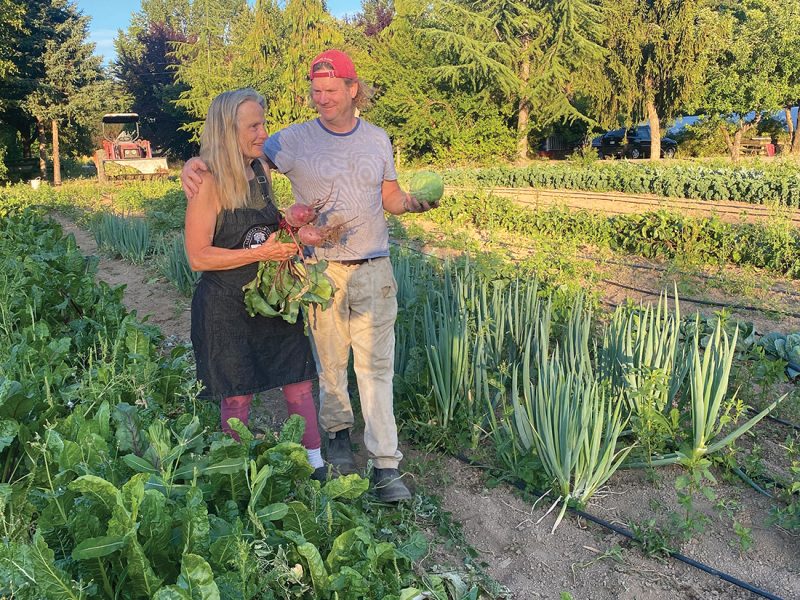
Katy and John Ehrlich are appealing an order that cut them off from their historic well after the province was unable to locate their original groundwater licence application. They're hoping a change in ministry heralds a more collaborative relationship with farmers. SUBMITTED

October 31, 2023 byPeter Mitham

DUNCAN – A well-loved farmstand and restaurant on Vancouver Island hopes a change in oversight of groundwater management will lead to a more collaborative approach to resolving licensing issues.

Katy and John Ehrlich of Alderlea Farm on Vancouver Island have run their award-winning farm for more than 20 years, growing a variety of vegetables and small fruits which are sold roadside, through a subscription program as well as served in their on-farm restaurant.

In 2020, they filed a groundwater licence application as existing users under BC’s new licensing regime in order to secure their farm’s historic water rights. The online application was, to all appearances, submitted – one of a handful received that year – and they went back to farming.

All seemed good until this summer, when drought conditions prompted requests for voluntary reductions in water use. Preliminary visits by natural resource officers were complimentary of their drip irrigation system.

But in mid-July, officers delivered an order under Section 93 of the Water Sustainability Act requiring them to shut off the well because the province said their water use was unauthorized.

“We are very conscientious about our watering,” says Ehrlich. “We had conservation officers come out and they said, ‘Oh wow, you’re good here; my boss will have no problem with what you’re doing.’ Then all off a sudden this order was presented.”

Within days, the Ehrlichs had a cistern installed and began trucking in water. A hydrologist was also hired to help them file a licence application as new users so they could resume using their well.

But they also applied for a stay of the order that cut them off – one of several filed this year regarding water shut-offs.

“Water is costly, and there’s no way we could irrigate our crops with shipped-in water, so we applied for a stay,” Ehrlich explains. “A stay was granted because of the irreparable harm this order would create for us.”

The stay set the scene for an appeal of the order, with a prehearing conference taking place before the BC Environmental Appeal Board on October 19. The attitude of the lawyers from the BC Ministry of Forests, which has managed the transition to the new groundwater licensing regime, was decidedly adversarial.

“[They] were really clear it wasn’t solutions-oriented,” she said.

The attitude is one reported by water users across the province, with several criticizing the unflinching attitude of natural resource officers who showed up in black Kevlar vests to serve Section 93 orders to what the province described as “suspected unauthorized users” or – as in Westwold – turn off irrigation infrastructure where licensed users resisted curtailment orders issued under Section 88 of the Water Sustainability Act to protect salmon.

“Our experience is that regulatory agencies are there to work as a team with people,” Ehrlich says. “We can be the best we can by working with the regulatory agencies.”

The stay shows that a more reasonable approach is possible, something she hopes will follow the mid-October transfer of responsibility for watershed management to the aptly named BC Ministry of Water, Land and Resource Stewardship (WLRS) from Forests.

“I think they will have a different place that they’re coming from to implement this,” Ehrlich says. “I’m hoping the new ministry will handle this in a different way.”

The province has not indicated if any changes are forthcoming. A statement to Country Life in BC framed the shift as part of a “necessary and natural” restructuring of resource management in BC. Transferring responsibility for groundwater licensing to the new ministry is simply the next step in that process. Water management branch staff attending a local watershed group meeting in Vernon on October 20 described the change as primarily one of oversight.

Wait and see

While the change in ministry is promising, Haley Argen of Nature Tech Nursery in Courtenay is waiting to see what it means for growers. She has long felt more could be done to manage water wisely across vulnerable watersheds.

She draws water from the Tsolum, one of four watersheds where irrigation of forage crops was curtailed under Section 88 orders this summer. The restrictions frustrated several local growers, with a delegation urging the regional district to step in and lead a comprehensive approach to water management that included forest management companies and other stakeholders.

Argen wasn’t part of the delegation, but she feels the new ministerial oversight could make a difference.

“I’ve always thought it made no sense for the Water Sustainability Act to be managed by the same ministry as manages our forests when the currently poor forest practices in BC have such a huge negative impact on our freshwater resources,” Argen says. “But whether it will be better for farmers is another question.”

A primary concern is how the new ministry will triage the thousands of cases of unlicensed water use across the province. Of about 20,000 known wells in BC whose owners were eligible to apply for licences as existing users prior to the March 1, 2022 deadline, just 7,711 applications were received.

Argen hopes there will be collaboration with staff in the agriculture ministry to ensure agricultural water use is given priority, so long as the operations are making efficient use of water.

There is also the question of the thousands of applications awaiting decision, not only from existing users but those who – like the Ehrlichs – submitted applications as new users after being issued cease-use orders.

As of October 23, just 2,411 groundwater licenses had been issued, including to new users. The backlog in decisions is estimated at up to four years, and the deluge of applications from the majority of well owners who have yet to apply has yet to arrive.

“Imagine what’s going to happen next year when those other 60% of people are presented with an order,” Ehrlich says. “If they continue in this way, it’s going to be a big, huge dark cloud over food production.”

Related Posts

You may be interested in these posts from the same category.

Southern Interior irrigators shut down

Island farmers fish for water solutions

Groundwater enforcement picks up

Westwold producers challenge curtailment

No licence, no problem

Hazelnut funding renewed

Watershed security report

Groundwater users could lose rights next year

Feeling the heat on water

Water licence angst

Grower takes issue with groundwater limits

Province updates watering intentions

Previous Post: « BCAC lobbying event positive
Next Post: Farm accelerator program renewed »

Copyright © 2025 Country Life in BC · All Rights Reserved