
OLIVER—Like a sliver of sky, a Western Bluebird drops from above and lands among the dried grasses at the edge of a meadow.
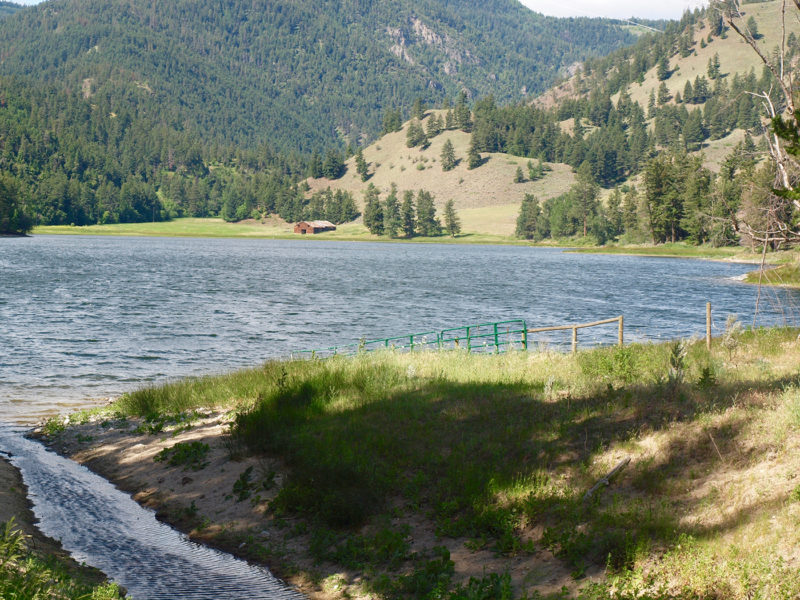
Down the hill, sun glints off a small, round lake surrounded by forest down to the water’s edge, and a creek flows out through a low spot, fenced off from the grassy rolling hills on either side.
Healthy green grass has been munched in a few places but the cattle grazing there don’t often trek down the hills to the creek for a drink because the rancher provides convenient troughs throughout the range, fed from springs high in the
hills.
Instead, explains Wade Clifton, whose family owns the Clifton Ranch in Keremeos, his cows tend to drift across the hills so there’s less erosion than would occur if they wandered regularly up and down the hills between grazing and drinking water.
The streamside is also less eroded and the riparian zone is being restored to a more natural state now that the cows are watered elsewhere through the 17,000 feet of water line and troughs.
It’s all part of the Nature Trust of BC’s White Lake Basin Biodiversity Ranch, at Twin Lakes, west of Kaleden and Penticton.
Clifton owns a neighbouring parcel and is now running about 500 cows on both his own and the Nature Trust’s conservation property, allowing more space for the cattle so the pressure on the land is sustainable on all parcels.
“We try to keep the cattle dispersed,” he notes.
Co-management
In all, the partners own, lease and hold grazing licences on a total of 8,056 hectares of grassland in the area of the White Lake Basin and Twin Lakes, managing it jointly as both ranch land for grazing cattle and as conservation lands for nationally endangered and threatened species at risk and their habitat.
Although the concept of combining a working, viable cattle ranch with land conservation for species at risk may seem odd, it is working, says Jasper Lament, CEO of the Nature Trust.
A management plan for the properties was completed in 2014 and includes creation of grazing pasture units so science dictates efficient use of the land without negatively impacting native species.
“By using good practices we help both ourselves and the natural world,” notes Clifton. “We need good grass to produce pounds of beef, so it benefits us to not over-graze the land as well as conserving native species.”
He says Twin Lakes was once used 24/7 for grazing, but now he only puts cows out every two years in each grazing unit instead.
“That gives the grasses a chance to recoup,” he explains. The grasses also benefit from being cropped by cows, which also dig up the soil with their hooves and prevent it from becoming compacted.
Riparian exclusion fencing has been installed by the Nature Trust, which has also provided the knowledge of its biologists to help the Cliftons determine their management practices.
However, Wade is the third generation on the land and his father Wilson was already conscious of the importance of maintaining a diverse ecosystem and he passed that concern on to his sons.
“Dad was always open-minded about change and we adopted that way of thinking, too,” he says.
“Sometimes you learn more from a fresh viewpoint. This has been a real learning experience for all of us. We are monitoring progress all the time, and so does the Nature Trust,” he explains.
For instance, the cows are moved into mountain pastures for the summer, then into fall grazing pastures after those grasses have grown up and gone to seed.
He says cattle are an important part of the ecosystem when properly managed.
Included in this biodiversity ranch are critical grassland, sagebrush shrub-steppe, dry forest and riparian habitats. It’s one of the largest intact private grassland properties in the South Okanagan.
Its size also provides connectivity with adjacent conservation lands, with links to the Vaseux-Bighorn National Wildlife Area of the Canadian Wildlife Service and more Nature Trust holdings on the west side of Vaseux Lake.
There are 27 red and blue-listed plant communities that have been identified within the boundaries of the biodiversity ranch, along with 57 species at risk.
Today, most of the property surrounding the upper Twin Lake is owned by the Nature Trust, which purchased it just as a developer was working to convert the wooded margins from natural forest into residential ‘ranchettes.’
Different landscape, similar issues
Across the valley is a very different landscape, but one which also features a variety of at-risk species, including the Lewis’s Woodpecker.
The Okanagan Falls Biodiversity Ranch is 715 hectares of private land plus a 44,126 hectare grazing licence which provides critical wildlife corridors east and west, as well as conserving a wide variety of habitat types, from bunchgrass and antelope-brush to riparian areas and wetlands and coniferous forest.
The entire property is critical for bighorn sheep. It is a foraging and lambing area for them as well as a migration corridor.
Ranching partner Brian Thomas of Thomas Ranches runs 200 to 300 cows on it, and he’s the third generation on this land. His ancestors purchased it in 1905 and a barn which was built around 1860 still stands on the ranch—a legacy of the previous owners.
With the help of the Nature Trust, all of the creeks have now been fenced off as well as a spring and the 10 or 15 acres around it.
There are three creeks on the property and dugouts are used to water cows.
“It’s a bit of a pain keeping the fencing up, but the fencing does keep the cattle out,” admits Thomas.
Targeted grazing helps to control wildfire and gravity-fed irrigation is provided from McLean Lake for the hayfields on the ranch.
“We have to conserve water and this year water is going to be an issue,” notes Thomas.
He says his family has always managed the ranch using the principles of biodiversity.
For most of Thomas’s life, the Lewis’s Woodpeckers—with their distinctive dark red face framed in black, pale collar separating the head from the bright pink breast—have frequented the ranch property, he recalls, although they were not considered endangered.
But today, they are declining in population because of habitat loss and competition from European starlings for nesting sites—yet they still swoop up and glide about the corrals, snatching insects on the wing and perching on gates and fence posts.
The colourful birds are on the provincial blue list of at-risk species and are considered a species of special concern in Canada by the committee on the status of endangered wildlife in Canada.
As well, there are still conflicts with wildlife on the ranch, but Thomas says a federal compensation program helps them recoup the costs of lost feed. The herd of bighorn sheep in the area used to be 30 or 40 in the 1950s, but today, he estimates the number to be closer to 120 animals.
Nicholas Burdock is Okanagan Conservation Land Manager for the Nature Trust and notes you can hear the bighorn sheep knocking heads in the fall up in the hills around the ranch, as the rams vie for dominance over other males during breeding season.
“Biodiversity ranches like those at White Lake and Okanagan Falls help to protect endangered species and habitats,” says Burdock, “and provide opportunities for other ranchers to see how an innovative approach to managing the land and cattle can make a huge impact.”
All content on this website is copyrighted, and cannot be republished or reproduced without permission.
 Women farmers receive double