
• Menu
  • Skip to primary navigation
  • Skip to main content
  • Skip to primary sidebar

Country Life In BC Logo

The agricultural news source in British Columbia since 1915

  • Headlines
  • Calendar
  • Subscribe
  • Advertise
  • About
  • Archives
  • Contact
  • Search
  • Headlines
  • Calendar
  • Subscribe
  • Advertise
  • About
  • Archives
  • Contact
  • Search

Primary Sidebar

Originally published:

NOVEMBER 2022
Vol. 108 Issue 11

Subscribe Now!

Sign up for free weekly FARM NEWS UPDATES

Select list(s) to subscribe to


By submitting this form, you are consenting to receive marketing emails from: Country Life in BC. You can revoke your consent to receive emails at any time by using the SafeUnsubscribe® link, found at the bottom of every email. Emails are serviced by Constant Contact
Your information will not be
shared or sold ever

Stories In This Edition

Final inspection

Dry Season

Country Life in BC wins awards

Duncan feed mill sounds supply chain alarm

The great pumpkin

Editorial: The price of peace

Back 40: Pumpkins make great conversation starters

Viewpoint: The roots of the ALR point a way to its future

Producers look beyond 2021’s flood

No quick fix

Ag Briefs: Plant centre breaks ground

Ag Briefs: 4-H LEADer recognized

Ag Briefs: New child worker rules

Movement of poultry banned to curb AI threat

Sentencing of animal activists disappoints industry

Weather makes for easier harvest in Peace

Western dairy groups target processors

Funding supports First Nations’ food security

Replant report targets industry over orchards

New national soil study underway

Honey producers target growth with new study

Sweet reward

Hazelnut industry continues to thrive

Producers push for social welfare in organic standards

Sidebar: Compliance rate high

Garlic grower cuts the mustard – and pests

Extended fall improves outcome at corn trial

Forest planning pilot includes range values

Diversification keeps families on the farm

Farm Story: Rethinking the sales strategy could improve profits

Automation boosts market garden’s efficiency

Fallow deer rattle Mayne Island farmers

Best of the best

Winery stakes its hopes on sur echalas planting

Woodshed: “One sweet deal” too hard for Kenneth to resist

Rising input costs create challenges for direct sales

Sidebar: Provincial farmer-chef event returns

Jude’s Kitchen: Comfort comes from the oven

More Headlines

Follow us on Facebook

Comments Box SVG iconsUsed for the like, share, comment, and reaction icons

2 weeks ago

The Canadian Food Inspection Agency is preparing to implement changes to its livestock traceability rules that will include mandatory computer reporting within seven days on movement of animals for veterinary appointments, community pastures, exhibitions, carcass and on-farm disposal and the births and deaths of every animal on your farm. Writer Tom Walker first brought these changes to the attention of our readers back in June 2023. We've posted his story to our website:

www.countrylifeinbc.com/cfia-proposes-traceability-updat#BCAg#BCag
... See MoreSee Less

The Canadian Food Inspection Agency is preparing to implement changes to its livestock traceability rules that will include mandatory computer reporting within seven days on movement of animals for veterinary appointments, community pastures, exhibitions, carcass and on-farm disposal and the births and deaths of every animal on your farm. Writer Tom Walker first brought these changes to the attention of our readers back in June 2023. Weve posted his story to our website: 

https://www.countrylifeinbc.com/cfia-proposes-traceability-updates/

#BCag
View Comments
  • Likes: 11
  • Shares: 21
  • Comments: 15

Comment on Facebook

I love hpw the cow in the picture hasn't even got a RFID tag in it but I digress. We can not read the link, it says "we are not permitted to read drafts". Please post again with the correct link.

Dairy farmers having been doing this several years. The app we use has become quite simple to use

Including equine?

Premise ID was slowly rolled through the country, voluntary then mandatory. Transparency and 'Consultation' has been light. Those who tried to bring this for discussion a couple years ago, because of forseen overreach, were quite often labeled conspiracy theorists and that it wasnt meant to be so heavily regulated and controlled. Gardens and seeds will be next. "Invasive species" reporting, check out the plants medicinal properties. Read the BC intentions papers. The premise ID that already heavy regulated commodities have claims to be treated different in the intentions papers on page 8. www2.gov.bc.ca/assets/gov/farming-natural-resources-and-industry/agriculture-and-seafood/food-saf...

Says i am "not allowed to preview draft".

Also concerning is the part on compliance...they can 'stumble onto' any farm and if you're not complying there are consequences.

When the CFIA stumbles into the wrong place compliance will be met with civil engagement

Says I can't preview draft

This is government overreach - Do Not Comply!

Do not comply

Fu

As if the price of beef isn't bad enough for consumers,,,,,be prepared to be gouged some more now

Ridiculous!!

Let's hold up on the beef exports tell we can get our own house in order... we need to deregulated, cheapen up the supply chain back into a 5 buck a pound rage so the good people canada can eat healthy food.. fuck your bean diets, that's retarded

This, along with the majority of new legislation pertaining to any type of farm, is a blatant squeeze on any sort of small, alternative agricultural venture. I am a massive believer in working together and sharing resources and costs and solutions - do not get me wrong - but this and the water registration among others, is an overreach (at most generous) and an absolute killer to smaller, local initiatives that LITERALLY save lives during extreme events. There is ONE ROAD into and out of my community. We don’t need or want some sort of backlogged government response when shit goes sideways. We want the ability AND SUPPORT to provide for our communities without penalty when things go badly. We want to produce sustainability for our communities. We live here, we work here, we want to STAY HERE. Stop making it harder.

View more comments

3 weeks ago

BC's minimum piece rates for 15 hand-harvested crops increased 2.6% on December 31. Crops include peaches, apricots, brussels sprouts, daffodils, mushrooms, apples, beans, blueberries, cherries, grapes, pears, peas, prune plums, raspberries and strawberries. Farm-worker piece rates in BC were increased by 11.5% in January 2019 and 6.9% in December 2024. BC’s current minimum wage sits at $17.85 per hour.

#BCAg
... See MoreSee Less

BCs minimum piece rates for 15 hand-harvested crops increased 2.6% on December 31. Crops include peaches, apricots, brussels sprouts, daffodils, mushrooms, apples, beans, blueberries, cherries, grapes, pears, peas, prune plums, raspberries and strawberries. Farm-worker piece rates in BC were increased by 11.5% in January 2019 and 6.9% in December 2024. BC’s current minimum wage sits at $17.85 per hour. 

#BCAg
View Comments
  • Likes: 10
  • Shares: 0
  • Comments: 2

Comment on Facebook

I'm not sure what they're telling us. Did peace rates have to increase so that Farm workers could make minimum wage?

They deserve it, but the general public will be whining about increased prices in the stores. Will need to make more information average to the g.p.

3 weeks ago

... See MoreSee Less

View Comments
  • Likes: 14
  • Shares: 0
  • Comments: 1

Comment on Facebook

105 Mile Ranch

4 weeks ago

... See MoreSee Less

View Comments
  • Likes: 7
  • Shares: 0
  • Comments: 0

Comment on Facebook

1 month ago

Water volumes from the Nooksack River are at levels similar to 1990 and 2021, but the province says flows should peak at 10pm tonight. The shorter duration, as well as conditions in other watercourses within the watershed and performance of flood protection infrastructure should avoid a catastrophe on the scale of 2021. However, several landslides mean road closures have once again effectively isolated the Lower Mainland from the rest of the province.

#BCAg
... See MoreSee Less

Water volumes from the Nooksack River are at levels similar to 1990 and 2021, but the province says flows should peak at 10pm tonight. The shorter duration, as well as conditions in other watercourses within the watershed and performance of flood protection infrastructure should avoid a catastrophe on the scale of 2021. However, several landslides mean road closures have once again effectively isolated the Lower Mainland from the rest of the province.

#BCAg
View Comments
  • Likes: 9
  • Shares: 3
  • Comments: 1

Comment on Facebook

Family living in Sumas WA say it's very much like '21. They have the same amount of water in their house as last time.

Subscribe | Advertise

The agricultural news source in British Columbia since 1915
  • Email
  • Facebook

Automation boosts market garden’s efficiency

Sayward Haven Farm uses sensors, timers and spreadsheets

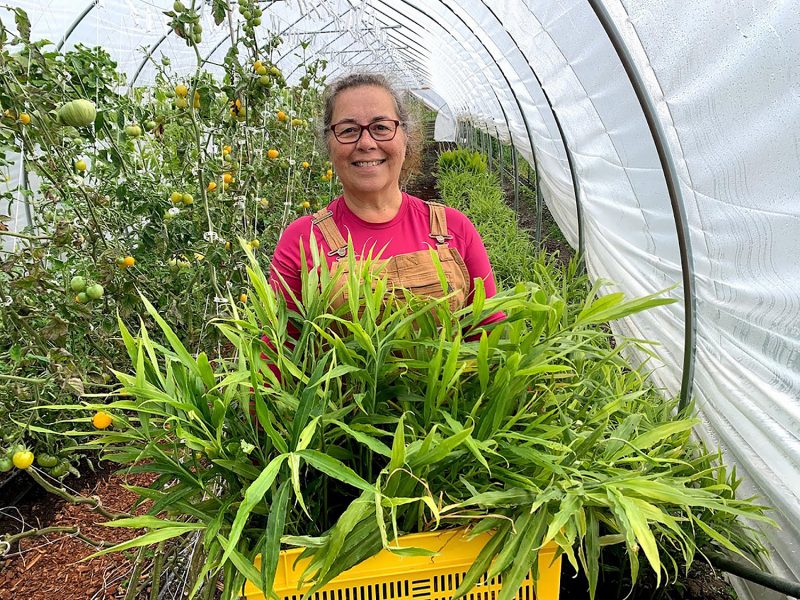
Tracey Wilkin shows off an impressive display of ginger grown in one of Sayward Haven Farm’s hoop houses. SUBMITTED

November 1, 2022 byKate Ayers

COBBLE HILL – Tracey Wilkin and Don Nelson entered the agricultural industry later in life but apply previous job skills, including marketing and mechanical engineering, to bolster their market garden’s productivity and business strategy.

The middle-aged couple from Cobble Hill started their Sayward Haven Farm last year and just wrapped up their second growing season. They grow vegetables such as salad greens, carrots, turnips, radishes, tomatoes, cucumbers and fresh ginger, outdoors and in hoop houses.

“I’ve always been an avid gardener,” Wilkin says. “We value preserving the environment, particularly around climate change, so that was our inspiration.”

The couple formerly ran their own businesses, so the transition to operating a farm business happened “organically,” Wilkin says.

“We didn’t want to work for anybody, and we didn’t want anybody working for us,” Nelson laughs.

The couple were surprised by the physical demand of farm work. Fortunately, Nelson’s background in mechanical engineering saw them install solar-powered infrastructure that can be controlled from a smart phone.

They have optimized their watering system by using drip irrigation on timers and a central computer that tracks weather and precipitation patterns. Nelson uses coding and spreadsheets to calculate the optimal timing and amount of water that needs to be applied. They store water in a 9,000-litre tank.

“We dealt with the local water authority. They looked up our water usage and said that we use less water than some people use to water their lawns. It’s extremely efficient,” Nelson says.

This efficiency and ability to apply water when it’s most needed is important, especially during Vancouver Island summers. This August, most of the southern half of the island received just 1 millimetre of rain, pushing the region to a Level 5 drought by mid-October.

Nelson and Wilkin also built a wash and pack station and a walk-in cooler to maintain vegetable shelf-life during hotter months. Nelson’s cooler system uses a Coolbot, which hijacks a regular home air conditioner to keep the cooler’s temperature at around 3°C.

No easy feat

While the couple has invested in production-boosting infrastructure, starting a farm during last year’s heat dome and adjusting to the weather extremes since has been no easy feat.

They tripled the size of their garden this year and despite the expansive build-out and challenges of growing during record-breaking temperatures last summer, “we’ll be lucky to do the same amount of sales as last year,” Nelson says. “That’s how much of an impact the spring had.”

Pests and weeds are additional challenges. This spring, they lost 80% of their crops to wire worms, and weeds are a constant battle.

“You can only pull so many weeds. I was introduced to the old idea of flame weeding,” Nelson says. “I got a hold of that just in time for the fire ban. We wish we had people available, like a community that we could phone up and seek advice.”

Wilkin echoes the need for reliable information that is applicable to a market-garden scale.

“There are not a lot of resources for market farmers. Lots for big farmers but having community and knowledge-based support for market farmers – there’s not as much industry information out there. And we’re constantly battling Mother Nature,” she says.

Fortunately, because of their professional backgrounds in business management, the couple drew up a realistic business plan and run their farm to make profits. Project management software is one tool they use to keep track of notes and important year-over-year data.

Overall, the couple recommends that farmers – of any age and level of expertise – should invest in technologies that will improve operational efficiency.

“What we lack in energy and what we can feel in our bodies we make up for in the fact from a financial standpoint, we were able to make an investment in the efficiency stuff up front,” Wilkin says. “Anyone looking to get into it, really look at where you’re going to get efficiencies for yourself in your work. Make sure you’re making investments early on [in equipment] that you really need. It doesn’t need to be fancy. Get the barebones in place and then you can augment and invest in the nice-to-have things.”

Proceed with caution

While automation has its benefits and can bolster production, farmers, especially those in rural or remote areas, may face barriers to adoption and they should do their research.

Some of these hurdles include lack of Internet connectivity, platform subscription and equipment costs, and sensitivity around data usage, says UBC’s LiteFarm team product manager Kevin Cussen.

“Farmers are oftentimes either maliciously or carelessly kind of taken advantage of by people that are building tools,” Cussen says.

LiteFarm is a free and open-source farm management tool co-designed by farmers. Producers who use the tool retain control over their data, which can be used for commercial or research purposes only with their consent.

If farmers choose to adopt third-party automation tools, Cussen urges them to read the fine print.

“When they’re choosing tools to automate, [ask] what does the organization do with my data? Are they going to use it for research purposes? … Are they going to use it for commercial purposes? Sell it?” Cussen says. “Or is it just going to sit there, and no one will ever see it except for me? What your data is used for and how that impacts the farmer is another angle that many producers [should be] interested in.”


Related Posts

You may be interested in these posts from the same category.

Previous Post: « BC Tree challenge falls short
Next Post: Shuswap water grants offered »

Copyright © 2026 Country Life in BC · All Rights Reserved