
• Menu
  • Skip to primary navigation
  • Skip to main content
  • Skip to primary sidebar

Country Life In BC Logo

The agricultural news source in British Columbia since 1915

  • Headlines
  • Calendar
  • Subscribe
  • Advertise
  • About
  • Archives
  • Contact
  • Search
  • Headlines
  • Calendar
  • Subscribe
  • Advertise
  • About
  • Archives
  • Contact
  • Search

Primary Sidebar

Originally published:

MARCH 2025
Vol. 111 Issue 3

Subscribe Now!

Sign up for free weekly FARM NEWS UPDATES

Loading form…

Your information will not be
shared or sold ever

Stories In This Edition

Tariff Shock

Room to grow

Province delivers for fruit growers

BC honours its ag leaders at annual gala

Editorial: Good neighbours

Back 40: Political landscapes, and our own backyard

Viewpoint: Avian influenza is here to stay

Regulations frustrate on-farm water stewardship

Sidebar: Study says process takes too long

Bessette Creek irrigators band together

Show and tell

Ag Briefs: Chick shortage for broilers

Delta events centre quashed

Letters: Feeling connected

Letters: The good old days

Premier’s task force to boost sector

Dairy industry calls for unity amid trade threats

Mainland Milk Producers prepare for growth

Grape job

Vet urges dairies to be vigilant against HPAI

Winery banned from hiring temporary foreign workers

Grapevine losses continue to mount

Ranchers pack early calf survival forum

Good job

Auctioneer calls it a day

Food hub slated to open in Rock Creek

Cattlemen examine production costs

Emergency processing could be a trailer away

Cattle talk

New at-risk species tool launching this spring

Happy Hills looks beyond the challenges

BC potato trial joins national data bank

Farm Story: My computer wants to write farm stories

Farm tours showcase South Island agriculture

Brian Hughes remembered as organic advocate

Hazelnuts enjoy strong picing as global production falls

Chilliwack group wants agriculture back at fairgrounds

Woodshed: The Duke and Kenneth get off to a rocky start

Beef tasting helps raise profile of 4-H

Jude’s Kitchen: Try healthier Tex-Mex flavours

More Headlines

Follow us on Facebook

Comments Box SVG iconsUsed for the like, share, comment, and reaction icons

6 days ago

A BC Forest Practices Board investigation has found overgrazing has damaged grasslands in the Coutlee Range Unit near Merritt — and the range-use plan meant to prevent it was unenforceable. With complaints about overgrazing on the rise and grasslands covering just 1% of BC's land mass, the findings raise fresh questions about how the province manages one of its most vulnerable — and valuable — food-producing ecosyste#BCAg#BCAg ... See MoreSee Less

Link thumbnail

Board finds overgrazing rules unenforceable unmeasurable

www.countrylifeinbc.com

MERRITT – A BC Forest Practices Board investigation has found instances of non-compliance related to overgrazing have damaged open grasslands in the Mine pasture, part of the Coutlee Range Unit near...
View Comments
  • Likes: 6
  • Shares: 6
  • Comments: 6

Comment on Facebook

Several ranchers in recent years have gone into temporary non use on that range , so that means the grass should grow. But drought conditions/lack of rain and snow don’t allow that to happen . Dried up springs , creeks waterholes in various pastures add to over grazing where there is water , as livestock and everything else stay close to the water source . So even though less cattle are on it , over grazing appears. There is a large volume of horses on it 365 days/year which is wrong ! They pull grass right out of the ground when it’s just trying to grow ,, opens the door for weeds to grow in. That don’t help it. Aging infrastructure ( fences) laying on the ground, pipe line building , ( lack of commitment to fence maintenance) amongst all users contributes also to over grazing. Recreational atv users leaving gates open between pastures allows livestock to go back or ahead in pastures also expidites over grazing. Logging ( bcts) has no problem laying out cut locks on both sides of a fence , then it gets smashed down during logging and they don’t take responsibility to stand it back up or clean the cattle gaurds out when they are done , that happened 4 years ago on pasture 5 up there . I bet it is still not fixed . There are lots of contributing factors to the problem.

Tragedy of the commons.

I looked through the report. I saw nothing about the effects of noxious weeds on productive grasslands. This particular area is vulnerable because of the Ministry’a efforts to diversify the use of the Grasslands.

This pasture is under tremendous pressure not only from cattle but from irresponsible local residents who treat it as a landfill dumping all manner of household debris here. And don't even get me started on the mud bogging and camping in sensitive riparian areas. The feral horses are in this pasture 365 days a year just hammering it. Would sure be nice to see some enforcement action on people who are intentionally ripping up the grasslands and riparian areas. Cattle could be a valuable resource for rebuilding soils and native grasses in this area with the help of electric fencing and/or e-collars. The humans will be harder to manage.

The Forest and Range Practices Act was written by lawyers for global forest licencee shareholders. Results-based = unenforceable.

Also, can we talk about the impact of a pipeline being built through the middle of this field for multiple years?

View more comments

1 week ago

East Kootenay rancher Randy Reay is digging a new well after two natural water sources dried up on his Crown tenures. A new Living Lakes Canada assessment found 15% of mapped aquifers in the region are high-priority for monitoring, yet 80% of those go unmonitored. With over 48% of BC's provincial observation wells reporting below-normal groundwater levels, ranchers and researchers are sounding the alarm on water security. The story is in our March edition, and we've posted it to our website thi#BCAgk.

#BCAg
... See MoreSee Less

Link thumbnail

Water woes: groundwater under pressure across BC

www.countrylifeinbc.com

JAFFRAY – As a young boy growing up in the Kootenay-Boundary region, Randy Reay never expected to run out of water. But this year, in mid-February, his fields are bare. There is no snow halfway up t...
View Comments
  • Likes: 8
  • Shares: 7
  • Comments: 1

Comment on Facebook

Jaffrey is in the east Kootenays not kooteney boundary

2 weeks ago

BC farmers are bracing for prolonged higher input costs as war in the Middle East drives up fuel and fertilizer prices. Nitrogen fertilizer costs were already climbing before the Iran conflict began, with prices still roughly 60% above pre-pandemic levels. Farm Credit Canada warns that unlike 2022, strong commodity prices may not offset rising costs this time. Local suppliers expect supply challenges and further price increases ahead.

#BCAg
... See MoreSee Less

Link thumbnail

Fertilizer prices on the rise

www.countrylifeinbc.com

War in the Middle East has delivered a generational shock to energy prices, meaning BC farmers can expect a prolonged period of higher costs not just for fuel but also for fertilizer.
View Comments
  • Likes: 2
  • Shares: 1
  • Comments: 0

Comment on Facebook

2 weeks ago

... See MoreSee Less

View Comments
  • Likes: 1
  • Shares: 0
  • Comments: 0

Comment on Facebook

2 weeks ago

Cameron Stockdale is the new executive director of provincial farm safety organization AgSafeBC. Find out more in this week's Farm News Update from Country Life in B#BCAg#BCAg ... See MoreSee Less

Link thumbnail

New leadership at AgSafe BC

www.countrylifeinbc.com

Cameron Stockdale is the new executive director of provincial farm safety organization AgSafeBC, succeeding Wendy Bennett. Bennett left AgSafeBC in September 2025, following 12 years with the…
View Comments
  • Likes: 5
  • Shares: 1
  • Comments: 0

Comment on Facebook

Subscribe | Advertise

The agricultural news source in British Columbia since 1915
  • Email
  • Facebook

Beef tasting helps raise profile of 4-H

Dinner party connects palates to pastures

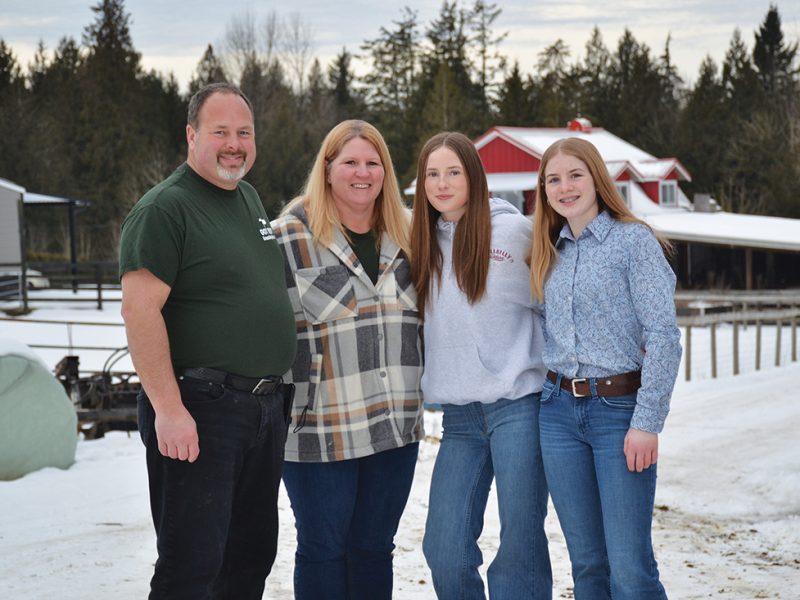
At Mount Lehman Farm, the Wolfe family (from left to right, Andy, Jenn, Alexis and Ashley) focus on providing grass-fed beef to their customers and sharing the benefits of 4-H membership. RONDA PAYNE

February 25, 2025 byRonda Payne

ABBOTSFORD – Wine and cheese tastings may be commonplace, but meat tastings?

If Abbotsford resident Don Campbell has a say, people will soon be hosting 4-H project dinner events to educate the mind and the senses.

Campbell and his wife Connie hosted a beef-forward dinner party for 10 at their Abbotsford home on January 17.

The beef’s rearing process was explained by 4-H members and sisters Alexa and Ashley Wolfe from Mount Lehman Farm, which raises grass-fed beef. Campbell bought two different years of their beef projects at the PNE’s 4-H auctions.

“We started the evening with the Wolfe girls coming in and explaining 4-H, why it’s important,” Campbell says.

The girls, who farm with their parents Jenn and Andy, then showed photos of the animals the guests were about to be served, outlining how one was more grass-fed and the other more grain-fed .

“This is my sixth year and this is Ashley’s fifth year,” says 15-year-old Alexis.

The two have focused on beef projects, and excelled. Alexis was awarded the George Preston Memorial trophy last year, an acknowledgement of 4-H excellence. Ashley, 13, received third-place for her beef carcass.

Campbell’s idea for the evening came from a night out at Elisa, a steakhouse in Vancouver where some cuts are offered in two-ounce portions for comparing.

“It was really good. But as we’re sitting there, we’re thinking our beef is a little bit better,” Campbell says.

Campbell not only bought the beef projects at auction, he owns one of 10 properties where the Wolfe family pasture their animals.

“Many of us support the philosophy behind Mount Lehman Farm by allowing their animals to graze on our properties,” he says.

Connie, a trained chef, prepared ribeye cuts from each animal in the same way.

Guest were split 50/50 on which they preferred.

“Some people prefer more marbling and some people like less marbling,” Campbell says. “That was fun. They all left with full bellies. The conversation continued for a couple of weeks.”

Dinner guests also learned about 4-H.

“They really didn’t know about 4-H, so I was happy to answer a lot of their questions,” says Alexis.

Campbell says the Q&A with the sisters was the best part of the evening.

“They started to ask detailed questions and the gals just stepped in and were able to answer them because of the 4-H training they’ve got,” he says. “They also have the animal-raising knowledge to be able to answer them technically.”

The group grew more engaged the more they learned and tasted the samples.

“As they’re talking to the gals, they’re eating the first bit of beef from the cattle,” he says. “This is how people need to learn about food. We need to do this again and we need to do this a lot. We held a mini one a week later and it was just as good.”

He sees this exposure as a way to encourage purchases from “farmgate instead of Walmart.”

“We’re trying to support buying local,” Campbell says. “The story becomes even more pertinent given the political stories the country is going through at the moment.”

It seems to have worked. One of Campbell’s friends ordered meat from Mount Lehman Farm to keep them in beef until they can attend this year’s 4-H auction and buy a project.

“Going to Don’s house was really exciting and cool as he’s bringing in new people for us to talk to and share our knowledge with them,” says Ashley. “Sharing our projects with them was definitely really fun.”

Related Posts

You may be interested in these posts from the same category.

Previous Post: « MMP announces new executive assistant
Next Post: Tariff shock »

Copyright © 2026 Country Life in BC · All Rights Reserved