• Menu
  • Skip to primary navigation
  • Skip to main content
  • Skip to primary sidebar

Country Life In BC Logo

The agricultural news source in British Columbia since 1915

  • Headlines
  • Calendar
  • Subscribe
  • Advertise
  • About
  • Archives
  • Contact
  • Search
  • Cart
  • Checkout
  • Headlines
  • Calendar
  • Subscribe
  • Advertise
  • About
  • Archives
  • Contact
  • Search
  • Cart
  • Checkout

Primary Sidebar

Originally published:

December 2017
Vol. 103 Issue 12

Subscribe Now!

Sign up for free weekly FARM NEWS UPDATES

Loading form…

Your information will not be
shared or sold ever

Stories In This Edition

Body cams are out

Turkey allocation reviewed

Meet ‘n’ Greet

Producers take concerns to Victoria

Editorial: Double standard

Back Forty: Perception is in the eyes of the beholder

Viewpoint: Trade negotiations creating uncertainty

Cattlemen speak out about groundwater licensing debacle

Sweet reward

WorkSafeBC set to lower most rates

Salmon farm debate raises concern for range tenures

Sidebar: Good relationships on the range

Breweries allowed

FIRB’s quota review is taking too long

Dairy farming under the microscope

Technology key to the fortunes of dairies of all sizes

BC Tree Fruit election may prompt legal action

Disease control worries honey producers

Beekeepers risk dumping charge

Honey in the house

Crop insurnace claims up

Stockmen receive update on wildfire recovery

Property assessments set for major shift after fires

Water access for range cattle

Compensation possible in Island sheep kills

Fall at its finest

Protection program has helped ranchers

Fair boards encouraged to sign up for Premises ID

Meadow Valley meats eyes new slaughterhouse

Potential for termination of Site C cause for hope

Jack Frost nips crops on heels of hot summer

Six-digit cattle attract deep-pocketed ownership teams

Kelowna seeks input on the future of local water management

West Kelowna pursues bylaw for worker housing

Sidebar: Taking the next step

Agri-tourism regulation has little impact on farmers

Privacy, conflict of interest need good protocols

Sidebar: Field media requests with confidence

Vernon orchardists develop award winning orchard

Seed growers find support at gathering

Photo bomb

Cleaner water promises greener greenhouses

4-H BC on the move

Entrepeneurs squeeze a profit from pressed fruit

Research: Heritage turkeys add a touch of nostalgia

4-H Canada’s top scholarship awarded to BC member

Woodshed: Awkward moments abound as date night nears

Langley meadery finds the sweet spot

Entertaining tidbits

All content on this website is copyrighted, and cannot be republished or reproduced without permission.
More Headlines

Follow us on Facebook

Comments Box SVG iconsUsed for the like, share, comment, and reaction icons

1 day ago

The committee of MLAs charged with setting priorities for the next provincial budget is recommending regular, annual funding for water storage infrastructure associated with food production, including for engineering inspections, maintenance and upgrades. The recommendation builds on the BC Cattlemen's Association's recommendation of an annual allocation of $5 million for water storage infrastructure related to food production, noting that it could also support resilience in the face of climate-related events. While the province has allocated $120 million for agricultural water infrastructure, agriculture minister Lana Popham told Country Life in BC this week that other ministries and the federal government will need to be involved in funding future p#BCAgts#BCAgCAg

#BCAg
... See MoreSee Less

The committee of MLAs charged with setting priorities for the next provincial budget is recommending regular, annual funding for water storage infrastructure associated with food production, including for engineering inspections, maintenance and upgrades. The recommendation builds on the BC Cattlemens Associations recommendation of an annual allocation of $5 million for water storage infrastructure related to food production, noting that it could also support resilience in the face of climate-related events. While the province has allocated $120 million for agricultural water infrastructure, agriculture minister Lana Popham told Country Life in BC this week that other ministries and the federal government will need to be involved in funding future projects.

#BCAg

#BCAg
View Comments
  • Likes: 23
  • Shares: 6
  • Comments: 3

Comment on Facebook

A typical small-to-medium farming operation featuring a house, main barn, and machine shed generally has around 8,000 to 12,000 square feet of total roof surface. The Okanagan Valley is one of the driest regions in Canada, averaging roughly 300 millimetres (11.8 inches) of annual precipitation. Storing a full year's collected rainwater from those roofs yields roughly 262,500 litres. In the three regional districts that make up the Okanagan valley proper (North Okanagan, Central Okanagan, and Okanagan-Similkameen), the 2021 Statistics Canada Census of Agriculture records roughly 3,100 total farms. Multiply that number by 262,500 litres of harvested rainwater equals 813.75 million litres of water saved per year. Capturing that volume of water across every farm roof in the region would significantly ease peak summer pumping pressure on local groundwater aquifers and Okanagan Lake.

Fantastic!! We will work hard to be involved and do what we can as well as a collective group on the Salmon River!

Absolutely! Long over due and very welcomed. Let's make this happen.

1 day ago

... See MoreSee Less

View Comments
  • Likes: 2
  • Shares: 0
  • Comments: 0

Comment on Facebook

2 days ago

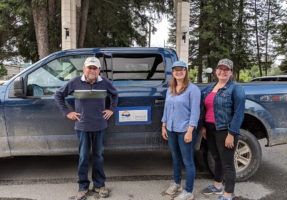
About 40 community members gathered at Silver Creek Community Hall near Salmon Arm last Thursday to discuss ways to improve water availability for both farms and spawning salmon. While the province has since rescinded a fish protection order for the watershed that shut down irrigation, future risks to water access remain top of mind. "We are here because water matters to each of us," says rancher and organizer Trudy Schweb. Farmland Riparian Interface Stewardship Program manager Lee Hesketh outlined the potential for upland water storage while Rob Dinwoodie highlighted cost-shared funding opportunities through the Environmental Farm Plan program for riparian assessments, irrigation efficiency upgrades and other water-related projects available to producers. Photo credit | Facebook/Trudy Schweb

#BCAg
... See MoreSee Less

About 40 community members gathered at Silver Creek Community Hall near Salmon Arm last Thursday to discuss ways to improve water availability for both farms and spawning salmon. While the province has since rescinded a fish protection order for the watershed that shut down irrigation, future risks to water access remain top of mind. We are here because water matters to each of us, says rancher and organizer Trudy Schweb. Farmland Riparian Interface Stewardship Program manager Lee Hesketh outlined the potential for upland water storage while Rob Dinwoodie highlighted cost-shared funding opportunities through the Environmental Farm Plan program for riparian assessments, irrigation efficiency upgrades and other water-related projects available to producers. Photo credit | Facebook/Trudy Schweb

#BCAg
View Comments
  • Likes: 36
  • Shares: 4
  • Comments: 4

Comment on Facebook

Salmon River Watershed Roundtable should be looked into again.

Well done my girl,the voice of Silver Creek ranchers and more

Thanks for covering this🌟

2 days ago

The BC Fruit Growers Association is urging Greater Vernon Water and the Regional District of North Okanagan to halt water shut-offs hitting 2,100+ acres of Okanagan orchards mid-season. With losses potentially topping $250 million, fruit growers say decisions of this scale demand a coordinated plan with farmers and the province — not one-sided cuts. They’re not the only producers affected by this year’s dry conditions.

#BCAg
... See MoreSee Less

Cash Flows

www.countrylifeinbc.com

VERNON – Water restrictions intensified across the southern Interior in late July, with record low stream flows clouding the cash outlook for ranches and orchards. Fourteen agricultural water users...
View Comments
  • Likes: 5
  • Shares: 3
  • Comments: 1

Comment on Facebook

Food should ALWAYS come first. Allow the farmers their water. My grandad watered the apples by flume from the mountain. Let’s get on with AG and get out of the way!

3 days ago

The BC Fruit Growers Association has joined Apples Canada, a new national voice for provincial apple organizations in BC, Ontario, Quebec, New Brunswick and Nova Scotia. Charles Stevens of Ontario chairs the new group, an evolution of the apple working group within Fruit & Vegetable Growers Canada (FVGC), the new group will tackle production, sustainability, research and policy issues as well as advocate for market access in partnership with FVGC. It follows the creation of the Greenhouse Produce Alliance of Canada earlier this year, which replaced the former greenhouse vegetable working group. The berry and field vegetable sectors will continue to maintain working groups with FVGC, while the long-estblished Canadian Potato Council serves the interests of potato growers under the FVGC umbrella.

#BCAg
... See MoreSee Less

The BC Fruit Growers Association has joined Apples Canada, a new national voice for provincial apple organizations in BC, Ontario, Quebec, New Brunswick and Nova Scotia. Charles Stevens of Ontario chairs the new group, an evolution of the apple working group within Fruit & Vegetable Growers Canada (FVGC), the new group will tackle production, sustainability, research and policy issues as well as advocate for market access in partnership with FVGC. It follows the creation of the Greenhouse Produce Alliance of Canada earlier this year, which replaced the former greenhouse vegetable working group. The berry and field vegetable sectors will continue to maintain working groups with FVGC, while the long-estblished Canadian Potato Council serves the interests of potato growers under the FVGC umbrella.

#BCAg
View Comments
  • Likes: 4
  • Shares: 0
  • Comments: 0

Comment on Facebook

Subscribe | Advertise

The agricultural news source in British Columbia since 1915
  • Email
  • Facebook

Cattlemen speak out about groundwater licensing debacle

December 1, 2017 byTom Walker

KAMLOOPS – Kevin Boon, general manager of the BC Cattlemen’s Association (BCCA), is calling the Ministry of Environment (MOE) to task for its inept handling of groundwater licensing.

“It’s been a fiasco from the start. It has been utter chaos and it has been, I would say, the biggest example of bureaucratic mishandling that I have ever seen,” says Boon, his frustration evident, at the Kamloops Stockman’s Association’s recent semi- annual meeting.

Since the BC Water Sustainability Act took effect two years ago, there have been little more than 1,500 applications, for which MOE has only issued 97 actual licenses.

“There has been a real glitch in the get- along somewhere,” he said. “Some of the applications have been in for more than a year and have not yet reached the desk of those that approve it. It has been an embarrassment to be quite frank and we made that very clear to the Ministry of Environment.”

Changes to the application form have made it simpler, and FrontCounter BC has made more computers available, but Boon says the issues run deeper.

“We are not sure the applications are leaving FrontCounter and ending up on the desk of Environment,” he says. “We are hoping the problems have been resolved. They promise us they have. But in the meantime, the new government is doing a review on the application process.”

While the government is working to move the application process online, Boon says this doesn’t work for all ranchers. Some don’t have computer skills or adequate Internet service.

“We’ve certainly made them aware that this does not work well for a lot of our members,” he says. “We have pushed hard to be able to have it done by paper.”

Giving credit

Boon credits BCCA director Linda Allison, who ranches in the Similkameen Valley near Princeton, with ensuring that ranchers have submitted the majority of the  license applications the province has received to date.

“She really understands the value of water licensing and the need for all ranchers to get their groundwater licensed,” he said.

BCCA is asking the province to permanently waive application fees and to extend “first- in- time, first- in- right” privileges to late applications.

“We got a one- year waiver and we had it extended to the end of this year but it is very evident that it is still not working and it is not our fault,” Boon says. “We are also asking that they extend the first- in- time, first- in- right recognition because of the flawed process.”

Boon wonders what value BC taxpayers are getting from the process. He notes that $25 million was allocated for extra staffing to do the applications.

“If we are spending $25 million and getting 97 licenses approved in that time, I would not say that that is a very good use of our dollars,” he says. “Especially when I consider that the contribution for AgriRecovery towards fires that devastated three million acres was $20 million dollars. Where’s the best use of those funds?”

All content on this website is copyrighted, and cannot be republished or reproduced without permission.
Related Posts

You may be interested in these posts from the same category.

Groundwater deadline firm

Groundwater users could lose rights next year

Grant funding for nutrient management projects

No extension for groundwater

Ranchers troubled by inconsistencies in well licensing

Dairy producers surveyed on regulation impact

Groundwater bill causes confusion for Island farmer

Ministry working on land use inventory

Slow drip on groundwater licences

Irrigation

Water fees questioned

Irrigation

Groundwater application deadline extended

BREAKING NEWS! Groundwater licencing deadline extended

Previous Post: « Producers take concerns to Victoria
Next Post: Property assessments set for major shift after fires Wildfire»

© 2026 COUNTRY LIFE IN BC - ALL RIGHTS RESERVED