
• Menu
  • Skip to primary navigation
  • Skip to main content
  • Skip to primary sidebar

Country Life In BC Logo

The agricultural news source in British Columbia since 1915

  • Headlines
  • Calendar
  • Subscribe
  • Advertise
  • About
  • Archives
  • Contact
  • Search
  • Headlines
  • Calendar
  • Subscribe
  • Advertise
  • About
  • Archives
  • Contact
  • Search

Primary Sidebar

Originally published:

SEPTEMBER 2022
Vol. 108 Issue 9

Subscribe Now!

Sign up for free weekly FARM NEWS UPDATES

Select list(s) to subscribe to


By submitting this form, you are consenting to receive marketing emails from: Country Life in BC. You can revoke your consent to receive emails at any time by using the SafeUnsubscribe® link, found at the bottom of every email. Emails are serviced by Constant Contact
Your information will not be
shared or sold ever

Follow us on Facebook

Comments Box SVG iconsUsed for the like, share, comment, and reaction icons

3 days ago

Water volumes from the Nooksack River are at levels similar to 1990 and 2021, but the province says flows should peak at 10pm tonight. The shorter duration, as well as conditions in other watercourses within the watershed and performance of flood protection infrastructure should avoid a catastrophe on the scale of 2021. However, several landslides mean road closures have once again effectively isolated the Lower Mainland from the rest of the province.

#BCAg
... See MoreSee Less

Water volumes from the Nooksack River are at levels similar to 1990 and 2021, but the province says flows should peak at 10pm tonight. The shorter duration, as well as conditions in other watercourses within the watershed and performance of flood protection infrastructure should avoid a catastrophe on the scale of 2021. However, several landslides mean road closures have once again effectively isolated the Lower Mainland from the rest of the province.

#BCAg
View Comments
  • Likes: 9
  • Shares: 3
  • Comments: 1

Comment on Facebook

Family living in Sumas WA say it's very much like '21. They have the same amount of water in their house as last time.

2 weeks ago

... See MoreSee Less

View Comments
  • Likes: 4
  • Shares: 0
  • Comments: 0

Comment on Facebook

2 weeks ago

On the last day of the BC Organic Conference, Thursday, Molly Thurston of Pearl Agricultural Consulting helped growers learn how to manage bugs such as codling moth, wireworm, and rootworm in organic growing systems. Her talk alongside Renee Prasad included hands-on activities in which participants checked out various traps and examined pests under microscopes. Be sure to look for more upcoming ag events on our online calendar at www.countrylifeinbc.com/calendar/

#BCAg
... See MoreSee Less

On the last day of the BC Organic Conference, Thursday, Molly Thurston of Pearl Agricultural Consulting helped growers learn how to manage bugs such as codling moth, wireworm, and rootworm in organic growing systems. Her talk alongside Renee Prasad included hands-on activities in which participants checked out various traps and examined pests under microscopes. Be sure to look for more upcoming ag events on our online calendar at www.countrylifeinbc.com/calendar/

#BCAg
View Comments
  • Likes: 15
  • Shares: 0
  • Comments: 0

Comment on Facebook

2 weeks ago

Well-known organic farmer and podcaster Jordan Marr gets interviewed by Country Life in BC’s own columnist and potato mavin Anna Helmer during the opening session of the BC Organic Conference at Harrison Hot Springs yesterday. Sessions run today (Wednesday) and Thursday and include organic and regenerative growing practices and expanding and advocating for the organic sector, all under the background of the newly launched Organic BC banner.

#BCAg
... See MoreSee Less

Well-known organic farmer and podcaster Jordan Marr gets interviewed by Country Life in BC’s own columnist and potato mavin Anna Helmer during the opening session of the BC Organic Conference at Harrison Hot Springs yesterday. Sessions run today (Wednesday) and Thursday and include organic and regenerative growing practices and expanding and advocating for the organic sector, all under the background of the newly launched Organic BC banner.

#BCAg
View Comments
  • Likes: 37
  • Shares: 2
  • Comments: 1

Comment on Facebook

Interested in finding out more about this

1 month ago

Today, we remember those who sacrificed their lives or their well-being for our freedom. Lest we forget. ... See MoreSee Less

Today, we remember those who sacrificed their lives or their well-being for our freedom. Lest we forget.
View Comments
  • Likes: 8
  • Shares: 0
  • Comments: 0

Comment on Facebook

Subscribe | Advertise

The agricultural news source in British Columbia since 1915
  • Email
  • Facebook

Cool weather improves wildfire response

Southern Interior the most active in terms of ranch impacts

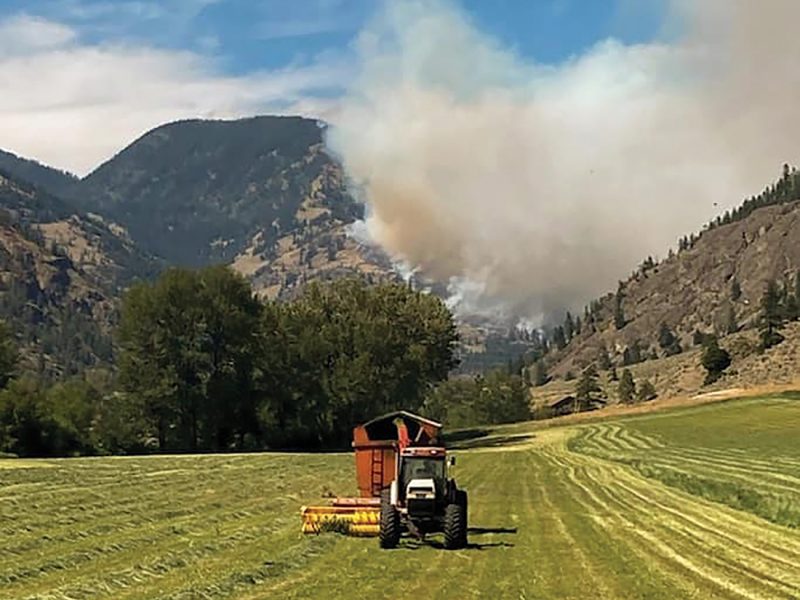
It’s hard to imagine business as usual when a wildfire is nipping at your doorstep, but cows need to be fed this winter and forage needs to be cut. The fire came close but did not directly impact Clifton Ranch in Keremeos. FACEBOOK

August 31, 2022 byKate Ayers And Peter Mitham

PENTICTON – Wildfires in the area between the Okanagan and Similkameen valleys have shaped up as the biggest direct threat to BC ranchers this summer, with many still on edge after last year’s intense, wind-driven fires with lengthy perimeters.

The Keremeos Creek wildfire 21 kilometres southwest of Penticton, the largest blaze in the province outside the Northwest at 17,401 acres, was among 322 fires recorded in the Kamloops fire centre this year.

Kamloops is the most active area for wildfires this season, accounting for more than a quarter of the 1,242 reported fires. Total area burned as of deadline was just short of 97,500 acres – a fraction of the millions of acres burned in recent years.

But for Wade Clifton of Clifton Ranch, located north of Keremeos off Highway 3A, the Keremeos Creek fire was a stark reminder of the danger ranchers face each summer. While the fire kept its distance from his property, it was thanks largely to a backburn crews lit on the Olalla Creek Forest Service Road on August 11.

“We were really nervous about the ash because we thought it was going to come down on us. In the end, it never really got here,” Clifton says.

Concerted efforts to smooth relationships between provincial first-responders and ranchers have improved firefighting efforts, and Clifton praised the BC Wildfire service crews.

“They did a very good job on our end when they got here,” Clifton says of the fire crews in his area.

While a cooler season and higher moisture have helped limit fire risks this year, a more collaborative approach between landowners and BC Wildfire Service crews has also helped incident management teams keep ahead of the fires.

“The teamwork that we’re seeing between the BC Wildfire Service, ranchers, loggers, First Nations – it’s fantastic,” says Norene Parke, rancher liaison manager with the BC Cattlemen’s Association. “We haven’t had near the devastation that we had last year, for sure.”

Rancher liaisons, an initiative that debuted last year, has helped.

The first year of the program saw 13 people tapped to give rancher input to the incident management teams. But liaisons were quickly overwhelmed by the number and intensity of the fires and the sheer volume of cattle and livestock involved.

The rancher liaison for the McKay Creek fire, Parke urged BC Cattlemen’s to have a dedicated manager overseeing the program. A former superintendent for the BC Ambulance Service, she was asked to step into the role. Over the winter, she drafted a manual for rancher liaisons distributed to the 42 individuals tapped to be on standby this year in case of wildfires.

“The rancher liaisons were much better prepared in their role this year,” she says. “This year, there was a clear expectation as to what was going to happen.”

Communications have also improved, thanks in part to an app that allows ranchers and others to quickly report fires as they happen.

“They’re being reported quicker,” Parke says. “The incident management teams have actioned them quickly and they haven’t grown to any size.”

She says many ranchers report that crews are arriving within 15 minutes to extinguish the fires.

The result is that just four rancher liaisons have been activated this year, primarily in the Kamloops fire centre. The exception is for the Connell complex, a 7,000-acre fire in the Kootenays.

While this year’s fires have been less devastating, not all ranchers have been as lucky as the Cliftons. The wildfires south of Penticton have claimed residences and ranch infrastructure, one of three in the region to cause property damage.


Related Posts

You may be interested in these posts from the same category.

Previous Post: « Cattleliner loss mourned
Next Post: Rate hike demands planning »

Copyright © 2025 Country Life in BC · All Rights Reserved