
• Menu
  • Skip to primary navigation
  • Skip to main content
  • Skip to primary sidebar

Country Life In BC Logo

The agricultural news source in British Columbia since 1915

  • Headlines
  • Calendar
  • Subscribe
  • Advertise
  • About
  • Archives
  • Contact
  • Search
  • Headlines
  • Calendar
  • Subscribe
  • Advertise
  • About
  • Archives
  • Contact
  • Search

Primary Sidebar

Originally published:

MARCH 2024
Vol. 110 Issue 3

Subscribe Now!

Sign up for free weekly FARM NEWS UPDATES

Select list(s) to subscribe to


By submitting this form, you are consenting to receive marketing emails from: Country Life in BC. You can revoke your consent to receive emails at any time by using the SafeUnsubscribe® link, found at the bottom of every email. Emails are serviced by Constant Contact
Your information will not be
shared or sold ever

Stories In This Edition

Crown land shakeup

Start me up!

BC Veg mandate expands

Trade show, gala celebrate the best in agriculture

Editorial: Reconciliation is never a one-way street

Back 40: We need to do better, and we can

Viewpoint: The Land Act: important context, faulty process

BC vineyards wiped out by freeze event

Sidebar: Cherries, tender fruits affected

Apple industry eyes orderly marketing plan

Ag Briefs: BC Tree Fruits members vote down hostile motions

Ag Briefs: Farmers lead protest in Duncan

BC FIRB strategic plan aims to clarify role

Two Interior farms face abuse claims

Good times!

Study shows BC farmers markets add value

Story  tellers

Berry farmer recognized for achievements

Nursery specialist appointed

Blueberries top pick amid strong demand

Awards generate buzz for BC beekeepers

Promising developments in berry breeding

Help takes stress out of Farmgate meat licences

New abattoir offers lifeline to local growers

Pest science

Cattle spark fencing debate

Thistle require innovative management

Job well done!

Pruners should focus on needs of the bush

Islands show brings community together

Farm Story: Spring is claling, but my phone is in pieces

Forecasting will improve with AI technology

Woodshed: Breakfast gives Delta time to do her research

New honeybee program in works for Cariboo

Jude’s Kitchen: Food trend points to healthier eating

More Headlines

Follow us on Facebook

Comments Box SVG iconsUsed for the like, share, comment, and reaction icons

2 weeks ago

FarmFolk CItyFolk is hosting its biennial BC Seed Gathering in Harrison Hot Springs November 27 and 28. Farmers, gardeners and seed advocates are invited to learn more about seed through topics like growing perennial vegetables for seed, advances in seed breeding for crop resilience, seed production as a whole and much more. David Catzel, BC Seed Security program manager with FF/CF will talk about how the Citizen Seed Trail program is helping advance seed development in BC. Expect newcomers, experts and seed-curious individuals to talk about how seed saving is a necessity for food security. ... See MoreSee Less

Link thumbnail

BC Seed Gathering - FarmFolk CityFolk

farmfolkcityfolk.ca

Save the date for our upcoming 2023 BC Seed Gathering happening this November 3rd and 4th at the Richmond Kwantlen Polytechnic University campus.
View Comments
  • Likes: 1
  • Shares: 0
  • Comments: 0

Comment on Facebook

4 weeks ago

BC has reported its first case of highly pathogenic avian influenza (HPAI) in the eighth wave of the disease since 2021. Canadian Food Inspection Agency officials confirmed October 13 that a premises in Abbotsford tested positive for the disease, the first infected premise in BC during this fall's migration. The farm is the 240th premises infected in BC since the current national outbreak began four years ago with a detection in Newfoundla#BCAg#BCAg ... See MoreSee Less

BC has reported its first case of highly pathogenic avian influenza (HPAI) in the eighth wave of the disease since 2021. Canadian Food Inspection Agency officials confirmed October 13 that a premises in Abbotsford tested positive for the disease, the first infected premise in BC during this falls migration. The farm is the 240th premises infected in BC since the current national outbreak began four years ago with a detection in Newfoundland.

#BCAg
View Comments
  • Likes: 50
  • Shares: 195
  • Comments: 444

Comment on Facebook

But the ostrich’s have the cure ….

I don't believe anything the CfIA says, like saying ostriches are chickens so that's why everything has to get culled.

Who in BC has reported this, not a word in the news. Why are you spreading fear propaganda? If you cannot add a source do not post this crap! It appears your page knows absolutely nothing about COUNTRY LIFE IN BC OR ELSEWHERE!

Just put one-way arrows on the floor of the chicken coop, keep them 6ft apart from each other and stock up on toiletpaper for them. 😉

Source? I can't find anything to corroborate this story.

Perhaps if they had allowed the ostrich to be tested and discovered how they developed antibodies we could quit culling our food supplies. Yes I know ostrich are not chickens

This only made the news to confuse those interested in the ostrich farm, relax, has nothing to do with the ostriches

How convenient that carney has a pocket in this 🤔

The ostriches eggs can save your flock

Weird how it only affects birds we eat. Kinda like how no homeless people got convid.

How convenient. Now it's off to the ostrich farm, right?

Have you went chicken catching for 8 hours all night 36000 birds

My advice take your chickens and run!

Have none of you guys ever seen the hundreds of birds falling from the sky? Ya me nether

Brainwashing if you ask me

just like on people- that mask looks like its doing a lot of nothing on that rooster!

Is it as deadly as monkey pox?? 🐵

Quick kill all the food! Perhaps we should study the ostriches...

Ostriches not chicken and not reproduced for human consumption

The condom is too small for the CO?K

I don't know how you do it, but invest in egg futures RIGHT NOW. The price will be skyrocketing.

So is it the first or the 240th?

240th. So how many birds culled is that now? The stamping out policy is working so well, isn’t it? Maybe cramming millions of stressed birds, receiving no sunlight, into facilities, all within a few kilometres apart (talk about having all your eggs in one basket) is not the brightest idea. Maybe we should scrap the Quito system, allow regular folks to have more than 100 birds and supply their neighbourhoods with meat and eggs. Maybe we should raise more robust birds with better immune systems. Maybe we shouldn’t give birds sunlight, less crowded conditions, and give them a full 24 hours to lay an egg, instead of artificially giving them shorter days, trying to squeeze more eggs out of them. Maybe, without the quota system, instead of a few mega farms, egg producers would again dot the entire province.

Lol are they going to blaim the ostriches

You mean to tell us all, THE CULL isn’t working, maybe, just maybe we should try something just a bit more humanly and have maybe a slight hint of scientific evidence!!!

View more comments

1 month ago

Here we go again!

With no immediate end in sight for the Canada Post strike, we have uploaded the October edition of Country Life in BC to our website. While it's not the preferred way to view the paper for most of our subscribers, we're grateful to have a digital option to share with them during the strike. The October paper is printed and will be mailed soon as CP gets back to work! In the meantime, enjoy!

... See MoreSee Less

Link thumbnail

CLBC October 2025

news.countrylifeinbc.com

CLBC October 2025
View Comments
  • Likes: 7
  • Shares: 4
  • Comments: 2

Comment on Facebook

The 1 person in Canada who contracted avian flu speaks to Rebel.news

STOP SPREADING LIES ABOUT AVIAN FLU NO BIRD GETS THIS

1 month ago

... See MoreSee Less

View Comments
  • Likes: 8
  • Shares: 0
  • Comments: 0

Comment on Facebook

1 month ago

... See MoreSee Less

View Comments
  • Likes: 6
  • Shares: 0
  • Comments: 0

Comment on Facebook

Subscribe | Advertise

The agricultural news source in British Columbia since 1915
  • Email
  • Facebook

Forecasting will improve with AI technology

Big data driving improvements in weather forecasts

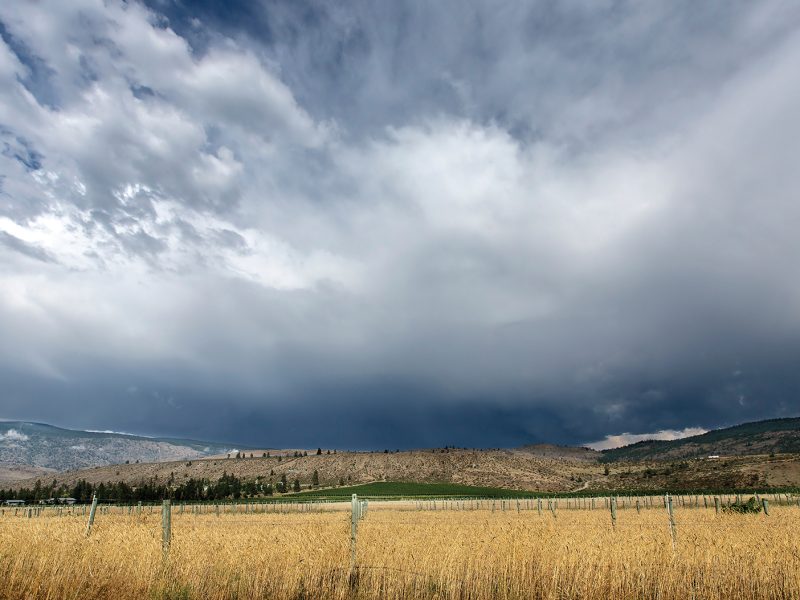
File photo

March 1, 2024 byMyrna Stark Leader

ABBOTSFORD – Producers can’t control the weather, but they absolutely need the most accurate forecasts to determine the right times to plant, spray, harvest, and so on.

“Farmers need confidence in the forecast to do their work,” agricultural meteorologist Andy Nadler of Peak HydroMet Solutions in Campbell River told producers attending the Lower Mainland Horticultural Conference at the end of January.

Weather modelling isn’t an exact science but Nadler expects short-term weather forecasts to become more accurate within two to five years as artificial intelligence advances. In the meantime, Nadler encourages producers to use a few different tools to check weather forecasts.

While advances in computer modelling over the past few decades have delivered improved three, five and 10-day forecasting, Nadler says shorter-term weather reports may be more valuable to growers. Precipitation forecasts and modelling the duration of cold snaps like the one accompanying the Arctic outflow in January are examples.

Weather conditions are made up of precipitation, humidity, temperature, pressure, sky cover (sun/cloud) and wind. To create a forecast, data such as historical and current weather, the state of the atmosphere and ocean currents are run through complex computer models. Variables are tweaked slightly each time the models are run. After many possible outcomes, the result is a most likely weather scenario – commonly known as a forecast.

Environment and Climate Change Canada’s weather forecasts may be among the best-known in Canada, but there are many other trusted weather prediction organizations in the world. The European Centre for Medium-Range Weather Forecasts (ECMWF) generates 10-day hourly forecasts across the globe. The high-resolution, rapid refresh (HRRR) forecasts from the US National Oceanic and Atmospheric Administration is a real-time atmospheric model that forecasts weather every 15 minutes at a 3-kilometre resolution.

The US Global Forecast System (GFS) and North American Mesoscale (NAM) generate multiple grids of forecasts over North America at various horizontal resolutions. Meanwhile, ICON (Icosahedral Nonhydrostatic) is a suite of models created by the German national weather service.

“All forecasts are pretty good, but you need to find the ones that work for you,” said Nadler, showing how Environment and Climate Change Canada’s models only forecast weather for larger regions without the level of detail needed to understand incoming conditions for a specific farm property.

To help producers out, Nadler suggested a few options he likes.

Windy.com, a free app, allows users to drill down to a very specific location and see hourly predictions each day. Windy combines five of the international weather models mentioned above to make predictions. It also shows the nearest weather station to a specific location, fires, and wind speed and direction by the hour, a bonus for spray application.

The site MeteoBlue.com includes agricultural tools and provides daily forecasts, rating the accuracy of the prediction.

Farmwest.com shows information like evapotranspiration, moisture deficit and previous year’s moisture.

Additionally, Nadler says Google is working on an AI-based forecasting tool called GraphCast for medium-range forecasting. Rather than traditional numerical weather models, it uses a machine learning-based approach. It’s said that GraphCast predicts weather up to 10 days in the future with greater speed and accuracy than today’s leading forecast models.

No matter what forecast tool farmers prefer, Nadler suggests farmers compare several if they want increased certainty that predictions or measures are accurate.

“They need to be away from things like water bodies and buildings which can impact readings and also away from equipment paths to prevent them being damaged,” said Nadler. “You’re likely looking at $1,000 and up for a good one.”

Nadler says 25 new on-farm weather stations have been installed in the Okanagan since 2018 as part of the provincially funded BC Decision Aid System. Some producers are also purchasing their own stations. If producers allow, their privately owned machines can also feed data into larger network systems, which is helpful.

Related Posts

You may be interested in these posts from the same category.

Previous Post: « Awards generate buzz for BC beekeepers
Next Post: Domestic labour gap grows »

Copyright © 2025 Country Life in BC · All Rights Reserved