
• Menu
  • Skip to primary navigation
  • Skip to main content
  • Skip to primary sidebar

Country Life In BC Logo

The agricultural news source in British Columbia since 1915

  • Headlines
  • Calendar
  • Subscribe
  • Advertise
  • About
  • Archives
  • Contact
  • Search
  • Headlines
  • Calendar
  • Subscribe
  • Advertise
  • About
  • Archives
  • Contact
  • Search

Primary Sidebar

Originally published:

JULY 2024
Vol. 110 Issue 7

Subscribe Now!

Sign up for free weekly FARM NEWS UPDATES

Select list(s) to subscribe to


By submitting this form, you are consenting to receive marketing emails from: Country Life in BC. You can revoke your consent to receive emails at any time by using the SafeUnsubscribe® link, found at the bottom of every email. Emails are serviced by Constant Contact
Your information will not be
shared or sold ever

Stories In This Edition

Disaster fund denied

Liquid gold

BC Millk halts deductions

Watering exemptions extended

Editorial: Who stands on guard for thee?

Back 40: Redefining labour as a technological problem

Viewpoint: Extension needs to be a two-way conversation

Stabilization initiative yet to bear fruit

Industry first as mushroom workers unionize

Ag Brief: High cost stall South Okanagan food hub

Ag Brief: Supply management limits food inflation

Orchard industry bids farwell to a staunch leader

Persistent drought conditions have ranchers on edge

Lacklustre season expected for berries

Island Trust turns 50

Land Act, water issues aired at Cattlemen’s AGM

Eye-to-eye

Grasslands tour puts spotlight on common ground

Telkwa producers step up to provide slaughter services

Sidebar: Dieleman family feels feed, labour crunch

Tour showcases sustainability of Abbotsford farms

Agritech company aims for the stars

Embracing regenerative cattle ranching

It’s not what, it’s how you spread it

Farm Story: A rake’s progress has no end

Ranchers follow beavers for water storage solutions

Woodshed: New beginnings for Kenneth, and for Deborah

Mary Forstbauer grant funds new farmer’s dreams

Jude’s Kitchen: Patio food for summer

More Headlines

Follow us on Facebook

Comments Box SVG iconsUsed for the like, share, comment, and reaction icons

6 days ago

... See MoreSee Less

View Comments
  • Likes: 4
  • Shares: 0
  • Comments: 0

Comment on Facebook

6 days ago

On the last day of the BC Organic Conference, Thursday, Molly Thurston of Pearl Agricultural Consulting helped growers learn how to manage bugs such as codling moth, wireworm, and rootworm in organic growing systems. Her talk alongside Renee Prasad included hands-on activities in which participants checked out various traps and examined pests under microscopes. Be sure to look for more upcoming ag events on our online calendar at www.countrylifeinbc.com/calendar/

#BCAg
... See MoreSee Less

On the last day of the BC Organic Conference, Thursday, Molly Thurston of Pearl Agricultural Consulting helped growers learn how to manage bugs such as codling moth, wireworm, and rootworm in organic growing systems. Her talk alongside Renee Prasad included hands-on activities in which participants checked out various traps and examined pests under microscopes. Be sure to look for more upcoming ag events on our online calendar at www.countrylifeinbc.com/calendar/

#BCAg
View Comments
  • Likes: 15
  • Shares: 0
  • Comments: 0

Comment on Facebook

1 week ago

Well-known organic farmer and podcaster Jordan Marr gets interviewed by Country Life in BC’s own columnist and potato mavin Anna Helmer during the opening session of the BC Organic Conference at Harrison Hot Springs yesterday. Sessions run today (Wednesday) and Thursday and include organic and regenerative growing practices and expanding and advocating for the organic sector, all under the background of the newly launched Organic BC banner.

#BCAg
... See MoreSee Less

Well-known organic farmer and podcaster Jordan Marr gets interviewed by Country Life in BC’s own columnist and potato mavin Anna Helmer during the opening session of the BC Organic Conference at Harrison Hot Springs yesterday. Sessions run today (Wednesday) and Thursday and include organic and regenerative growing practices and expanding and advocating for the organic sector, all under the background of the newly launched Organic BC banner.

#BCAg
View Comments
  • Likes: 37
  • Shares: 2
  • Comments: 1

Comment on Facebook

Interested in finding out more about this

3 weeks ago

Today, we remember those who sacrificed their lives or their well-being for our freedom. Lest we forget. ... See MoreSee Less

Today, we remember those who sacrificed their lives or their well-being for our freedom. Lest we forget.
View Comments
  • Likes: 8
  • Shares: 0
  • Comments: 0

Comment on Facebook

1 month ago

FarmFolk CItyFolk is hosting its biennial BC Seed Gathering in Harrison Hot Springs November 27 and 28. Farmers, gardeners and seed advocates are invited to learn more about seed through topics like growing perennial vegetables for seed, advances in seed breeding for crop resilience, seed production as a whole and much more. David Catzel, BC Seed Security program manager with FF/CF will talk about how the Citizen Seed Trail program is helping advance seed development in BC. Expect newcomers, experts and seed-curious individuals to talk about how seed saving is a necessity for food security. ... See MoreSee Less

Link thumbnail

BC Seed Gathering - FarmFolk CityFolk

farmfolkcityfolk.ca

Save the date for our upcoming 2023 BC Seed Gathering happening this November 3rd and 4th at the Richmond Kwantlen Polytechnic University campus.
View Comments
  • Likes: 1
  • Shares: 0
  • Comments: 0

Comment on Facebook

Subscribe | Advertise

The agricultural news source in British Columbia since 1915
  • Email
  • Facebook

Grasslands tour puts spotlight on common ground

Good management leads to positive outcomes

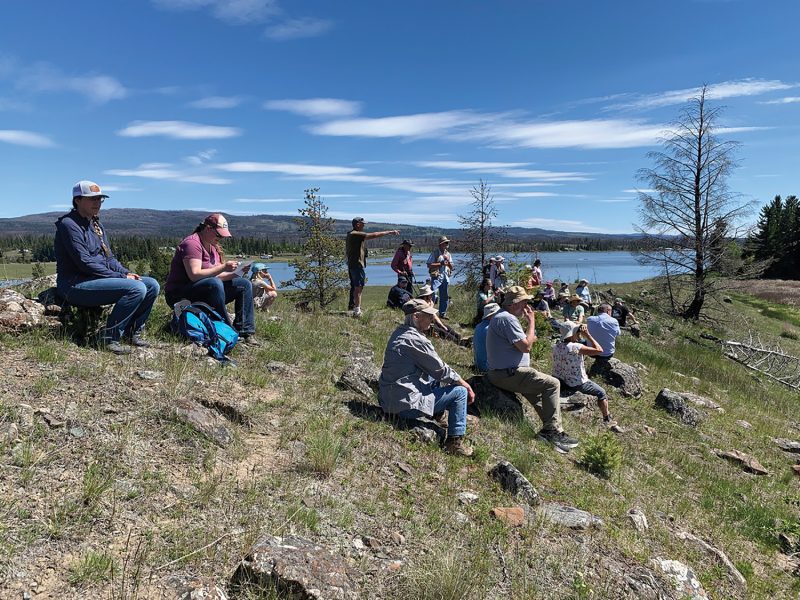
Restricting access by cattle to riparian areas and lakes in Tunkwa Provincial Park was a first step in protecting the park’s vulnerable grasslands. | TOM WALKER

July 2, 2024 byTom Walker

KAMLOOPS – The annual Grasslands Conservation Council of BC (GCC) field day visited Tunkwa Provincial Park on June 8, with participants learning about the park’s creation and management of the surrounding grasslands.

Tunkwa Provincial Park was created in 1996 to protect a portion of the area’s extensive mid-elevation grasslands, as well as lakes, wetlands and forests on the South Thompson Plateau between the towns of Logan Lake and Savona.

Both Tunkwa and adjacent Leighton Lake, are man-made, the result of damming by ranchers in the mid 1800s. Both remain within the grazing licences of Indian Gardens Ranch, operated by GCC chair Bob Haywood-Farmer.

The area is popular with recreationists for the excellent fishing as well as hunting and backcountry activities. By the mid 1990s, the BC Forest Service recreation site campgrounds on each lake were being heavily used and the surrounding landscape was suffering.

“The area was getting trashed,” says Denis Lloyd, a forest ecologist and key member of the park creation process who now serves as GCC treasurer. “Bob [Haywood-Farmer] and I sometimes had conflicting views at the time, but I think the benefit to the grasslands, the lakes and wetlands, the aspen copses and the overall biodiversity of the area has been very positive.”

Lloyd says some environmentalists wanted to keep cattle out completely.

“But we needed ranchers on side; they are major players in the landscape management. We were looking for a consensus to develop a park system in the southern Interior,” he says.

Indian Gardens’ cows were impacting the area and they had few tools to manage them, Bob’s son Ted Haywood-Farmer explains.

“Pre-1995, the whole thing from one horizon to the next was one big open area,” he recalls. “Without any fencing, after turnout, cattle would come up at the beginning of June and go right to the shores of Tunkwa Lake.”

Summers were spent keeping the cattle away from the lake.

“I remember how sore my butt would get as a kid spending eight hours a day in the saddle,” Haywood-Farmer chuckles. “Keeping them there was good for breeding but they would over-graze the area.”

Lloyd says a compromise was reached at the table.

“We fenced off a few sizable areas to protect and be a representative example of what these landscapes would look like in an ungrazed situation,” Lloyd says.

The first benefit to cattle management was a perimeter fence through the park and the surrounding open grasslands.

“We were able to keep the cows out of the lakes and wetlands without having to come up every third day and drive them out,” Haywood-Farmer says.

That fence also helped with the ranch’s grazing rotations.

“It allows us to use the timbered area that is more dominated by pine grass early in the season when the pine grass has a higher feed value,” he explains. “And it lets the hard grass in the open country have the whole growing season to produce. That grass is of greater value to us in the fall when it is dormant than the pine grass is, and we can move our animals in to feed on it.”

The province also provided a grazing enhancement fund to support additional fencing that allowed the Haywood- Farmers to build more cross fencing to further manage their animals.

But all those fences disappeared in August 2021 when the Tremont Creek fire destroyed over 63,000 hectares, including almost the entire park. Both Lloyd and Haywood-Farmer say they need the fences back.

“I had the opportunity to be in one of the protected areas just before the fire and it is amazing how the area had improved with two-foot high fescue and a diversity of wildlife,” Lloyd says. “We need those fences back so the area can recover again.”

“I think we may still have two-thirds left to rebuild and we are still having real problems with our cattle management because we don’t have the fences,” he says.

Related Posts

You may be interested in these posts from the same category.

Previous Post: « Groundwater enforcement picks up
Next Post: BC-Alberta sign wine MOU »

Copyright © 2025 Country Life in BC · All Rights Reserved