• Menu
  • Skip to primary navigation
  • Skip to main content
  • Skip to primary sidebar

Country Life In BC Logo

The agricultural news source in British Columbia since 1915

  • Headlines
  • Calendar
  • Subscribe
  • Advertise
  • About
  • Archives
  • Contact
  • Search
  • Headlines
  • Calendar
  • Subscribe
  • Advertise
  • About
  • Archives
  • Contact
  • Search

Primary Sidebar

Originally published:

FEBRUARY 2021
Vol. 107 Issue 2

Subscribe Now!

Sign up for free weekly FARM NEWS UPDATES

Select list(s) to subscribe to


By submitting this form, you are consenting to receive marketing emails from: Country Life in BC. You can revoke your consent to receive emails at any time by using the SafeUnsubscribe® link, found at the bottom of every email. Emails are serviced by Constant Contact
Your information will not be
shared or sold ever

Stories In This Edition

CPR on ALR Track

Sea of greens

Farm properties rising

Genomics lab expands service to local growers

Editorial: Put farmers first

Back 40: Knowing when to pull back on extensions

Viewpoint: A watershed moment for BC farms

Egg producer questions support for local eggs

Milk consumption up among young minorities

Nutrient recovery system in third phase

North Saanich approves Sandown proprosal

Tsartlip acquire Woodwyn Farm with provincial help

Woodwynn Farm was first known as Mawuec

Pandemic was profitable for nursery growers

Researcher brings experience to sweet role

Consultant delivered practical advice

Tributes pour in for Island farmer Colin Springford

On-farm abattoir approved for Alberni Valley

Plans for a provincial weather network move forward

Feedlots under pressure with kill instability

If you go out in the woods today …

Round bale bounty

CFIA services get a funding boost

Help available for farm business succession

Sidebar: Considering all the options

Diversification helps farms prepare for challenges

Creston advocacy group continues push for food hub

Frind matches his love of data with grape production

Greenhouse sets example for others to follow

On-farm food networks wire farms for success

OK irrigation systems have a long history

Pemberton family farms beer with deep roots

When life gives you lemons

Personal money strategy as important as farm stragegy

Farm Story: Winter brings the distractions of technology

Well-designed vegetable coolers make for hot sales

Woodshed: Janice Newberry sets the record straight

Research: Plants can recognize attacking herbivores

Jude’s Kitchen: Super simple

More Headlines

Follow us on Facebook

Comments Box SVG iconsUsed for the like, share, comment, and reaction icons

1 week ago

FarmFolk CItyFolk is hosting its biennial BC Seed Gathering in Harrison Hot Springs November 27 and 28. Farmers, gardeners and seed advocates are invited to learn more about seed through topics like growing perennial vegetables for seed, advances in seed breeding for crop resilience, seed production as a whole and much more. David Catzel, BC Seed Security program manager with FF/CF will talk about how the Citizen Seed Trail program is helping advance seed development in BC. Expect newcomers, experts and seed-curious individuals to talk about how seed saving is a necessity for food security. ... See MoreSee Less

Link thumbnail

BC Seed Gathering - FarmFolk CityFolk

farmfolkcityfolk.ca

Save the date for our upcoming 2023 BC Seed Gathering happening this November 3rd and 4th at the Richmond Kwantlen Polytechnic University campus.
View Comments
  • Likes: 1
  • Shares: 0
  • Comments: 0

Comment on Facebook

3 weeks ago

BC has reported its first case of highly pathogenic avian influenza (HPAI) in the eighth wave of the disease since 2021. Canadian Food Inspection Agency officials confirmed October 13 that a premises in Abbotsford tested positive for the disease, the first infected premise in BC during this fall's migration. The farm is the 240th premises infected in BC since the current national outbreak began four years ago with a detection in Newfoundla#BCAg#BCAg ... See MoreSee Less

BC has reported its first case of highly pathogenic avian influenza (HPAI) in the eighth wave of the disease since 2021. Canadian Food Inspection Agency officials confirmed October 13 that a premises in Abbotsford tested positive for the disease, the first infected premise in BC during this falls migration. The farm is the 240th premises infected in BC since the current national outbreak began four years ago with a detection in Newfoundland.

#BCAg
View Comments
  • Likes: 50
  • Shares: 195
  • Comments: 444

Comment on Facebook

But the ostrich’s have the cure ….

I don't believe anything the CfIA says, like saying ostriches are chickens so that's why everything has to get culled.

Who in BC has reported this, not a word in the news. Why are you spreading fear propaganda? If you cannot add a source do not post this crap! It appears your page knows absolutely nothing about COUNTRY LIFE IN BC OR ELSEWHERE!

Just put one-way arrows on the floor of the chicken coop, keep them 6ft apart from each other and stock up on toiletpaper for them. 😉

Source? I can't find anything to corroborate this story.

Perhaps if they had allowed the ostrich to be tested and discovered how they developed antibodies we could quit culling our food supplies. Yes I know ostrich are not chickens

This only made the news to confuse those interested in the ostrich farm, relax, has nothing to do with the ostriches

How convenient that carney has a pocket in this 🤔

The ostriches eggs can save your flock

Weird how it only affects birds we eat. Kinda like how no homeless people got convid.

How convenient. Now it's off to the ostrich farm, right?

Have you went chicken catching for 8 hours all night 36000 birds

My advice take your chickens and run!

Have none of you guys ever seen the hundreds of birds falling from the sky? Ya me nether

Brainwashing if you ask me

just like on people- that mask looks like its doing a lot of nothing on that rooster!

Is it as deadly as monkey pox?? 🐵

Quick kill all the food! Perhaps we should study the ostriches...

Ostriches not chicken and not reproduced for human consumption

The condom is too small for the CO?K

I don't know how you do it, but invest in egg futures RIGHT NOW. The price will be skyrocketing.

So is it the first or the 240th?

240th. So how many birds culled is that now? The stamping out policy is working so well, isn’t it? Maybe cramming millions of stressed birds, receiving no sunlight, into facilities, all within a few kilometres apart (talk about having all your eggs in one basket) is not the brightest idea. Maybe we should scrap the Quito system, allow regular folks to have more than 100 birds and supply their neighbourhoods with meat and eggs. Maybe we should raise more robust birds with better immune systems. Maybe we shouldn’t give birds sunlight, less crowded conditions, and give them a full 24 hours to lay an egg, instead of artificially giving them shorter days, trying to squeeze more eggs out of them. Maybe, without the quota system, instead of a few mega farms, egg producers would again dot the entire province.

Lol are they going to blaim the ostriches

You mean to tell us all, THE CULL isn’t working, maybe, just maybe we should try something just a bit more humanly and have maybe a slight hint of scientific evidence!!!

View more comments

1 month ago

Here we go again!

With no immediate end in sight for the Canada Post strike, we have uploaded the October edition of Country Life in BC to our website. While it's not the preferred way to view the paper for most of our subscribers, we're grateful to have a digital option to share with them during the strike. The October paper is printed and will be mailed soon as CP gets back to work! In the meantime, enjoy!

... See MoreSee Less

Link thumbnail

CLBC October 2025

news.countrylifeinbc.com

CLBC October 2025
View Comments
  • Likes: 7
  • Shares: 4
  • Comments: 2

Comment on Facebook

The 1 person in Canada who contracted avian flu speaks to Rebel.news

STOP SPREADING LIES ABOUT AVIAN FLU NO BIRD GETS THIS

1 month ago

... See MoreSee Less

View Comments
  • Likes: 8
  • Shares: 0
  • Comments: 0

Comment on Facebook

1 month ago

... See MoreSee Less

View Comments
  • Likes: 6
  • Shares: 0
  • Comments: 0

Comment on Facebook

Subscribe | Advertise

The agricultural news source in British Columbia since 1915
  • Email
  • Facebook

Greenhouse sets example for others to follow

Salmo venture helps extend season for market gardeners

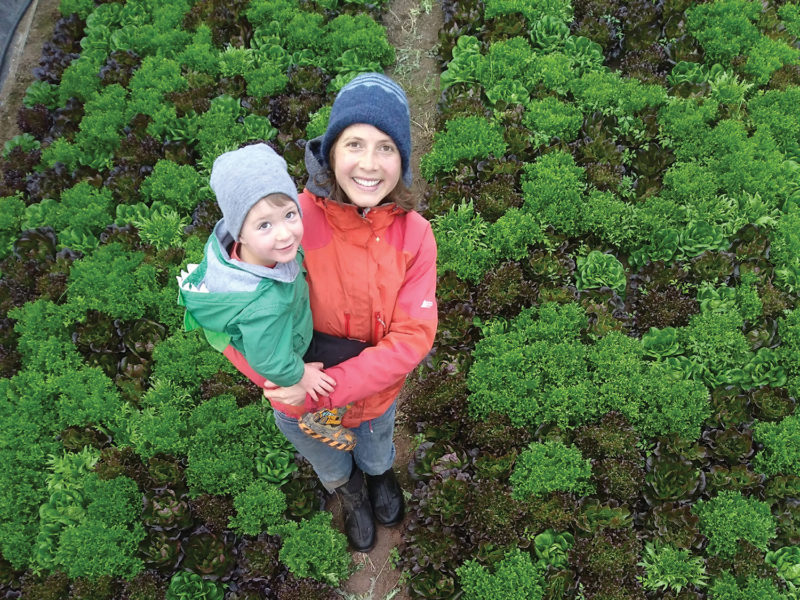
Cali Olleck and son Atlin Carson stand in a sea of kale and other hardy greens growing in the family's Salmo greenhouse at Salix & Sedge, a market garden that has extended its season by tapping into the natural gas line running across its property. PHOTO SALIX & SEDGE

February 1, 2021 byTom Walker

SALMO – It’s -8°C and snowing in the central Kootenay town of Salmo, but inside the greenhouse at Salix and Sedge Farm, lettuce and arugula are growing in the soil.

“It’s not really growing, it’s more like being in a refrigerator,” clarifies Brendan Parsons who with his partner Cali Olleck owns the farm. “The low winter light and the temperature just above zero keep the plants alive, but mostly dormant, and we are able to harvest fresh lettuce through the winter.”

Parsons and Olleck are just finishing up their first complete year of running the greenhouse, built as an addition to their five-year old market garden. Rather than cram all their production into six months like other market gardeners, a greenhouse was a way to broaden their production window.

“We were looking to balance our workload over the course of the year and extend our season,” says Parsons. “We began by growing storage crops that we could sell during the winter and create some additional cash flow, and the greenhouse is a way to extend that and give us some work during the winter.”

The greenhouse also allows them to produce high-value crops out of season, a key element of their business plan.

Those greens were sown in September, and although the greenhouse gives the couple the technology to hold them through February, they were sold out by Christmas. Come March, they will be seeding tomatoes and cucumbers with an intercropping of greens.

“We will start harvesting the cucumbers in early May and the tomatoes will be ready in June,” says Parsons.

That’s early by any standard. By comparison, the cherry tomatoes they grew outside last year under high tunnels weren’t ready until August.

Parsons says the greenhouse revenue has allowed them to ease out of their off-farm jobs (Parsons worked as a carpenter, and Olleck was in forestry) and have a bit more time for their three-year old son as well as the skiing and climbing that drew them to the area in the first place.

“I was living in Nelson and Cali was going to school in Castlegar and we were looking to farm, but still stay attached to the outdoor community here,” he says.

The two are new farmers. Olleck completed a year at Kwantlen Polytechnic University’s farm school in Richmond and Parsons did a gardening program at Linnaea Farm on Cortes Island prior to starting Salix and Sedge.

“But it would have been good to have spent time on a commercial farm to learn the business side of things,” says Parsons.

The farm initially had chickens, pigs and bees, but they have focused on vegetables over the last three years.

Their 20-acre property is tucked away on the west side of the Salmo River just outside of town. The name reflects the surrounding ecosystem. Salix is a genus of willow in the area and sedge is the primary perennial weed the farm has to deal with.

“Our soil is wonderful Salmo River bottom, but we have a lot of wetlands on our property,” explains Parsons. “We have been able to lease a neighbouring property that has the same great soil, but better drainage where we have our garden and greenhouse.”

The property sits on a natural gas mainline.

“The gas line was an important part of our decision to build the greenhouse, but I think that using propane would be a similar cost,” says Brendan.

The 120×35-foot greenhouse was manufactured in Quebec and engineered to withstand the snow load in Salmo. Two layers of polyethylene with air in between provide cover and some insulation.

“It sheds the snow really well, but I have to clear the snow from around the base with a blower attachment for my tractor,” explains Parsons. “We get so much [snow] here that it would impact the wall of the house if I didn’t clear it.”

Salmo itself is a small community, but it’s in a strategic location, being a half-hour drive from the three main towns in the central Kootenays. Their certified organic produce is available at grocers in Castlegar, Nelson and Trail, and at their farm stand.

“We don’t have a retail outlet in Salmo, but we are so close to town that people can ride their bikes or even walk to our farm store and we have enough of a range of vegetables to make it worth their trip,” says Parsons. “The local community has been really supportive of our farm, and more so this year. We have been able to sell out everything that we have grown.”

The greenhouse has been a steep learning curve.

“It’s only been our first year and I imagine that in five years we will look back and realize we have come a long way,” says Parsons.

Plant nutrition, pest and disease management as well as responding to shifting temperatures have all been new challenges. An outbreak of spider mites shortened their cucumber season.

“We need to develop a better IPM plan this year,” says Parsons, noting the lack of other greenhouses in the area to share ideas.

But that could change. Kootenay & Boundary Farm Advisors organized an early November tour of Salix and Sedge for 12 attendees who had a “commercial interest” in greenhouse production.

“They had some very in-depth discussion of the greenhouse business,” says KBFA coordinator Rachael Roussin.

Related Posts

You may be interested in these posts from the same category.

Field days give farmers the dirt on soil management

RegenBC conference emphasizes context

Building soil structure with organic compost

Passion and schooling pay off for young grower

Field days feeling the pinch of social distancing rules

BC organic growers flourish

Top grape grower recognized

Organic growers discuss challenges

New executive director for COABC appointed

No-till takes centre stage at field day

COABC seeks new ED

Organics

Study compares organic, conventional diets

Previous Post: « Pacific Agriculture Show kicks off
Next Post: Help available for farm business succession »

Copyright © 2025 Country Life in BC · All Rights Reserved