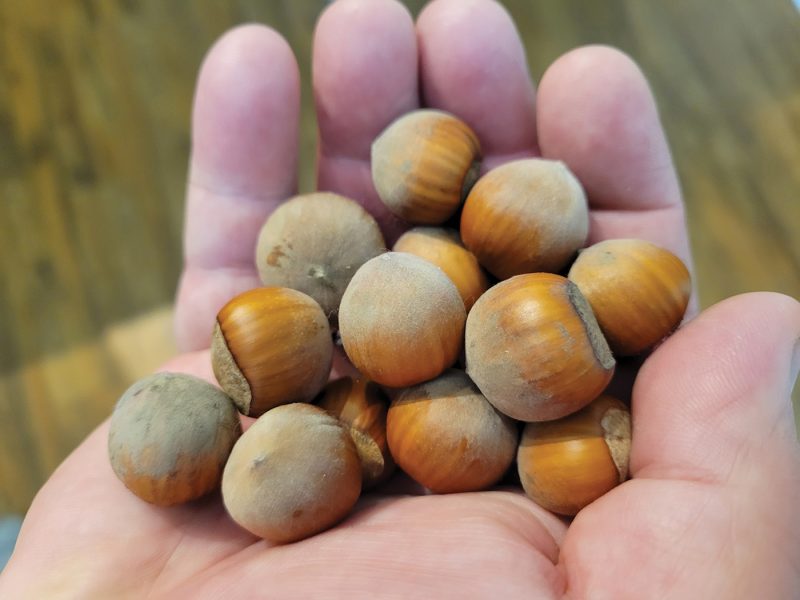
ERICKSON – Hazelnut production was the focus of a field day Kootenay and Boundary Farm Advisors organized September 30 at two Creston Valley farms.
Led by BC Hazelnut Growers Association president Zachary Fleming, approximately 15 participants from around the Kootenays saw both a fledgling planting barely two years old and an established farm in production for several years.
Fleming owns Pacific Coast Agriculture, which started growing hazelnut trees on 40 acres in Chilliwack in 2018. Pacific Coast began selling bare-root stock from its nursery in 2021.
As a grower, the past five years have been “a very fast learning curve” for Fleming; as an eater, they’re nothing new.
“I grew up with them in my backyard,” says Fleming. “Everybody had hazelnuts.”
The nuts were introduced to BC from Europe in the 1920s. Commercial hazelnut growing began in the 1950s and 1960s, with about 80% of production located in the Fraser Valley.
But the hazelnut industry could have a future in the Creston Valley. The newer trees at Baillie-Grohman Estate Winery in Erickson are promising. Guests toured a four-acre section that owners Wes Johnson and Myran Hagenfeldt found wasn’t suitable for grapes.
“This slope was not good for grapes,” says Johnson. “It holds the frost.”
Passing beautiful old hazelnut orchards during a visit to Oregon, the couple were impressed.
“[They] were amazing,” he recalls.
Inspiration struck, and in 2021 they planted 435 hazelnut trees with support from the BC Hazelnut Replant Program, which covered about half of the trees’ cost of $11.
Fleming said the program, now part of the Perennial Crop Replant Program, offers a good incentive to small producers wanting to diversify their crops, or processors wanting to develop a value-added product. It also offsets the cost of replacing older trees with newer cultivars that are more resistant to Eastern Filbert Blight and other diseases.
Both goals are the result of a severe decline in BC’s hazelnut industry, which was devastated by EFB in the early 2000s.
To combat the blight, orchards in Oregon were replanted with disease-resistant cultivars from the Oregon State University breeding program. For five decades, the program has selectively bred trees and then distributed them to growers and retailers, including Fleming.
BC’s average harvest peaked in 2006-2010 at more than a million pounds. It dropped to a low of 40,000 pounds as infected trees were removed and growers left the sector, but the replant program has supported a rebound. Between 2018 and 2023, 7,315 trees were removed from 62.5 acres and replaced by 67,777 trees on 338 acres, bringing the current harvest to almost 120,000 pounds annually.
While selling hazelnuts wholesale may seem attractive to new growers, it doesn’t always deliver the best returns. Nuts fetch up to $1.50 a pound wholesale, but can sell for more than $7 a pound direct to consumers.
“[The value] keeps snowballing further if you process them,” says Fleming.
When starting a hazelnut orchard, pollination is a key consideration. Specific varieties are required for effective crop set, with pollen typically wind-borne about 150 feet to surrounding trees.
At his nursery in Chilliwack, Fleming grows Jefferson, Wepster and Yamhill varieties, which can cross-pollinate.
Timing is important for a good match. Some varieties can completely miss another variety’s cycle, although that’s not a problem for Fleming.
“Some have no overlap,” he says. “In Chilliwack, they all overlap.”
The nuts mature at different times, primarily because the husks develop at different rates. Yamhill is the earliest and Jefferson the latest. Harvest occurs by knocking them off the branches, pulling them off with a vacuum backpack or by simply letting them fall to the ground – the latter a consideration when pruning the young trees.
“With a single stem, the nuts fall to the ground,” says Fleming. “With multi-stem, you get a nice crown, but the nuts get stuck in it.”
Scaffold branches create the bulk of the tree’s shape. Pruning to ensure three to five point away from the trunk in opposite directions is ideal. They can be easily changed early in the tree’s life, though.
“If you don’t like the scaffold you have, cut them all off and start over,” Fleming says. “They’re going to come back twice as fast next year.”
That said, buds develop in first-year wood, so some caution is also required to ensure that nuts will actually grow. Year four, he says, is the first year a harvest should be big enough to be economical.
“If you are pruning heavily, it will be a year or two before the nuts are back,” says Fleming. “It’s better earlier, so you don’t lose your yield. When you’re looking at a new orchard, you get three years to make mistakes.”
Hazelnuts trees are aggressive growers, so cutting the sapling to the ground and then allowing the best suckers to grow, likely faster than the tree did initially, is also an option.
“It’s as much an art as a science — what I’ll tell you for this tree, I might contradict,” Fleming tells the crowd, and then demonstrated both by selecting branches to develop one tree’s canopy and then simply cutting off a weaker sapling at the base.
After a couple of hours at Baillie-Grohman, the field day group moved on to Evan Davies’ farm.
A long-time Erickson resident, Davies previously ran a nursery and garden centre before moving to a farm with fruit trees and berries. He planted hazelnuts in 2016.
Most of his three dozen trees are over 20 feet tall, with about 60% of them Yamhill. There is nothing high-tech about his harvesting method.
“Everything just comes off by hand on this farm,” says Davies. “It’s just, at this point, how it’s done.”
The demand for hazelnuts is increasing, and considering the drop in BC production, there is room for smaller producers to fill the gap. New growers would also help to meet local need with local product. Currently, over 60% of the world’s hazelnuts are grown in Turkey, and 25% of the global crop is purchased by Ferrero, the company behind Nutella, Ferrero Rocher and Kinder Surprise.
In addition to being high in antioxidants and sequestering more carbon than annual crops, hazelnuts are a low-input crop that can even have other crops grown between the rows.
“They’re grown minimally, which is an awesome thing about this industry,” says Fleming.
And if those reasons aren’t convincing enough, the flavour will be.
“Hazelnuts taste delicious,” says Fleming. “That’s why I still work with them and love them.”
 BC FIRB gets a good egg