• Menu
  • Skip to primary navigation
  • Skip to main content
  • Skip to primary sidebar

Country Life In BC Logo

The agricultural news source in British Columbia since 1915

  • Headlines
  • Calendar
  • Subscribe
  • Advertise
  • About
  • Archives
  • Contact
  • Search
  • Headlines
  • Calendar
  • Subscribe
  • Advertise
  • About
  • Archives
  • Contact
  • Search

Primary Sidebar

Originally published:

NOVEMBER 2023
Vol. 109 Issue 11

Subscribe Now!

Sign up for free weekly FARM NEWS UPDATES

Loading form…

Your information will not be
shared or sold ever

Stories In This Edition

Ottawa delivers disaster support

Make ’em shine

Avian influenza returns

Okanagan egg producers eye expansion

Editorial: A sense of purpose

Back 40: Hayride reality is a head-shaker for visitors

Viewpoint: Narrow margins an industry-wide concern

Water license fight highlights need for change

Dairy producers not making from milk sales

Ag Briefs: Country Life in BC team wins national awards

Ag Briefs: BC farmland values flat

Ag Briefs: Poultry farm loses appeal

Letter: Thumbs up

Nursery sector pays tribute to Hedy Dyck

Beekeepers keep the emphasis on loal stock

Pollination blues discussed by beekeepers

Apple crop down, but quality up

KPU pursues year-round berry production

Record sale volumes shrink BC beef herd

Grizzly mitigation strategy in the works

Creston field day offers ‘bragging rights’

Sidebar: George Kepke Memorial Trophy honours farming history

Hazelnuts are an opportunity for Kootenay growers

Biocontrol for blight in blueberries promising

Aphids in cranberries under the microscope

Education program in Kootenays gets funding boost

Farm Story: Winter can’t come soon enough

BC pumpkins weigh in

Woodshed: Digger Dan(i) draws a winner in the water bet

Bursary open for journalism & ag related students

Jude’s Kitchen: Fresh bread tops the list of comfort food

More Headlines

Follow us on Facebook

Comments Box SVG iconsUsed for the like, share, comment, and reaction icons

2 hours ago

BC Supreme Court has blocked an attempt by remaining BC Tree Fruits Cooperative members to amend a rule that would have excluded former members from receiving their share of the co-op’s remaining assets. In her ruling, Justice Miriam Gropper called the bid to amend Rule 125, which would allow 32% of the surplus to be distributed among former members based on tonnage shipped to the co-op during its last six years of operation, “oppressive and unfairly prejudicial.” The co-op closed in July 2024, and remaining assets are estimated at between $12 and $15 million.

#BCAg
... See MoreSee Less

BC Supreme Court has blocked an attempt by remaining BC Tree Fruits Cooperative members to amend a rule that would have excluded former members from receiving their share of the co-op’s remaining assets. In her ruling, Justice Miriam Gropper called the bid to amend Rule 125, which would allow 32% of the surplus to be distributed among former members based on tonnage shipped to the co-op during its last six years of operation, “oppressive and unfairly prejudicial.” The co-op closed in July 2024, and remaining assets are estimated at between $12 and $15 million.

#BCAg
View Comments
  • Likes: 1
  • Shares: 3
  • Comments: 0

Comment on Facebook

1 day ago

From our Country Life in BC family to yours, HAPPY FAMILY DAY!

Photo by Liz Twan

#BCAg
... See MoreSee Less

From our Country Life in BC family to yours, HAPPY FAMILY DAY!

Photo by Liz Twan

#BCAg
View Comments
  • Likes: 10
  • Shares: 1
  • Comments: 1

Comment on Facebook

🥰🐮🩷

3 days ago

Full-time students employed in BC agriculture during the summer season are eligible to apply for a bursary of up to $3,000. The bursary, administered by the Investment Agriculture Foundation, aims to increase youth and domestic seasonal worker employment in the ag sector. Funding is awarded on a first-come, first-serve basis. More information is available at tinyurl.com/5ef6pe3m

#BCAg IAF
... See MoreSee Less

Full-time students employed in BC agriculture during the summer season are eligible to apply for a bursary of up to $3,000. The bursary, administered by the Investment Agriculture Foundation, aims to increase youth and domestic seasonal worker employment in the ag sector. Funding is awarded on a first-come, first-serve basis. More information is available at https://tinyurl.com/5ef6pe3m

#BCAg IAF
View Comments
  • Likes: 13
  • Shares: 11
  • Comments: 0

Comment on Facebook

4 days ago

BC fruit and vegetable farmers are being asked to share their views on farming technology in a 10-minute survey from Royal Roads University and the University of the Fraser Valley. The survey looks at how fruit and vegetable farmers are adopting emerging farming technologies -- such as digital tools, “controlled environment agriculture systems” (greenhouses) and agri-genomics (DNA analysis) -- to cope with changing climate conditions. The survey takes about 10 minutes to complete, and participants will be eligible to win an assortment of $50-$200 gift cards.

insights.kaianalytics.com/s3/PAS2026
... See MoreSee Less

BC fruit and vegetable farmers are being asked to share their views on farming technology in a 10-minute survey from Royal Roads University and the University of the Fraser Valley. The survey looks at how fruit and vegetable farmers are adopting emerging farming technologies -- such as digital tools, “controlled environment agriculture systems” (greenhouses) and agri-genomics (DNA analysis) -- to cope with changing climate conditions. The survey takes about 10 minutes to complete, and participants will be eligible to win an assortment of $50-$200 gift cards. 

https://insights.kaianalytics.com/s3/PAS2026
View Comments
  • Likes: 5
  • Shares: 1
  • Comments: 0

Comment on Facebook

4 days ago

The District of Coldstream is proposing the creation of farm property tax subclasses to distinguish between small-scale and large-scale farm operations. Currently, all farms are classified as Class 9 regardless of size or infrastructure needs. The district argues larger farms require more municipal services and should be taxed accordingly. It plans to pitch its proposal at the Southern Interior Local Government Association convention in Revelstoke at the end of April. Support there could escalate the discussion to the Union of BC Municipalities convention next September in Vancouver.

#BCAg
... See MoreSee Less

The District of Coldstream is proposing the creation of farm property tax subclasses to distinguish between small-scale and large-scale farm operations. Currently, all farms are classified as Class 9 regardless of size or infrastructure needs. The district argues larger farms require more municipal services and should be taxed accordingly. It plans to pitch its proposal at the  Southern Interior Local Government Association convention in Revelstoke at the end of April. Support there could escalate the discussion to the Union of BC Municipalities convention next September in Vancouver. 

#BCAg
View Comments
  • Likes: 12
  • Shares: 2
  • Comments: 11

Comment on Facebook

Which municipal services do they require more of? Even larger farms typically still have only one or possibly two dwellings. Most have their own well and septic, and I suppose it depends on location, but most rural properties don't have garbage pick up either. And whether 20 driveways or one join the road, the cost to plow that road is the same. I no longer live within a municipality so of course there could be costs I've overlooked that are contributing to the District's proposal.

Large farms put more back into the community too.

The larger farms are the only farms paying wages, allowing people to spend money in their communities, the beauty of a network of small business. Small farms more often then not, is a single transaction, a hobby. Large- buy feed, raise cow, calf is born, sell calf, pay wage(support livlihoods), buy fence posts, buy more feed and so forth. Feeding the community. Small- Buy feed, raise cow, kill cow, eat cow.

And this is why farmers left California. British Columbia is no different

I am not sure how to post the actual Resolution that Council Pat Cochrane put forward but here is the link to the special meeting they are holding to pass the resolution: www.coldstream.ca/government-bylaws/news-alerts/notice-special-council-meeting-3.

Why not find ways to bring in more business's and audit municipal spending and regulate short term rentals (because Coldstream has essentially zero places to stay technically, insane) instead of raising taxes arbitrarily because "bigger costs more"

Attending that meeting, they claimed that “large farms” use more municipal services, yet Cochrane consistently stated he was going after “smaller estate properties not actively farming.” This is not only contradictory but misinformed. It would take him but three door knocks before he learned that the “estate farms” not actively farming are typically leased to a larger conglomerate to maintain farm classification. “Rural living at its finest,” though it seems not a soul on council is well-versed in this wheelhouse. What’s worse is that they somehow don’t think it’s necessary to bring in a single subject expert before blindly tossing around recommendations and solutions to problems that don’t really exist—or at least not as they perceive them. Don’t get me started on their rhetoric comparing the value of class 9 properties to other residential classes, when even my 12 year old understands that the values are drastically different when one property can be subdivided, and an ALR property cannot. Forever to the left of the point.

They want to tax a large farm more? Do people realize that farmers aren't becoming rich. Also, a small or hobby farm isn't contributing much to the local economy or community. This doesn't make sense. If we don't support our farmers. We need them. We can't import all our food.

What bs. I can't do a water and sewer hook up for an agricultural building, (a farm vegie stand) on a 160 acre farm in downtown Kelowna because there is already one at the far end of the lot for the principal residence. What extra infrastructure would they be talking about. Our irrigation is by licensed ground water well put in, powered and serviced by me. Any change in tax code should be on farm estates that do bogus farm gate sales at the minimum requirement, not viable commercial farming enterprizes that employ and contribute economic benefits to so many other businesses

Instead of increasing property taxes on large farms, I think governments need to revise the threshold needed for a property to qualify for farm status. That threshold has not changed in over 20 years and many non farmers are taking advantage of the ridiculously low threshold that was intended for real farmers.

And then you tax the farmers more and wonder why food prices keep going up. Why is it that the only thing government does is find more reasons and ways to tax people?

View more comments

Subscribe | Advertise

The agricultural news source in British Columbia since 1915
  • Email
  • Facebook

Hazelnuts are an opportunity for Kootenay growers

Erickson growers showcase the development of their trees

| MYRNA STARK LEADER PHOTO

November 1, 2023 byBrian Lawrence

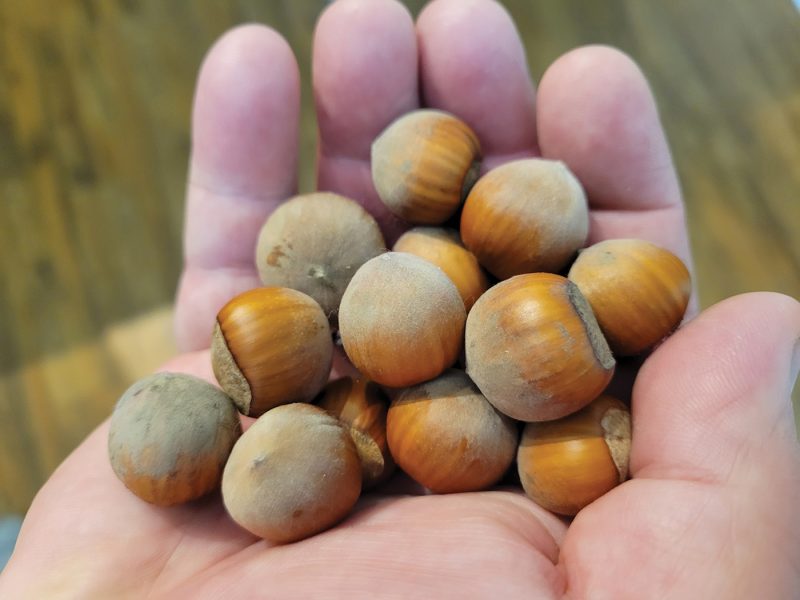
ERICKSON – Hazelnut production was the focus of a field day Kootenay and Boundary Farm Advisors organized September 30 at two Creston Valley farms.

Led by BC Hazelnut Growers Association president Zachary Fleming, approximately 15 participants from around the Kootenays saw both a fledgling planting barely two years old and an established farm in production for several years.

Fleming owns Pacific Coast Agriculture, which started growing hazelnut trees on 40 acres in Chilliwack in 2018. Pacific Coast began selling bare-root stock from its nursery in 2021.

As a grower, the past five years have been “a very fast learning curve” for Fleming; as an eater, they’re nothing new.

“I grew up with them in my backyard,” says Fleming. “Everybody had hazelnuts.”

The nuts were introduced to BC from Europe in the 1920s. Commercial hazelnut growing began in the 1950s and 1960s, with about 80% of production located in the Fraser Valley.

But the hazelnut industry could have a future in the Creston Valley. The newer trees at Baillie-Grohman Estate Winery in Erickson are promising. Guests toured a four-acre section that owners Wes Johnson and Myran Hagenfeldt found wasn’t suitable for grapes.

“This slope was not good for grapes,” says Johnson. “It holds the frost.”

Passing beautiful old hazelnut orchards during a visit to Oregon, the couple were impressed.

“[They] were amazing,” he recalls.

Inspiration struck, and in 2021 they planted 435 hazelnut trees with support from the BC Hazelnut Replant Program, which covered about half of the trees’ cost of $11.

Fleming said the program, now part of the Perennial Crop Replant Program, offers a good incentive to small producers wanting to diversify their crops, or processors wanting to develop a value-added product. It also offsets the cost of replacing older trees with newer cultivars that are more resistant to Eastern Filbert Blight and other diseases.

Both goals are the result of a severe decline in BC’s hazelnut industry, which was devastated by EFB in the early 2000s.

To combat the blight, orchards in Oregon were replanted with disease-resistant cultivars from the Oregon State University breeding program. For five decades, the program has selectively bred trees and then distributed them to growers and retailers, including Fleming.

BC’s average harvest peaked in 2006-2010 at more than a million pounds. It dropped to a low of 40,000 pounds as infected trees were removed and growers left the sector, but the replant program has supported a rebound. Between 2018 and 2023, 7,315 trees were removed from 62.5 acres and replaced by 67,777 trees on 338 acres, bringing the current harvest to almost 120,000 pounds annually.

While selling hazelnuts wholesale may seem attractive to new growers, it doesn’t always deliver the best returns. Nuts fetch up to $1.50 a pound wholesale, but can sell for more than $7 a pound direct to consumers.

“[The value] keeps snowballing further if you process them,” says Fleming.

When starting a hazelnut orchard, pollination is a key consideration. Specific varieties are required for effective crop set, with pollen typically wind-borne about 150 feet to surrounding trees.

At his nursery in Chilliwack, Fleming grows Jefferson, Wepster and Yamhill varieties, which can cross-pollinate.

Timing is important for a good match. Some varieties can completely miss another variety’s cycle, although that’s not a problem for Fleming.

“Some have no overlap,” he says. “In Chilliwack, they all overlap.”

The nuts mature at different times, primarily because the husks develop at different rates. Yamhill is the earliest and Jefferson the latest. Harvest occurs by knocking them off the branches, pulling them off with a vacuum backpack or by simply letting them fall to the ground – the latter a consideration when pruning the young trees.

“With a single stem, the nuts fall to the ground,” says Fleming. “With multi-stem, you get a nice crown, but the nuts get stuck in it.”

Scaffold branches create the bulk of the tree’s shape. Pruning to ensure three to five point away from the trunk in opposite directions is ideal. They can be easily changed early in the tree’s life, though.

“If you don’t like the scaffold you have, cut them all off and start over,” Fleming says. “They’re going to come back twice as fast next year.”

That said, buds develop in first-year wood, so some caution is also required to ensure that nuts will actually grow. Year four, he says, is the first year a harvest should be big enough to be economical.

“If you are pruning heavily, it will be a year or two before the nuts are back,” says Fleming. “It’s better earlier, so you don’t lose your yield. When you’re looking at a new orchard, you get three years to make mistakes.”

Hazelnuts trees are aggressive growers, so cutting the sapling to the ground and then allowing the best suckers to grow, likely faster than the tree did initially, is also an option.

“It’s as much an art as a science — what I’ll tell you for this tree, I might contradict,” Fleming tells the crowd, and then demonstrated both by selecting branches to develop one tree’s canopy and then simply cutting off a weaker sapling at the base.

After a couple of hours at Baillie-Grohman, the field day group moved on to Evan Davies’ farm.

A long-time Erickson resident, Davies previously ran a nursery and garden centre before moving to a farm with fruit trees and berries. He planted hazelnuts in 2016.

Most of his three dozen trees are over 20 feet tall, with about 60% of them Yamhill. There is nothing high-tech about his harvesting method.

“Everything just comes off by hand on this farm,” says Davies. “It’s just, at this point, how it’s done.”

The demand for hazelnuts is increasing, and considering the drop in BC production, there is room for smaller producers to fill the gap. New growers would also help to meet local need with local product. Currently, over 60% of the world’s hazelnuts are grown in Turkey, and 25% of the global crop is purchased by Ferrero, the company behind Nutella, Ferrero Rocher and Kinder Surprise.

In addition to being high in antioxidants and sequestering more carbon than annual crops, hazelnuts are a low-input crop that can even have other crops grown between the rows.

“They’re grown minimally, which is an awesome thing about this industry,” says Fleming.

And if those reasons aren’t convincing enough, the flavour will be.

“Hazelnuts taste delicious,” says Fleming. “That’s why I still work with them and love them.”


Related Posts

You may be interested in these posts from the same category.

Previous Post: « BC FIRB gets a good egg
Next Post: Cherry growers weigh trade complaint »

Copyright © 2026 Country Life in BC · All Rights Reserved