
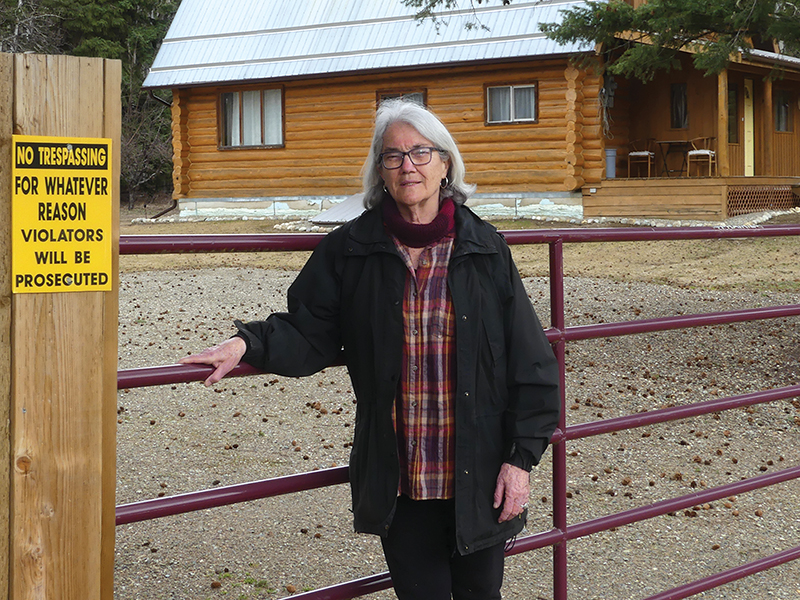
DUNSTER – Purchases of swathes of farmland in the Robson Valley by wealthy American businessmen have some in BC demanding restrictions on foreign and corporate ownership of agricultural land.
The issue centres on the small, remote community of Dunster, where Fraser River Landholdings Ltd. has purchased approximately 3,850 acres – much of it agricultural land – since the late 2000s.
The company is co-directed by Mark Walter and Robert “Bobby” Patton Jr., both successful US businessmen.
Walter is CEO of Guggenheim Partners, a global financial management firm which handles more than $350 billion in assets. Patton is a Texas investor with holdings in oil, real estate and ranching.
Loretta Simpson is a long-time resident of the valley and president of the Dunster Community Association. She says her community is struggling to attract new residents.
“The main concern is no new people are moving in because the corporate interests are buying up the farms,” she says.
Parcel by parcel, Fraser River Landholdings has accumulated acreages in the Dunster area, and many of these lots now have gates and “no trespassing” signs.
Nancy Taylor, also a long-time resident and a member of the Dunster Community Association, came to the valley as part of a “migration of back-to-the-land people” in 1974.
Taylor says her community has seen intense population decline, much of which she attributes to the land buy-up.
“The population has decreased by a third to a half … it’s noticeable,” she says.
Dunster Community Association members have set up a steering committee to study the issue of land use and push for policy solutions that can be implemented province-wide.
Taylor says the committee aims to connect with other BC communities dealing with corporate and foreign land buy-ups, because the small community of Dunster is facing a “David and Goliath” situation it cannot overcome by itself.
Taylor points to Quebec’s recent crackdown on non-resident farmland buyers as a potential strategy to “make farmland accessible to young families.”
Bill 86, “an Act to ensure the long-term preservation and vitality of agricultural land,” was passed in March 2025 and introduced a slate of new measures limiting the ability of non-Quebec residents, non-farm operations and investment firms to buy farmland.
The bill also gives municipalities the power to impose a tax on “workable but unworked agricultural land.”
Vince Lorenz and his son, Troy Lorenz, handle land purchases for Fraser River Landholdings.
Vince, a long-time resident of the valley, is also a guide outfitter for Fraser River Partners, a company that arranges hunting and wildlife viewing opportunities on Fraser River Landholdings’ properties.
The outfitting company is also co-directed by Mark Walter and Robert Patton Jr., and Lorenz says both men make yearly visits to the Dunster area, bringing friends along.
He disputes the idea that the American businessmen are squeezing potential buyers out of the valley.
“They’ve all been for sale … nobody else has put an offer in, and I don’t outbid nobody. Most of the properties have been sitting, and nobody can afford them,” he argues.
He also disagrees with the claim put forward by Fraser River Landholdings’ local critics that little farming is done on the nearly 4,000 acres now owned by the businessmen.
He says agricultural activity still takes place, noting as an example that hay is sold to locals, while other hay is grown and put out as bait for elk.
“We put the hay bales out for the elk, and there’s no law against that,” he says. “We break no laws.”
As for the idea of restricting foreign and corporate farmland purchases in BC, Lorenz isn’t worried.
“If they want to do it, go ahead. It wouldn’t bother us; we’re not buying much more,” he says.
Ownership restrictions
Dannielle Alan, director for Electoral Area H of the Regional District of Fraser-Fort George, says ownership restrictions are needed to preserve the “huge potential for agriculture” in north-central BC, which she argues could become a breadbasket and guarantor of food security as the climate warms.
Alan says she has tried to raise the Dunster land buy-up with the province, to no avail.
“We’ve put this before minister after minister after minister for decades, and nothing is done … the moneyed interests are speaking louder than communities,” Alan says.
Rosalyn Bird, BC Conservative MLA for Prince-George Valemount, says the land buy-up is pushing “young Canadian farmers” out of the Robson Valley.
Bird draws a clear distinction between immigrants who move to Canada to farm, which she supports, and “large US conglomerates purchasing large chunks of land.”
She sees a glaring omission in the federal ban on non-Canadians buying houses.
“Currently, in Canada, foreigners can’t buy residential property, but farms, because they fall under ALR, they don’t fall under that designation – and I don’t know why, when we should actually be protecting Canadian farmland,” she says.
More oversight needed
Delta South MLA Ian Paton, agriculture critic for the provincial Conservatives, says there needs to be “more oversight of agricultural land that is being purchased.”
Paton says he will be pressing BC agriculture minister Lana Popham on the province’s inaction on the issue of farmland being bought for non-agricultural purposes.
He sees a contradiction in the BC NDP boasting of their crackdown on empty homes, while not acting on “empty farmland.”
“The BC government, the NDP, are so proud of themselves because they brought in the empty home tax … if they want to start running around taxing people for not making use of their homes all year round, maybe there should be some kind of an empty farmland tax as well,” says Paton.
In 2023, Premier David Eby floated the idea of creating a tax for underused farmland in the ALR, modelled on the speculation and vacancy tax BC levies on underused housing, but this concept has not become a reality.
In response to an inquiry from Country Life in BC on the Dunster land buy-up controversy, BC agriculture minister Lana Popham says she is “strongly committed to protecting farmland and supporting farming in the Agricultural Land Reserve”.
“We share the concerns around land use and affordability in the ALR and have been clear in our belief that land in the ALR should be used for farming as it remains the foundation of our province’s food security,” says Popham.
Global phenomenon
For David Connell, a professor at the University of Northern British Columbia whose interests include agriculture and local food systems, the situation in Dunster is an example of a global phenomenon of “financialization” and “speculative ownership” of farmland.
Connell says the buy-up of farmland for non-agricultural purposes drives up land prices and fuels “rural decline.”
He says BC has a strong approach to “land use” regulations, but notes it lacks limits on foreign or corporate farmland purchases.
Connell points to Quebec’s robust new farmland protection legislation as a model that BC can take as a “point of reference.”
“The first thing that BC can learn is that it’s possible – some other province has exercised that political will,” he says.
All content on this website is copyrighted, and cannot be republished or reproduced without permission.
 Dry start to wildfire season