
• Menu
  • Skip to primary navigation
  • Skip to main content
  • Skip to primary sidebar

Country Life In BC Logo

The agricultural news source in British Columbia since 1915

  • Headlines
  • Calendar
  • Subscribe
  • Advertise
  • About
  • Archives
  • Contact
  • Search
  • Headlines
  • Calendar
  • Subscribe
  • Advertise
  • About
  • Archives
  • Contact
  • Search

Primary Sidebar

Originally published:

AUGUST 2023
Vol. 109 Issue 8

Subscribe Now!

Sign up for free weekly FARM NEWS UPDATES

Loading form…

Your information will not be
shared or sold ever

Stories In This Edition

Lettuce Grow!

Turning off the taps

Drought threatens feed supply

Fire, drought and now grasshoppers

Editorial: Public service

Back 40: Food democracy will decide relavance of ALR

Viewpoint: Reconciliation is more than just a land deal

Peace Region land-sharing proposal nixed

Sinkholes blamed on Fraser Valley pipeline work

Ag Briefs: BC Ferries steps up protocols for hay shipments

Ag Briefs: Bird processing goes mobile

Ag Briefs: Penticton agriculture committee fails

Huge cherry crop sparks dumping allegations

Soil, leaf testing key to gauging nutrient needs

Drought prompts cattle sell0ff

Urban farm almost shut down by noise complaint

Watchdog call for overhaul of fire management

CYL semi-finalists share positive outlook

Grain producers share experience during field day

Range management showcased on tour

Prescribed burns improve range health

Sheep breeders flock to BC for national show

Farmers look to fill wool processing gap

Smart tools point a way to more efficient weeding

Farm Story: Doing the “right” thing comes at a price

Island couple future-proof new farm operation

Instrumental insemination boosts bee vigour

Growing opportunities for fellow farms

Partnerships underpin success of Langley stewardship program

Woodshed Chronicles: Gladdie reminisces about long-ago truth or dare

Christmas tree growers look to scale up local

Jude’s Kitchen: Patio fare for the lazy days of summer

All content on this website is copyrighted, and cannot be republished or reproduced without permission.

More Headlines

Follow us on Facebook

Comments Box SVG iconsUsed for the like, share, comment, and reaction icons

15 hours ago

A Maple Ridge dairy producer has been fined $7,512, had his licence suspended for three months, and faces quota restrictions for two years after an undercover investigation confirmed raw milk was sold directly from the farm on three separate occasions.

#BCAg
... See MoreSee Less

Link thumbnail

Maple Ridge farm fined for raw milk sales

www.countrylifeinbc.com

Raw milk remains off the table for dairy producers, with the BC Milk Marketing Board (BCMMB) taking action against a Maple Ridge producer for illicit sales. An undercover investigation of Maple Ridge...
View Comments
  • Likes: 13
  • Shares: 12
  • Comments: 24

Comment on Facebook

Unpasteurized milk is sold in Europe. It's the only milk certain cheeses can be made from.

A person can shoot up government drugs in a playground but milk is the issue. 🙄

leave him the hell alone! if someone wants to buy raw milk at their own risk, let them. At least they can see where the milk came from

Europeans used raw milk to make cheese for millenia, the farmer should sue them back on cultural grounds and a charter violation.

Some comments seem to be missing the point of the article. NO ONE was sick from the milk. It’s all about money. “By selling milk outside the regulated system, where revenues are pooled, the board claimed Stuyt had cost producers as a whole $195,185 and ordered him to repay this amount. It also ordered Stuyt to pay $33,266 to cover the cost of BCMMB’s investigation and hearings into the matter. The BC Dairy Association, which stood as an intervenor in the appeal before FIRB, said illicit raw milk sales are a direct threat to supply management.”

Yes we are NOT a capitalist economy in Canada

Rediculous

Raised my three daughters on raw milk. Made butter, yogurt, cheese. Farmer told me if they went over their quota, they were fined. They either fed it to new calf’s or had to dump it.

Government control at its finest .

🐀

Probably in the same situation as the rest of the farmers in BC too much milk can’t ship it swap too high so next option I guess is that I guess

to much government control!

Even more government control 😡 We need to remind them that they work for us!

When will people wake up to the fact that that Health Canada doesn’t care about our health? They only care about profiteering off our bad health..

Corrupt government

Good grief. Don’t inspectors have better things to do?

Wow 😒😒

Ridiculous

Why can’t we let the consumer decide the risk? Alcohol, and safe injection sites are legal. But not raw milk, they don’t want us to have it because it’s a super food.

Such bullshit. Corruption

Have you been inside a dairy barn Go lick the floor then drink the raw milk Cuz that’s what’s your doing Y’all need to give ur head a shake

What a travesty. We are Adults told by corrupt bribed morons, what we should eat or drink. But it is ok for taxpayers to pay for "safe" injection sites and killing unborn children, and child mutilation!!

How pathetic

What a waste of time and money.

View more comments

3 days ago

A draft update to the Code of Practice for the Care and Handling of Beef Cattle is now open for public comment until June 12. The code, one of 14 animal care codes developed and maintained by the National Farm Animal Care Council, is undergoing a routine 10-year review. "Your feedback will help shape the industry's guide to cattle welfare for the next decade," says Canadian Cattle Association policy manager Jessica Radau, urging producers to weigh in. For more information, visit tinyurl.com/58a3u9fz.

#BCAg
... See MoreSee Less

A draft update to the Code of Practice for the Care and Handling of Beef Cattle is now open for public comment until June 12. The code, one of 14 animal care codes developed and maintained by the National Farm Animal Care Council, is undergoing a routine 10-year review.  Your feedback will help shape the industrys guide to cattle welfare for the next decade, says Canadian Cattle Association policy manager Jessica Radau, urging producers to weigh in. For more information, visit https://tinyurl.com/58a3u9fz.

#BCAg
View Comments
  • Likes: 4
  • Shares: 2
  • Comments: 1

Comment on Facebook

I sat in the webinar yesterday by the Canadian Cattle Association. My initial concern was that this would be another "play" into the government's hands. It has been worked on by people that are actually in the Beef industry from Cow calf to feedlot. The thrust is an update of the 2013 Code of Practice which was reviewed in 2018. The changes are more a move from "left to the producers discretion" to clearer directions regarding pain management, proper transport of animals which are impaired and keeping cattle in in good condition. Much of what is recommended is what producers who care about animal husbandry already do. The important part is to GIVE THEM FEEDBACK good, bad or otherwise. The document is about 60 pages long, and I ran it through CHAT to see what had been changed. It is important to understand that the PUBLIC is invited to comment on the draft not just producers. Think about it... do you really want the public influencing how you manage your cattle. If you think that this is just one of those things, I have been following Bill 22 in Alberta which will grant the SPCA a proactive roll in entering farms and checking on animals. When I asked CHAT how the new bill relates to the Cattle Code, it came back that the Code although not a regulation will be able to be used as a guide by producers for backup in dealing with the SPCA regarding cattle conditions, sick animal handling etc. Take the time.... Go onto the Canadian Cattle Association website and speak to those parts that you wish to input.

4 days ago

According to the BC River Forecast Centre, the Okanagan snowpack stood at just 58% of normal on April 1 — the lowest reading since measurements began in 1980 — raising concerns about drought conditions in the region this summer. The rest of the province sits at 92% of normal.

#BCAg
... See MoreSee Less

According to the BC River Forecast Centre, the Okanagan snowpack stood at just 58% of normal on April 1 — the lowest reading since measurements began in 1980 — raising concerns about drought conditions in the region this summer. The rest of the province sits at 92% of normal.

#BCAg
View Comments
  • Likes: 3
  • Shares: 0
  • Comments: 0

Comment on Facebook

5 days ago

At her first AGM as executive director of BC Meats, held Saturday in Abbotsford, Jennifer Busmann spoke about her strong ties to agriculture and her optimism for the organization's future. Busmann has cattle of her own and came to the role with existing relationships with members and the board of directors that helped her feel integrated from the start. She stepped into the position in Februa#BCAg#BCAg ... See MoreSee Less

At her first AGM as executive director of BC Meats, held Saturday in Abbotsford, Jennifer Busmann spoke about her strong ties to agriculture and her optimism for the organizations future. Busmann has cattle of her own and came to the role with existing relationships with members and the board of directors that helped her feel integrated from the start. She stepped into the position in February.

#BCAg
View Comments
  • Likes: 6
  • Shares: 0
  • Comments: 0

Comment on Facebook

7 days ago

Shannon Wiggins of Headwind Farm in North Saanich is this year's Mary Forstbauer Grant recipient from the BC Association of Farmers Markets. The $500 grant will help Wiggins expand her plot at Sandown Centre for Regenerative Agriculture, growing more storage crops to extend her harvest season. Wiggins credits farmers markets with inspiring her own farming journey and commitment to building community through food. Congratulations!

tinyurl.com/45bdd#BCAg#BCAg
... See MoreSee Less

Shannon Wiggins of Headwind Farm in North Saanich is this years Mary Forstbauer Grant recipient from the BC Association of Farmers Markets. The $500 grant will help Wiggins expand her plot at Sandown Centre for Regenerative Agriculture, growing more storage crops to extend her harvest season. Wiggins credits farmers markets with inspiring her own farming journey and commitment to building community through food. Congratulations!

https://tinyurl.com/45bddtw8

#BCAg
View Comments
  • Likes: 50
  • Shares: 2
  • Comments: 3

Comment on Facebook

Wahoo! Congrats Shannon! I love your produce. Can’t wait for the radishes 🫜

Congratulations!

Well done!! 🩷🩷🩷

Subscribe | Advertise

The agricultural news source in British Columbia since 1915
  • Email
  • Facebook

Island couple future-proof new farm operation

Land costs and water scarcity drove business decisions

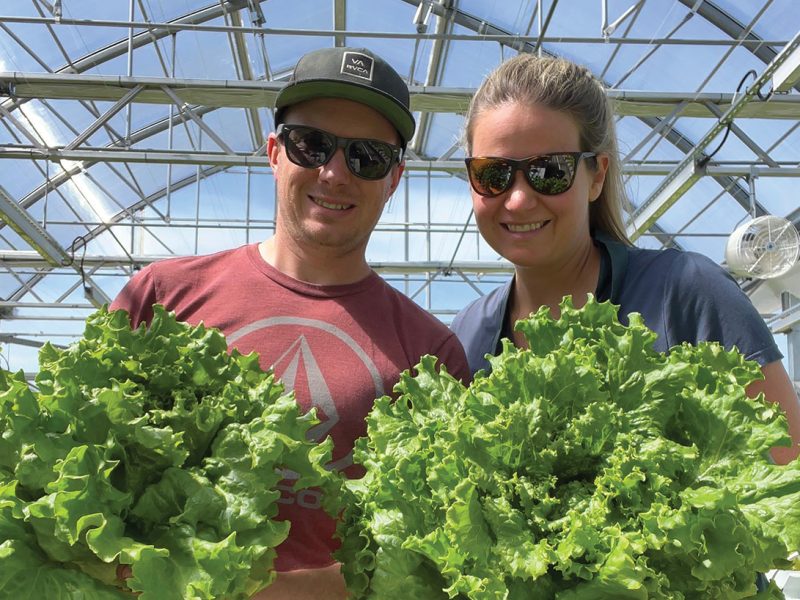
Matt and Selena Lawrence know two heads are better than one in life and in business as they work to establish a hydroponic greenhouse in Cumberland producing four types of lettuce. The small-scale operation was ideal for the growing family, and makes efficient use of water resources to produce 2,000 heads of lettuce a week. Read their story on page 29. FOREST VALLEY ACRES

August 2, 2023 byKate Ayers

COURTENAY – First generation farmers Matt and Selena Lawrence knew they wanted an acreage and to raise their family on a farm, but securing land and water for a large-scale operation in the Comox Valley was not in the cards.

However, after creating a viable farm business model, the couple were able to secure a mortgage and loan to buy a five-acre property in Courtenay and construct a hydroponic lettuce facility.

“Land is very expensive up here,” Selena says. “We thought, what can we farm small-scale that is sustainable if we can only afford up to five acres of land? We couldn’t have these massive cornfields and you know, water is very scarce on the Island. … So, we decided a greenhouse was going to be our best bet.”

The couple bought the property in June 2022, incorporated their business as Forest Valley Acres and ordered a greenhouse from Harnois Industries in Quebec. Delivered with instructions, greenhouse assembly was more of a challenge than Matt, a Red Seal carpenter, expected – even with his father’s help.

“Coming from working with wood as a carpenter to putting up the steel infrastructure frame with polycarbonate was definitely a challenge,” he says. “It probably took us twice the amount of time that we had budgeted. We had budgeted maybe three months but then the snow came, and we didn’t have that roof on.”

The unfinished building sustained some damage during a late November snowstorm, but once cleaned up, the gas fitters and electrical contractors were able to complete installing the building systems and commission the facility.

“There’s a thermometer, humidity sensor, sheet screens, fans and a cooling system and heater,” Lawrence says. “It stays between 21°C and 24°C at all times all through the year.”

With some help from Matt’s parents, the couple now manage a fully operational Nutrient Film Technique hydroponic system in which nutrient-rich water continuously flows down the channels past exposed plant roots. Any unused solution is captured at the end of each channel, returned to the reservoir, remixed for nutrient balance and recirculated to the plants.

The system recycles up to 95% of the water, Lawrence says. The plants consume about 100 gallons of water per day, which is replaced by their service well. It has been able to keep up with the daily demand so far, but the couple are considering alternatives as drought conditions persist on Vancouver Island.

One option is to buy municipal water from the Comox Valley Regional District at $1.50 per 400 gallons and truck it back to the farm. The other option is to dig a deeper well, but Lawrence says that’s a $20,000 project.

Now that their facility is up and running, the couple hope they can get an environmental farm plan audit and apply for some funding or grants to help cover the cost of a new well.

On June 27, the BC Ministry of Agriculture and Food announced the $20-million Agricultural Water Infrastructure program that will be administered by the Investment Agriculture Foundation of BC over the next three years. The program consists of three funding streams that support the improvement of water storage and delivery systems and agricultural water supply assessments, engineering studies or plans.

Water scarcity a limiting factor

Carmen Wakeling, owner of Eatmore Sprouts and Greens in Courtenay, says water scarcity is a significant limiting factor on regional production.

Each week, Eatmore produces about 10,000 pounds of sprouts, which are 99% water. This means a significant volume is regularly removed from the farm.

One of the main reasons Carmen and her husband bought their property was because it has two very deep wells that draw from the Quadra sand aquifer.

“The aquifer actually takes quite a long time to empty and recharge so probably the impact to us is about a six-month time from when we have an extreme weather event,” Wakeling says. “We’re really lucky because we have wells here so we can actually go online and see the wells on a regular basis and access all that information.”

The data allows Wakeling to plan half a year ahead if they experience drought conditions. She also has a drought plan and staged approach as to what they would do as a business if water access became restricted.

“We’re not being impacted this second, but we’re certainly paying attention and we certainly know that we could be.”

Patience

At Forest Valley Acres, April marked the start of the couple’s first growing season. They planted their first seeds on Easter, passed the CanadaGAP food safe certification in May and harvested their first plants on June 1.

In July, the couple were selling their lettuce at mid-Island Quality Foods, Thrifty Foods, the Real Canadian Superstore and their farm stand, with logistical support from Vancouver Island Farm Products Inc. From farm to grocery store should only be about 48 hours, Lawrence says, which together with having the lettuce’s live root ball attached extends its shelf life.

Forest Valley Acres currently supplies four varieties: green leaf, red leaf, green and red butter lettuce with seeds sourced from West Coast Seeds and Stokes Seeds in Ontario.

In their first month of production, patience was the biggest lesson learned, Lawrence says.

“We expected the sales to be there right away. … We hit the market when it was lettuce-growing season for everyone,” Lawrence says. “Our germination rates and our crop loss percentages are not exactly where we want them to be because we’re kind of still learning. We’re experimenting with seeds. We’re switching delivery companies to have better distribution.”

Despite the steep learning curve and evolving logistics, the couple are still providing products for local residents. Other destinations for their lettuce include local schools and Comox Valley Food Bank. Lawrence provides elementary students with fresh greens through the Salad Bar program.

“We were having some product that didn’t quite make the requirements for the grocery stores but was still like a very fine product, very edible. … And I tried to figure out how to kind of get rid of that product and be able to provide somebody with lettuce instead of just having it in our little farm stand,” Lawrence says. “It warms my heart as a mom being able to help these kids get some really fresh, local, clean produce.”

As they continue to refine their production techniques, the couple’s goal is to grow between 1,800 and 2,300 heads of lettuce per week. Right now, they can harvest about 2,000 plants over two days each week. They have a storage cooler on site that can hold about 4,800 heads of lettuce.

Moving forward, the couple eye consistency and expansion.

“Where we placed the greenhouse on the property, we could have up to four greenhouses. They’re a gutter-connect greenhouse, so you actually connect them side by side,” Lawrence says. “I would say the next five-year plan would be to add another greenhouse, whether it’s going to be lettuce or a different product in that greenhouse expansion is definitely in the works.”

However, the expansion will have to wait until Lawrence has a bit more time as her hands are now full with two boys under the age of four and another child due in September.

All content on this website is copyrighted, and cannot be republished or reproduced without permission.

Related Posts

You may be interested in these posts from the same category.

Previous Post: « Oat, wheat harvests down
Next Post: Water curtailments squeeze forage production »

© 2026 COUNTRY LIFE IN BC - ALL RIGHTS RESERVED