
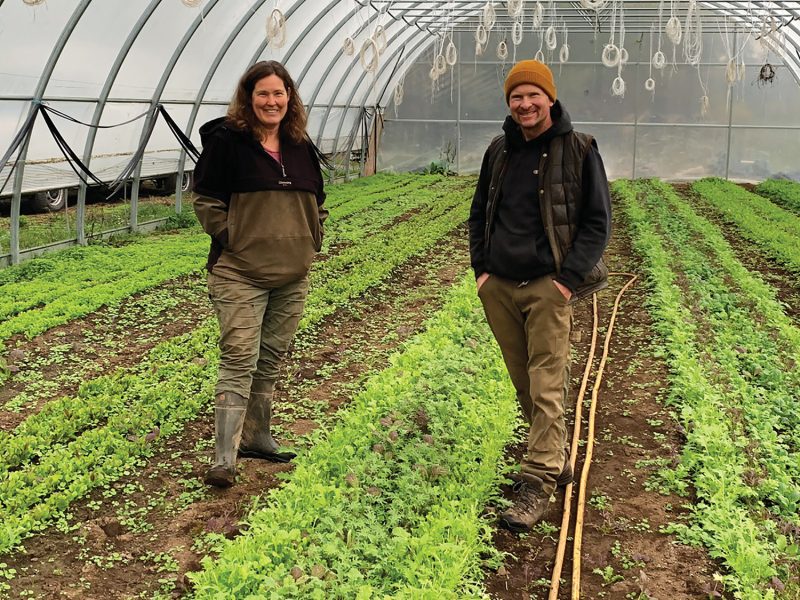
METCHOSIN – Long hours of hard work, years of experience and a ready local market will not guarantee success in vegetable farming on southern Vancouver island without stable, long-term land tenure.
“I was tired of leasing land. I’d been doing it for years and it felt like it could all be torn away so quickly,” says veteran market gardener Robin Tunnicliffe. “Often, it was just a year-long lease and there was no point in investing in perennial crops or infrastructure if I wasn’t going to be there the next year.”
It took the passion and legacy of a long-time Metchosin farmer to ensure that Tunnicliffe and her partner Sasha Kubicek could own land and run a successful farming business.
“Bob Mitchell was a well-known figure in the local farming community,” recalls Tunnicliffe.
Residents remember him hauling truckloads of seaweed from local beaches or the stench of the manure piles that helped build his soil. He served on the Metchosin council and the local agriculture committee.
“He was committed to local agriculture and he firmly believed that farmland should be farmed, not sit idle in the shadow of a large house,” she says.
In 2010, Tunnicliffe and her partners in Saanich Organics, Rachel Fisher and Heather Stretch, wrote All the Dirt: Reflections on Organic Farming.
“Bob read our book in 2012 and basically head-hunted me and Sasha to come and run Sea Bluff Farm,” Tunnicliffe recalls. “He told me during my first interview that if we did a good job at managing, the farm would be ours. But I didn’t really believe him.”
Kubicek, an accountant, put together a detailed business plan and budget and the couple agreed to move onto Sea Bluff Farm.
“We work about eight of the 10 acres of land, and we have a lease plot just up the road where we grow our warm summer crops,” Tunnicliffe says. “The soil is excellent from all the work Bob has done. “There is lots of water and pipes to the whole area and there were outbuildings, a tractor and other equipment.”
Mitchell was very keen to support the couple in making the farm a success.
“He really wanted the farm to thrive, and when I asked him for something, he would deliver,” says Tunnicliffe.
That included building a dedicated wash station on a cement pad, installing coolers and helping with hoop houses.
“I think it was one of the greatest joys for him, seeing this property become what he knew it could,” she said. “Every once in a while, Bob would mention that the farm would be ours, but it put us in a bit of a difficult situation.”
As farm mangers, the couple received a salary but didn’t have a lease on the property.
They talked to Bob’s son Geoff who assured them that his dad had always thought that way.
“Bob had always told his son that if he wasn’t going to farm it, he wasn’t going to get the land,” Tunnicliffe says.
Geoff assured them he wasn’t interested in being a farmer and that he would abide by his father’s wishes. Shortly before Mitchell’s death in 2022 at the age of 83, he had the papers drawn up and Tunnicliffe and Kubicek became the owners of Sea Bluff farm.
“We are so grateful to Bob,” Tunnicliffe says. “Owning a farm of our own is a dream come true and we love living in Metchosin.”
Ownership has given the couple the assurance they needed to continue to expand the operation to include strawberries, blueberries and more apple trees.
The mild southern Vancouver Island microclimate allows them to grow year-round, often with three plantings in a plot of soil and a variety of some 45 crops.
“This is such an excellent farm site,” Tunnicliffe says. “And we are in an ideal location for local sales.”
About 80% of their production is sold through their on-farm stand, open Tuesdays and Saturdays, and their local box program. The rest is sold through Saanich Organics, a group of three farmers who supply 200 CSA box customers, three downtown Victoria farmers markets and a stable of some 40 restaurants. “Our marketing is what makes us a success,” says Tunnicliffe. “Our local customers are amazing. They really value the quality of our produce and now we are finding that we are price-competitive with imported food in the chain grocery stores.”
Located 45 minutes from downtown Victoria, Metchosin is dotted with small multi-acre plots of ALR land, most with expansive houses. Many run just enough livestock to qualify for farm status.
“When you drive along William Head Road, there are dozens of farm properties like ours, but almost no one is farming as intensely as we are,” Tunnicliffe notes. “There is only one other vegetable stand at the Metchosin farmers market.”
She says she encourages her neighbours to lease out their fields.
“I tell them to get their hands on a Young Agrarian so they can continue their tax break, because the fellows that run livestock are getting pretty old,” she says.
Given the price of land, it’s not hard to see why there are so few farms.
“There is a 12-acre piece of bare land right across the road from us that has about eight acres in hay production and is listed for $2.195 million,” Tunnicliffe notes. “Our farm is a commercial success, we make a good income from our land, but there is no way we could afford to pay $2 million for a property.”
Tunnicliffe supports the work Young Agrarians is doing through the province’s land-matching program to link landowners with young farmers seeking land.
“But I believe that if properties are going to get a tax break by leasing to a farmer, there should be a requirement for a five-year lease in order to qualify for farm status,” she says. “That would give the farmer some security to make improvements to the land.”
Sea Bluff Farm is able to offer full-time employment to four workers, but Tunnicliffe says it’s hard to find reliable help who will accept the rigours of small-scale farming.
“It’s hard work, there is no way around it,” she says. “Even though we pay considerably more than minimum wage, it’s expensive to live on the south island.”
Tunnicliffe hasn’t ruled out turning to foreign workers.
“We know that would be a good source of labour on the farm, but it makes me sad that we can’t make it work with local workers growing food for locals,” she says.
There is so much potential for local food to be grown on the island, Tunnicliffe points out. Fifty years ago, the Capital Region Food and Agriculture Initiatives Roundtable (CRFAIR) estimates that over 80% of what Vancouver Island residents ate was grown there. Today, the share is around 10%.
“We have so much potential to be a breadbasket here,” Tunnicliffe says. “That’s my dream, to keep feeding Metchosin.”
 Throne speech silent on agriculture