
• Menu
  • Skip to primary navigation
  • Skip to main content
  • Skip to primary sidebar

Country Life In BC Logo

The agricultural news source in British Columbia since 1915

  • Headlines
  • Calendar
  • Subscribe
  • Advertise
  • About
  • Archives
  • Contact
  • Search
  • Headlines
  • Calendar
  • Subscribe
  • Advertise
  • About
  • Archives
  • Contact
  • Search

Primary Sidebar

Originally published:

FEBRUARY 2024
Vol. 110 Issue 2

Subscribe Now!

Sign up for free weekly FARM NEWS UPDATES

Loading form…

Your information will not be
shared or sold ever

Stories In This Edition

Green is gold

Water fines upped

Farm class numbers drop

Snowpack lows raise grower fears for summer

Editorial: Abundance and well-being

Back 40: An economy adrift in troubled waters

Viewpoint: There has to be a better way to manage water

Pitt Meadows ag strategy is action-based

Tesche take over as GM for fruit growers

Ag Briefs: BC potato harvest up 10% versus 2022

Ag Briefs: PRFA president brings fresh outlook

Ag Briefs: Nanaimo farm saved

Fruit sector has two years to take the reins

BC Fruit Works labour-matching tool paused

Okanagan grapes hit hard by Arctic outflow

Corn rootworm requires diligence and control

Population trends create new opportunities

Telus dials in new safety tools for agriculture

Living Wage’ certification out of reach for many

Cariboo potato a case study in local resilience

Arrow Lakes project revitalizing agriculture

Silvopasture a new frontier with deep roots

Getting through winter when feed is short

Details count

Salt Spring couple presses on with olive dream

Metchosin farm transitions to new owners

Farm Story: No crying over spilt spuds

Woodshed Chronicles: Henderson (finally) takes time for soul-searching

Cosmopolitan flavours lead chef to farming

Steak and potatoes, dressed up for fare

All content on this website is copyrighted, and cannot be republished or reproduced without permission.

More Headlines

Follow us on Facebook

Comments Box SVG iconsUsed for the like, share, comment, and reaction icons

1 week ago

Canada's mushroom growers will have to post countervailing duties next week following a US Department of Commerce determination that Canada's tax regime effectively subsidized growers, allowing them to cause "material injury" to US growers through their exports. Canada is a major exporter of mushrooms to the US, with the countries effectively operating as a single value chain thanks in part to one of the largest mushroom producers, South Mill Champs, headquartered in Pennsylvania.

#BCAg
... See MoreSee Less

Canadas mushroom growers will have to post countervailing duties next week following a US Department of Commerce determination that Canadas tax regime effectively subsidized growers, allowing them to cause material injury to US growers through their exports. Canada is a major exporter of mushrooms to the US, with the countries effectively operating as a single value chain thanks in part to one of the largest mushroom producers, South Mill Champs, headquartered in Pennsylvania.

#BCAg
View Comments
  • Likes: 2
  • Shares: 2
  • Comments: 0

Comment on Facebook

1 week ago

... See MoreSee Less

View Comments
  • Likes: 6
  • Shares: 0
  • Comments: 0

Comment on Facebook

1 week ago

The Jura Ranch near Princeton sold for nearly $5.3 million on May 12, the largest online ranch sale in BC in months, according to CLHBid.com, which handled the sale. The buyer was not named. Formerly owned by Rob and Kelly Lamoureux, which developed the successful Jura Grassfed brand, the ranch includes 2,625 deeded acres and a grazing licence totalling 83,698 acres. Originally offered at $4.2 million, the competitive bidding process delivered a higher value than the current market would suggest. Farm Credit Canada’s latest farmland value survey pointed to 1.7% decline in BC last year, which observers have attributed to tight margins and uncertainties related to Crown tenure.

#BCAg
... See MoreSee Less

The Jura Ranch near Princeton sold for nearly $5.3 million on May 12, the largest online ranch sale in BC in months, according to CLHBid.com, which handled the sale. The buyer was not named. Formerly owned by Rob and Kelly Lamoureux, which developed the successful Jura Grassfed brand, the ranch includes 2,625 deeded acres and a grazing licence totalling 83,698 acres. Originally offered at $4.2 million, the competitive bidding process delivered a higher value than the current market would suggest. Farm Credit Canada’s latest farmland value survey pointed to 1.7% decline in BC last year, which observers have attributed to tight margins and uncertainties related to Crown tenure.

#BCAg
View Comments
  • Likes: 40
  • Shares: 10
  • Comments: 4

Comment on Facebook

I sure hope it remains as farm land rather than a wind or solar installation.

Great grassland

yeah, who bought it? where are the checks and balances that ensure a ranch can continue being a ranch?

Uncertainty about crown land, aka native land grabs and unceded land claims being tossed around like it wasn't meant to destabilize the country?

2 weeks ago

American businessmen have quietly accumulated nearly 4,000 acres of farmland in the Robson Valley community of Dunster, sparking calls for restrictions on foreign and corporate agricultural land ownership in BC. Residents say the buy-up has driven population decline and priced out young farmers. MLAs from both parties and a UNBC professor are pointing to Quebec's new farmland protection legislation as a model BC should follo#BCAg#BCAg ... See MoreSee Less

Link thumbnail

Foreign land buyers hollow out Dunster

www.countrylifeinbc.com

DUNSTER – Purchases of swathes of farmland in the Robson Valley by wealthy American businessmen have some in BC demanding restrictions on foreign and corporate ownership of agricultural land.
View Comments
  • Likes: 26
  • Shares: 3
  • Comments: 1

Comment on Facebook

This is a serious issue in Dunster and one that has impacts for wildlife and human neighbours.

2 weeks ago

Representatives from Quail's Gate Winery Estate Winery in West Kelowna were panellists during the Okanagan Cultivates event held at Okanagan College's Kelowna campus on May 7. The college has been hosting events like this to help elevate conversations in the community about what's grown locally and its impact on the region's food, wine and tourism industry. The Quail's Gate panel, which included Ben Stewart, discussed the long history of grape growing and winemaking in front of a large crowd who came to listen, learn and taste products from a number of local wineries and restaurants. A new $48.8M food, wine and tourism centre is now under construction at the college to open in fall 2027. The building will have modern food labs, a student-led restaurant and café and specialized training spaces for culinary, viticultu#BCAgd tourism studies.

#BCAg
... See MoreSee Less

Representatives from Quails Gate Winery Estate Winery in West Kelowna were panellists during the Okanagan Cultivates event held at Okanagan Colleges Kelowna campus on May 7. The college has been hosting events like this to help elevate conversations in the community about whats grown locally and its impact on the regions food, wine and tourism industry. The Quails Gate panel, which included Ben Stewart, discussed the long history of grape growing and winemaking in front of a large crowd who came to listen, learn and taste products from a number of local wineries and restaurants. A new $48.8M food, wine and tourism centre is now under construction at the college to open in fall 2027. The building will have modern food labs, a student-led restaurant and café and specialized training spaces for culinary, viticulture and tourism studies.

#BCAg
View Comments
  • Likes: 8
  • Shares: 0
  • Comments: 0

Comment on Facebook

Subscribe | Advertise

The agricultural news source in British Columbia since 1915
  • Email
  • Facebook

Metchosin farm transitions to new owners with high hopes

Ownership lays a foundation for growing Sea Bluff’s legacy

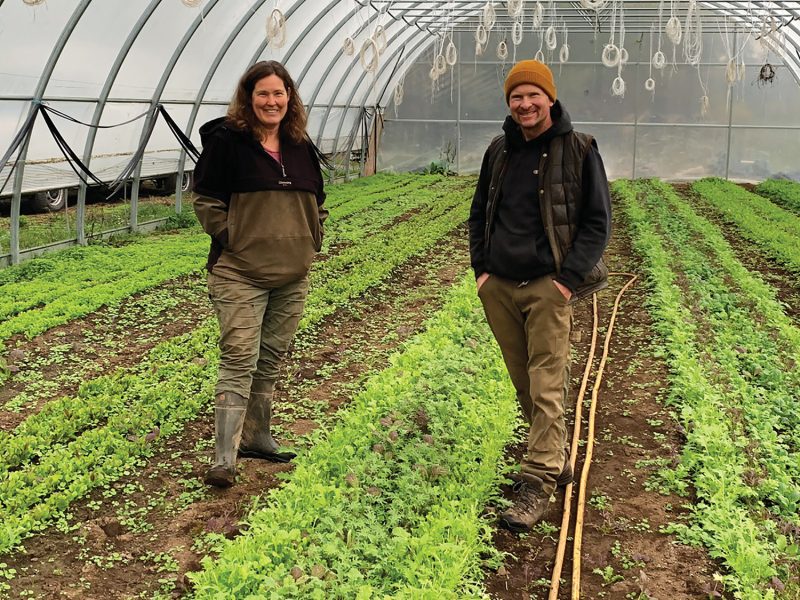
Robin Tunnicliffe, left, and her partner Sasha Kubicek, right, have the blessing of Geoff Mitchell to take Sea Bluff Farm forward. Tom Walker / Photo

February 1, 2024 byTom Walker

METCHOSIN – Long hours of hard work, years of experience and a ready local market will not guarantee success in vegetable farming on southern Vancouver island without stable, long-term land tenure.

“I was tired of leasing land. I’d been doing it for years and it felt like it could all be torn away so quickly,” says veteran market gardener Robin Tunnicliffe. “Often, it was just a year-long lease and there was no point in investing in perennial crops or infrastructure if I wasn’t going to be there the next year.”

It took the passion and legacy of a long-time Metchosin farmer to ensure that Tunnicliffe and her partner Sasha Kubicek could own land and run a successful farming business.

“Bob Mitchell was a well-known figure in the local farming community,” recalls Tunnicliffe.

Residents remember him hauling truckloads of seaweed from local beaches or the stench of the manure piles that helped build his soil. He served on the Metchosin council and the local agriculture committee.

“He was committed to local agriculture and he firmly believed that farmland should be farmed, not sit idle in the shadow of a large house,” she says.

In 2010, Tunnicliffe and her partners in Saanich Organics, Rachel Fisher and Heather Stretch, wrote All the Dirt: Reflections on Organic Farming.

“Bob read our book in 2012 and basically head-hunted me and Sasha to come and run Sea Bluff Farm,” Tunnicliffe recalls. “He told me during my first interview that if we did a good job at managing, the farm would be ours. But I didn’t really believe him.”

Kubicek, an accountant, put together a detailed business plan and budget and the couple agreed to move onto Sea Bluff Farm.

“We work about eight of the 10 acres of land, and we have a lease plot just up the road where we grow our warm summer crops,” Tunnicliffe says. “The soil is excellent from all the work Bob has done. “There is lots of water and pipes to the whole area and there were outbuildings, a tractor and other equipment.”

Mitchell was very keen to support the couple in making the farm a success.

“He really wanted the farm to thrive, and when I asked him for something, he would deliver,” says Tunnicliffe.

That included building a dedicated wash station on a cement pad, installing coolers and helping with hoop houses.

“I think it was one of the greatest joys for him, seeing this property become what he knew it could,” she said. “Every once in a while, Bob would mention that the farm would be ours, but it put us in a bit of a difficult situation.”

As farm mangers, the couple received a salary but didn’t have a lease on the property.

They talked to Bob’s son Geoff who assured them that his dad had always thought that way.

“Bob had always told his son that if he wasn’t going to farm it, he wasn’t going to get the land,” Tunnicliffe says.

Geoff assured them he wasn’t interested in being a farmer and that he would abide by his father’s wishes. Shortly before Mitchell’s death in 2022 at the age of 83, he had the papers drawn up and Tunnicliffe and Kubicek became the owners of Sea Bluff farm.

“We are so grateful to Bob,” Tunnicliffe says. “Owning a farm of our own is a dream come true and we love living in Metchosin.”

Ownership has given the couple the assurance they needed to continue to expand the operation to include strawberries, blueberries and more apple trees.

The mild southern Vancouver Island microclimate allows them to grow year-round, often with three plantings in a plot of soil and a variety of some 45 crops.

“This is such an excellent farm site,” Tunnicliffe says. “And we are in an ideal location for local sales.”

About 80% of their production is sold through their on-farm stand, open Tuesdays and Saturdays, and their local box program. The rest is sold through Saanich Organics, a group of three farmers  who supply 200 CSA box customers, three downtown Victoria farmers markets and a stable of some 40 restaurants. “Our marketing is what makes us a success,” says Tunnicliffe. “Our local customers are amazing. They really value the quality of our produce and now we are finding that we are price-competitive with imported food in the chain grocery stores.”

Located 45 minutes from downtown Victoria, Metchosin is dotted with small multi-acre plots of ALR land, most with expansive houses. Many run just enough livestock to qualify for farm status.

“When you drive along William Head Road, there are dozens of farm properties like ours, but almost no one is farming as intensely as we are,” Tunnicliffe notes. “There is only one other vegetable stand at the Metchosin farmers market.”

She says she encourages her neighbours to lease out their fields.

“I tell them to get their hands on a Young Agrarian so they can continue their tax break, because the fellows that run livestock are getting pretty old,” she says.

Given the price of land, it’s not hard to see why there are so few farms.

“There is a 12-acre piece of bare land right across the road from us that has about eight acres in hay production and is listed for $2.195 million,” Tunnicliffe notes. “Our farm is a commercial success, we make a good income from our land, but there is no way we could afford to pay $2 million for a property.”

Tunnicliffe supports the work Young Agrarians is doing through the province’s land-matching program to link landowners with young farmers seeking land.

“But I believe that if properties are going to get a tax break by leasing to a farmer, there should be a requirement for a five-year lease in order to qualify for farm status,” she says. “That would give the farmer some security to make improvements to the land.”

Sea Bluff Farm is able to offer full-time employment to four workers, but Tunnicliffe says it’s hard to find reliable help who will accept the rigours of small-scale farming.

“It’s hard work, there is no way around it,” she says. “Even though we pay considerably more than minimum wage, it’s expensive to live on the south island.”

Tunnicliffe hasn’t ruled out turning to foreign workers.

“We know that would be a good source of labour on the farm, but it makes me sad that we can’t make it work with local workers growing food for locals,” she says.

There is so much potential for local food to be grown on the island, Tunnicliffe points out. Fifty years ago, the Capital Region Food and Agriculture Initiatives Roundtable (CRFAIR) estimates that over 80% of what Vancouver Island residents ate was grown there. Today, the share is around 10%.

“We have so much potential to be a breadbasket here,” Tunnicliffe says. “That’s my dream, to keep feeding Metchosin.”

All content on this website is copyrighted, and cannot be republished or reproduced without permission.

Related Posts

You may be interested in these posts from the same category.

Previous Post: « Throne speech silent on agriculture
Next Post: Study shows BC farmers markets add value »

© 2026 COUNTRY LIFE IN BC - ALL RIGHTS RESERVED