
• Menu
  • Skip to primary navigation
  • Skip to main content
  • Skip to primary sidebar

Country Life In BC Logo

The agricultural news source in British Columbia since 1915

  • Headlines
  • Calendar
  • Subscribe
  • Advertise
  • About
  • Archives
  • Contact
  • Search
  • Headlines
  • Calendar
  • Subscribe
  • Advertise
  • About
  • Archives
  • Contact
  • Search

Primary Sidebar

Originally published:

JUNE 2021
Vol. 107 Issue 6

Subscribe Now!

Sign up for free weekly FARM NEWS UPDATES

Select list(s) to subscribe to


By submitting this form, you are consenting to receive marketing emails from: Country Life in BC. You can revoke your consent to receive emails at any time by using the SafeUnsubscribe® link, found at the bottom of every email. Emails are serviced by Constant Contact
Your information will not be
shared or sold ever

Stories In This Edition

Growers hopeful as BC opens

Tender touch

Japanese bettle control pays off

Nursery sales rise as consumers stick close to home

Editorial: Prospering together

Back 40: A mammoth solution to climate change

Viewpoint: Teamwork essential to grow in the new normal

Wind machines in Surrey face blowback

Sidebar: Dispute resolution

BC Veg unveils strategic priorities as it looks ahead

Quick turnaround

Ag Brief: South Asia flight ban strands BC farm workers

Ag Brief: Oliver vintner dies

Ag Brief: Province delivers AITC funding

Letter: Well “registration” misleading

Province’s chicken growers see rebound

Pricing formula on horizon for poultry sector

Snooze and lose

Grain costs put pressure on livestock producers

PST applicable to horse hay sales

BC raspberry growers face global issues

Little cherry disease a big threat to fruit growers

Core knowledge lands Kelowna grower top award

Strategy needed for Crown forage resources

BC abattoir volume up 30% in 2020

Ranchers urged to plan ahead for a changing climate

Cidery ups game with orchard purchase

The milkman makes a comeback on Island

Short season doesn’t stall northern berries

Cariboo-Chilcotin sheep group formed

Viewpoint: Farm insurance crisis threatens landowners

Mushroom harvester enters final testing

Sidebar: BC mushrooms at a glance

Mushrooms add value to cut blocks

Farm Story: Diversity and inclusion extends to tractors

Equipment intentions fall

Hops and CBC-centric hemp come together

Research: Processed foods are convenient but at what cost?

Soil science key for Kootenay farm project

Research sheds light on late blight strains

Woodshed: Deborah keeps divorce news between friends

OK apples at core of social entrepreneurship

Jude’s Kitchen: To the sea in summer

More Headlines

Follow us on Facebook

Comments Box SVG iconsUsed for the like, share, comment, and reaction icons

6 days ago

... See MoreSee Less

View Comments
  • Likes: 4
  • Shares: 0
  • Comments: 0

Comment on Facebook

6 days ago

On the last day of the BC Organic Conference, Thursday, Molly Thurston of Pearl Agricultural Consulting helped growers learn how to manage bugs such as codling moth, wireworm, and rootworm in organic growing systems. Her talk alongside Renee Prasad included hands-on activities in which participants checked out various traps and examined pests under microscopes. Be sure to look for more upcoming ag events on our online calendar at www.countrylifeinbc.com/calendar/

#BCAg
... See MoreSee Less

On the last day of the BC Organic Conference, Thursday, Molly Thurston of Pearl Agricultural Consulting helped growers learn how to manage bugs such as codling moth, wireworm, and rootworm in organic growing systems. Her talk alongside Renee Prasad included hands-on activities in which participants checked out various traps and examined pests under microscopes. Be sure to look for more upcoming ag events on our online calendar at www.countrylifeinbc.com/calendar/

#BCAg
View Comments
  • Likes: 15
  • Shares: 0
  • Comments: 0

Comment on Facebook

1 week ago

Well-known organic farmer and podcaster Jordan Marr gets interviewed by Country Life in BC’s own columnist and potato mavin Anna Helmer during the opening session of the BC Organic Conference at Harrison Hot Springs yesterday. Sessions run today (Wednesday) and Thursday and include organic and regenerative growing practices and expanding and advocating for the organic sector, all under the background of the newly launched Organic BC banner.

#BCAg
... See MoreSee Less

Well-known organic farmer and podcaster Jordan Marr gets interviewed by Country Life in BC’s own columnist and potato mavin Anna Helmer during the opening session of the BC Organic Conference at Harrison Hot Springs yesterday. Sessions run today (Wednesday) and Thursday and include organic and regenerative growing practices and expanding and advocating for the organic sector, all under the background of the newly launched Organic BC banner.

#BCAg
View Comments
  • Likes: 37
  • Shares: 2
  • Comments: 1

Comment on Facebook

Interested in finding out more about this

3 weeks ago

Today, we remember those who sacrificed their lives or their well-being for our freedom. Lest we forget. ... See MoreSee Less

Today, we remember those who sacrificed their lives or their well-being for our freedom. Lest we forget.
View Comments
  • Likes: 8
  • Shares: 0
  • Comments: 0

Comment on Facebook

1 month ago

FarmFolk CItyFolk is hosting its biennial BC Seed Gathering in Harrison Hot Springs November 27 and 28. Farmers, gardeners and seed advocates are invited to learn more about seed through topics like growing perennial vegetables for seed, advances in seed breeding for crop resilience, seed production as a whole and much more. David Catzel, BC Seed Security program manager with FF/CF will talk about how the Citizen Seed Trail program is helping advance seed development in BC. Expect newcomers, experts and seed-curious individuals to talk about how seed saving is a necessity for food security. ... See MoreSee Less

Link thumbnail

BC Seed Gathering - FarmFolk CityFolk

farmfolkcityfolk.ca

Save the date for our upcoming 2023 BC Seed Gathering happening this November 3rd and 4th at the Richmond Kwantlen Polytechnic University campus.
View Comments
  • Likes: 1
  • Shares: 0
  • Comments: 0

Comment on Facebook

Subscribe | Advertise

The agricultural news source in British Columbia since 1915
  • Email
  • Facebook

Mushrooms add value to cut blocks

Slash offers growing opportunities in the Kootenays

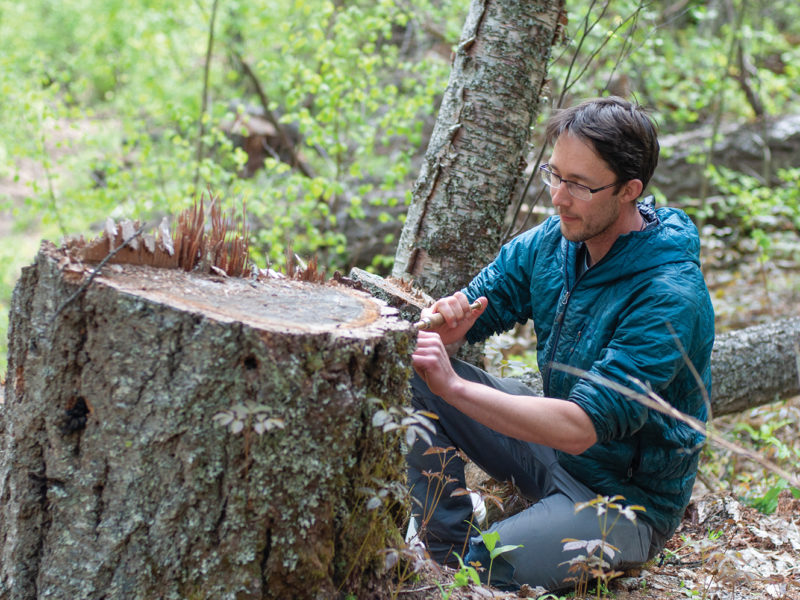
Robin Mercy of Mr. Mercy’s Mushrooms inoculates a stump with Phoenix oyster mushrooms on Kaslo’s Wardner Trail. Brian Lawrence

June 1, 2021 byBrian Lawrence

KASLO – They may not be ready to harvest until 2022 but mushrooms may soon catch the eye of hikers along Kaslo’s Wardner Trail.

A project to combine forestry and food production championed by Robin Mercy, owner of Mr. Mercy’s Mushrooms, saw the Village of Kaslo grant permission for Mercy to inoculate stumps and logs with Phoenix oyster mushrooms.

“I thought, let’s just do some research here, and see if it can grow in an unaided way,” says Mercy.

He usually grows mushrooms on hardwood, but this variety grows well on Douglas fir, which was among species recently cut by the Kaslo and District Community Forest Society on village land as part of wildfire mitigation efforts and to fight fir beetle.

In early May, Mercy and his employee drilled holes in the fallen wood and injected fungi, sealing the holes with beeswax. The waiting game is now on, as Mercy will eventually determine if the fungi fruits and, if it does, how well it fruits.

If the low-tech methods are effective, the potential to team up the forestry and agriculture industries is vast, particularly if forestry waste, such as logs and stumps, can be utilized.

“It’s trying to work more with what we have here,” says Mercy.

Not a new concept

The concept of growing food in the wild isn’t new to BC, according to a recent study by Simon Fraser University historical ecologists, which examined the diversity of ancient Indigenous forest gardens developed by the Ts’msyen and Coast Salish. Still growing today at archaeological sites, the gardens include fruit and nut trees, root foods and medicinal plants, among others.

Whatever the outcome in the forest, mycology is now a way of life for Mercy, who was raised in Argenta, at Kootenay Lake’s north end, and whose formal education is in music composition.

“‘Farmer’ was never a career path,” says Mercy. “I feel I come from a very homesteading background. … We always ate mostly from own garden. I experienced producing my own food, and never considered it on a commercial scale.”

The 33-year-old didn’t forage for mushrooms when he was young, but in his 20s as a tree planter and crew boss, he began carrying guidebooks to help him identify plants and mushrooms.

“I always got really excited whenever I would find wild mushrooms,” says Mercy. “They’re so mysterious. The same patch of ground looks totally bare 90% of the time –when the right conditions occur, you have mushrooms popping up. You have no idea what’s here unless you’re intensely studying that patch of land.”

During a break from work, Mercy took a cultivation course in Eugene, Oregon, which led to a month-long internship in 2016 at What the Fungus, a gourmet mushroom grower in Summerland. There, he learned about the specialty mushroom business from growing to marketing.

With his first son on the way in 2017, Mercy wanted steady home-based work. He launched the business, which grew to become his full-time job two years ago. He now harvests about 30 pounds of organic mushrooms daily from fruiting chambers on his two-acre property, which also houses a 500-square-foot laboratory – fitting for a self-proclaimed “lifelong nerd.”

“It’s the nerdiest form of farming you can imagine,” says Mercy. “I’m using a scalpel and working in a clean room, and putting cuttings onto Petri dishes. It’s precision work in a lot of ways, and that really appeals to me.”

So does the region’s foodie culture, which guarantees home cooks and restaurateurs will be more interested in specialty mushrooms than the typical white button, crimini and portobello mushrooms Mercy offers. The less common oyster, shitake and lion’s mane mushrooms have remained unchanged through millennia of agriculture.

“Humans haven’t been changing these species from what they are in nature at all,” he says.

The low-tech method he’s experimenting with in the forest will help bring production a bit closer to nature, avoiding the pasteurized sawdust and single-use plastics his regular operation uses.

“They grow on stumps and logs and trees in natural habitat,” he says. “We can start on a small scale, and move toward that as a production model.”

He hopes they’ll inspire mushroom lovers at the same time.

“Mushrooms really capture people’s imagination,” he says. “It kind of brings the idea of using mushrooms in this way to the forefront of people’s imaginations.”


Related Posts

You may be interested in these posts from the same category.

Previous Post: « BC fairs await reopening
Next Post: Core knowledge lands Kelowna grower top award »

Copyright © 2025 Country Life in BC · All Rights Reserved