• Menu
  • Skip to primary navigation
  • Skip to main content
  • Skip to primary sidebar

Country Life In BC Logo

The agricultural news source in British Columbia since 1915

  • Headlines
  • Calendar
  • Subscribe
  • Advertise
  • About
  • Archives
  • Contact
  • Search
  • Headlines
  • Calendar
  • Subscribe
  • Advertise
  • About
  • Archives
  • Contact
  • Search

Primary Sidebar

Originally published:

NOVEMBER 2020
Vol. 106 Issue 11

Subscribe Now!

Sign up for free weekly FARM NEWS UPDATES

Loading form…

Your information will not be
shared or sold ever

Stories In This Edition

Apple returns raise alarm

Ottawa urged to fulfil promises

Snow job

New government faces old issues in next term

Caught in the act

Editorial: Time for action

Back 40: Finding the perks in a pandemic world

Viewpoint: Changing times require a flexible vision

Invasive hornet nest destroyed south of Langley

Country Life in BC wins a record eight national awards

US launches investigation into blueberries

Hog producers face changes to code of practice

Growers, wineries welcome sustainability launch

Sustainability program delivers value to industry

Ag Briefs: Ag sector claims $8.5 billion economic impact

Ag Briefs: Farm worker protection funded

Ag Briefs: Autumn calf prices down

Grant programs encourage Indigenous ag projects

Range issues dominate NOLA meeting

Sidebar: BCV Cattlemen critique water intentions

BC Beef plant in Falkland ready to process this month

Winter warning

Corn trial results help make better planting decisions

Sidebar: Sweet results

New barn promises better egg production

ALR co-founder, defender embraces retirement

Seed sppliers seeing sustained demand as 2021 orders begin

Research: Breeding crops for the future means looking backwards

Straight ahead

Potatoes head for record-breaking harvest

Weather posed challenges for garlic growers

Garlic groewrs employ mixed marketing strategies

Association aims to foster collaboration

Demand boosts interest in older cider apples

Evans Farms marks a century of ranching

Farm Story: Nominees announced for seasonal awards

Bursary winner plants roots in Cawston

Provincial Winter Fair hosts live 4-H events

Woodshed: Janice Newberry bids farewell to love-sick Henderson

Where there’s a will, there’s gotta be a way

Jude’s Kitchen: Autumn Eats

All content on this website is copyrighted, and cannot be republished or reproduced without permission.
More Headlines

Follow us on Facebook

Comments Box SVG iconsUsed for the like, share, comment, and reaction icons

10 hours ago

A draft update to the Code of Practice for the Care and Handling of Beef Cattle is now open for public comment until June 12. The code, one of 14 animal care codes developed and maintained by the National Farm Animal Care Council, is undergoing a routine 10-year review. "Your feedback will help shape the industry's guide to cattle welfare for the next decade," says Canadian Cattle Association policy manager Jessica Radau, urging producers to weigh in. For more information, visit tinyurl.com/58a3u9fz.

#BCAg
... See MoreSee Less

A draft update to the Code of Practice for the Care and Handling of Beef Cattle is now open for public comment until June 12. The code, one of 14 animal care codes developed and maintained by the National Farm Animal Care Council, is undergoing a routine 10-year review.  Your feedback will help shape the industrys guide to cattle welfare for the next decade, says Canadian Cattle Association policy manager Jessica Radau, urging producers to weigh in. For more information, visit https://tinyurl.com/58a3u9fz.

#BCAg
View Comments
  • Likes: 2
  • Shares: 0
  • Comments: 1

Comment on Facebook

I sat in the webinar yesterday by the Canadian Cattle Association. My initial concern was that this would be another "play" into the government's hands. It has been worked on by people that are actually in the Beef industry from Cow calf to feedlot. The thrust is an update of the 2013 Code of Practice which was reviewed in 2018. The changes are more a move from "left to the producers discretion" to clearer directions regarding pain management, proper transport of animals which are impaired and keeping cattle in in good condition. Much of what is recommended is what producers who care about animal husbandry already do. The important part is to GIVE THEM FEEDBACK good, bad or otherwise. The document is about 60 pages long, and I ran it through CHAT to see what had been changed. It is important to understand that the PUBLIC is invited to comment on the draft not just producers. Think about it... do you really want the public influencing how you manage your cattle. If you think that this is just one of those things, I have been following Bill 22 in Alberta which will grant the SPCA a proactive roll in entering farms and checking on animals. When I asked CHAT how the new bill relates to the Cattle Code, it came back that the Code although not a regulation will be able to be used as a guide by producers for backup in dealing with the SPCA regarding cattle conditions, sick animal handling etc. Take the time.... Go onto the Canadian Cattle Association website and speak to those parts that you wish to input.

1 day ago

According to the BC River Forecast Centre, the Okanagan snowpack stood at just 58% of normal on April 1 — the lowest reading since measurements began in 1980 — raising concerns about drought conditions in the region this summer. The rest of the province sits at 92% of normal.

#BCAg
... See MoreSee Less

According to the BC River Forecast Centre, the Okanagan snowpack stood at just 58% of normal on April 1 — the lowest reading since measurements began in 1980 — raising concerns about drought conditions in the region this summer. The rest of the province sits at 92% of normal.

#BCAg
View Comments
  • Likes: 3
  • Shares: 0
  • Comments: 0

Comment on Facebook

2 days ago

At her first AGM as executive director of BC Meats, held Saturday in Abbotsford, Jennifer Busmann spoke about her strong ties to agriculture and her optimism for the organization's future. Busmann has cattle of her own and came to the role with existing relationships with members and the board of directors that helped her feel integrated from the start. She stepped into the position in Februa#BCAg#BCAg ... See MoreSee Less

At her first AGM as executive director of BC Meats, held Saturday in Abbotsford, Jennifer Busmann spoke about her strong ties to agriculture and her optimism for the organizations future. Busmann has cattle of her own and came to the role with existing relationships with members and the board of directors that helped her feel integrated from the start. She stepped into the position in February.

#BCAg
View Comments
  • Likes: 6
  • Shares: 0
  • Comments: 0

Comment on Facebook

4 days ago

Shannon Wiggins of Headwind Farm in North Saanich is this year's Mary Forstbauer Grant recipient from the BC Association of Farmers Markets. The $500 grant will help Wiggins expand her plot at Sandown Centre for Regenerative Agriculture, growing more storage crops to extend her harvest season. Wiggins credits farmers markets with inspiring her own farming journey and commitment to building community through food. Congratulations!

tinyurl.com/45bdd#BCAg#BCAg
... See MoreSee Less

Shannon Wiggins of Headwind Farm in North Saanich is this years Mary Forstbauer Grant recipient from the BC Association of Farmers Markets. The $500 grant will help Wiggins expand her plot at Sandown Centre for Regenerative Agriculture, growing more storage crops to extend her harvest season. Wiggins credits farmers markets with inspiring her own farming journey and commitment to building community through food. Congratulations!

https://tinyurl.com/45bddtw8

#BCAg
View Comments
  • Likes: 46
  • Shares: 2
  • Comments: 3

Comment on Facebook

Wahoo! Congrats Shannon! I love your produce. Can’t wait for the radishes 🫜

Congratulations!

Well done!! 🩷🩷🩷

6 days ago

New farmers can avoid costly mistakes by learning from those who've been there. At a Young Agrarians mixer in Penticton, five BC farmers shared hard-won lessons on pricing, pivoting, relationships and burnout. From coyote losses to business burnout, their message was clear: set prices that reflect true costs, make decisions quickly and don't let farming define your worth. Myrna Stark Leader's story appears in our April e-edition, now available to view online at: tinyurl#BCAg2uw53vvm

#BCAg
... See MoreSee Less

New farmers can avoid costly mistakes by learning from those whove been there. At a Young Agrarians mixer in Penticton, five BC farmers shared hard-won lessons on pricing, pivoting, relationships and burnout. From coyote losses to business burnout, their message was clear: set prices that reflect true costs, make decisions quickly and dont let farming define your worth. Myrna Stark Leaders story appears in our April e-edition, now available to view online at: https://tinyurl.com/2uw53vvm

#BCAg
View Comments
  • Likes: 15
  • Shares: 0
  • Comments: 0

Comment on Facebook

Subscribe | Advertise

The agricultural news source in British Columbia since 1915
  • Email
  • Facebook

New barn promises better egg production

Multimillion-dollar facility puts emphasis on comfort, automation

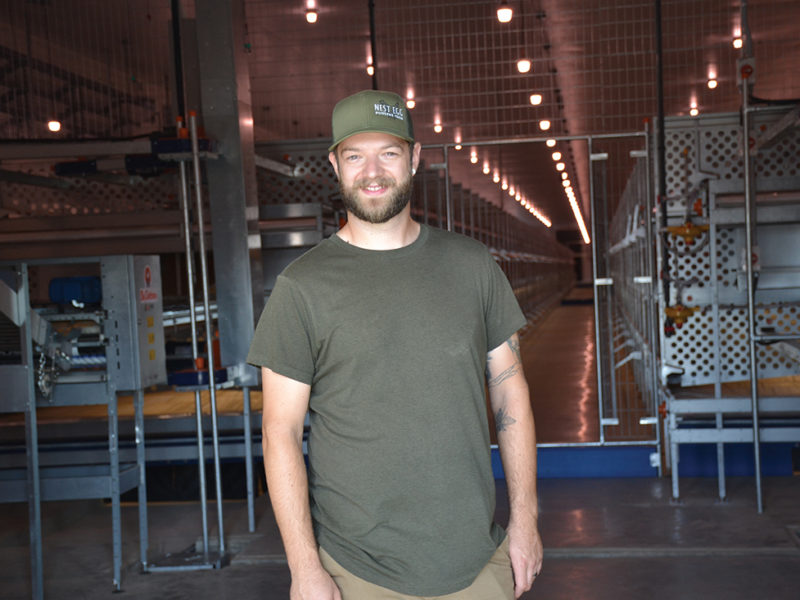
Andrew Penner has taken over his parents’ layer operation, investing in a new aviary setup that’s the largest of its kind in the world. PHOTO / RONDA PAYNE

November 1, 2020 byRonda Payne

ABBOTSFORD – Many young farmers face necessary upgrades to facilities when they take on the family business. Sometimes, maintaining the status quo isn’t always an option.

Andrew and Stephanie Penner went big when they took over their layer operation from Andrew’s parents two years ago. The barns were already at capacity and they knew the timing was right to build for the future, not just for now.

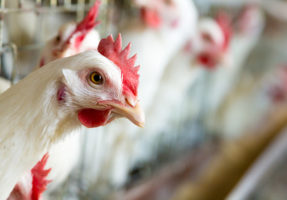
Nest Egg Poultry is now the largest aviary facility of its kind in the world according to Tyler de Boer with AgPro West Supply. The multi-million dollar operation is outfitted with a Big Dutchman Natura Step XL Aviary system, which de Boer describes as the big brother of other aviary systems.

“The main [difference] is its width,” he says. “It allows for more birds while complying [with] any regulations.”

As a third-generation egg farmer, 34-year-old Andrew Penner watched his family farm grow to slightly more than 20,000 birds, all of them in conventional cage housing.

“We knew we had to move out of cage systems. It was the time to decide,” he says. “I decided I wanted to be in specialty, so went with the aviary, free run.”

Building new also allowed him to build for expansion. The new facility, developed over the course of a year, effectively doubles the farm’s capacity to 40,000 birds. It’s laid out as two barn units under a single roof. Each barn has a capacity of 20,000 birds. Penner plans to sit at 11,000 per barn (22,000 total) for a while by adding quota credits to his current quota level that allows for slightly more than 20,000 birds. He may consider expanding to as many as 35,000 in the future.

While currently built for free-run production, with a few minor modifications, the new barns will accommodate free range or organic. Free range would require installation of a fence and windows would need to be installed in pre-framed spaces to qualify for organic certification. (A change to feed is also required.)

The barns are designed for maximum bird comfort. Computer controls and sensors monitor and allow the Penners to control temperature, carbon dioxide and ammonia in addition to the custom ventilation system.

“Andrew is being progressive in wanting the best quality of life for the birds,” says de Boer.

In conventional barns, manure piles up but the aviary system’s conveyors ensure manure is removed.

“Barns used to live for a cycle and now we’re moving the manure regularly,” says de Boer. “It’s better for the birds.”

Specialty production

Penner isn’t the only one seeing the benefits of specialty egg production. BC Egg reports that more than 44% of BC eggs are a specialty product, with 14.5% produced in enriched environments, 8.6% free run, 9.2% free range and 11.9% organic.

Scott Janzen, who ships to Island Gold, also has layers in the Fraser Valley.

“We have farmed with an aviary system – both free range and free run. The Penners came to see ours and to decide which way to go. I call it a jungle gym for chickens,” he says of the aviary system. “You have to farm it a bit differently. You have to see them, smell what they’re smelling, hear what they’re saying.”

He feels that more Grade A eggs come out of a system like the Penners, helping meet rising demand for cage-free production. The Penners’ ship their eggs to Island Gold, which distributes them across Vancouver Island and the Lower Mainland.

The Penners’ first batch of birds, Novogen pullets, came to the barns at 15 to 18 weeks old and have been specifically reared to an aviary system environment by Abbotsford-based Pacific Pride Chicks.

Attached to the barn is the automated Damtech egg packer which de Boer says has the smallest footprint of anything on the market. It moves eggs from the barns’ conveyors into flats. Flats stack up at the end of the packing line where they’re transferred to a cooler to await pickup.

Having strong family relationships is “huge” to making such a large undertaking work, says Penner. He says the family talks a lot about the operation. While it’s his now, he also values the wisdom and experience his parents bring.


All content on this website is copyrighted, and cannot be republished or reproduced without permission.
Related Posts

You may be interested in these posts from the same category.

AI response in spotlight

Ministers discuss avian influenza

Poultry gatherings banned

Second high-path AI case

BC Chicken picks Siemens

COVID influences food demand

Record temps kill poultry

Livestock producers count losses

Supply management crucial to BC

Poultry sector receives $86.8 million

Egg producer questions support for local eggs

The spirit of giving

Previous Post: « Hog producers face changes to code of practice
Next Post: Weather posed challenges for garlic growers »

© 2026 COUNTRY LIFE IN BC - ALL RIGHTS RESERVED