
• Menu
  • Skip to primary navigation
  • Skip to main content
  • Skip to primary sidebar

Country Life In BC Logo

The agricultural news source in British Columbia since 1915

  • Headlines
  • Calendar
  • Subscribe
  • Advertise
  • About
  • Archives
  • Contact
  • Search
  • Cart
  • Checkout
  • Headlines
  • Calendar
  • Subscribe
  • Advertise
  • About
  • Archives
  • Contact
  • Search
  • Cart
  • Checkout

Primary Sidebar

Originally published:

SEPTEMBER 2026
Vol. 112 Issue 9

Subscribe Now!

Sign up for free weekly FARM NEWS UPDATES

Loading form…

Your information will not be
shared or sold ever

Stories In This Edition

After the fires

Burn out

Canada-US trade war heats up

Repeated water shutdowns spur calls for action

Editorial: Winds of change

Back 40: Climate crisis trumps fiscal economy concerns

Viewpoint: Regulato needs to find the right balance

Water restrictions collide with wildfire season

Grout leaves ALC as province moves to open ALR

Ag Briefs: New national apple advocacy group formed

Ag Briefs: Paton leaves Conservatives

Letter: Small farms, big impact

Dairy industry pays tribute to David Janssens

Orchardists lose a strong advocate for the sector

FIRB urges review of regulated marketing policy

Wine grape task force reports on first year

BC ranch wins national nod for stewardship

Cattle prices expected to remain stable

When BC’s burning, Range Riders saddle up

Orchard embraces leasing to preserve family legacy

Tour connects local media with food supply

Ugly Potato Day breaks Guiness world record

Small farms in BC gain new loan option

Farm Story: Clutch cable wages war on patience

Cover crops could extend the life of raspberry fields

Viewpoint: Farmers deserve a practical watershed plan

Student pursues dream of farming full-time

Woodshed: Delta’s balloon ride is what memories are made of

Century-old fair draws record attendance

Jude’s Kitchen: Protein-packed power bowls hit the spot

All content on this website is copyrighted, and cannot be republished or reproduced without permission.

More Headlines

Follow us on Facebook

Comments Box SVG iconsUsed for the like, share, comment, and reaction icons

14 hours ago

With the Surrey-Langley SkyTrain line turbocharging development of the Fraser Hwy corridor and surrounding agricultural lands, the BC NDP today announced it is naming the new line after former Premier Dave Barrett, whose government created the Agricultural Land Reserve to protect farmland. The announcment comes in advance of this Friday’s deadline for submitting feedback on a proposal to open the ALR to processors using as little as 5% local ingredients.

#BCAg
... See MoreSee Less

With the Surrey-Langley SkyTrain line turbocharging development of the Fraser Hwy corridor and surrounding agricultural lands, the BC NDP today announced it is naming the new line after former Premier Dave Barrett, whose government created the Agricultural Land Reserve to protect farmland. The announcment comes in advance of this Friday’s deadline for submitting feedback on a proposal to open the ALR to processors using as little as 5% local ingredients.

#BCAg
View Comments
  • Likes: 3
  • Shares: 1
  • Comments: 4

Comment on Facebook

Thousands of big round bales of hay got shipped, and are getting shipped from the lower mainland to the interior due to dry weather and low water supply up country. Those ranchers are sure glad that we still have a few acres down here that can produce when other parts of the province dry up.

No disrespect meant but perhaps they should have named it the "ALR Line" to help educate those who don't know what the ALR is and what it does and doesn't allow.

The A.L.R is a pain in the A.S.S

I do not agree with this proposed change to the ALR. It is a trojan horse designed to open up the ALR for development. Gary Runka must be turning in his grave. :(

2 days ago

More than two years after the BC Tree Fruits Co-op shut down, a payout of $11.5 million is heading to former members this week. The payout follows a share purchase agreement approved this spring allowing the new privately owned BC Tree Fruits partnership to acquire the co-op’s shares in addition to the assets previously acquired. A further, final payout to growers is expected in December, once other outstanding claims have been resolved.

#BCAg
... See MoreSee Less

More than two years after the BC Tree Fruits Co-op shut down, a payout of $11.5 million is heading to former members this week. The payout follows a share purchase agreement approved this spring allowing the new privately owned BC Tree Fruits partnership to acquire the co-op’s shares in addition to the assets previously acquired. A further, final payout to growers is expected in December, once other outstanding claims have been resolved.

#BCAg
View Comments
  • Likes: 5
  • Shares: 1
  • Comments: 0

Comment on Facebook

5 days ago

Canadian Forest Owners and McGill University researchers have launched the first national survey of private forest owners in over 20 years. With some 50% of farmers across Canada owning woodlots, the results of the survey could help shape policy at both the federal and provincial level. According to Woodlots BC, there are 836 woodlot licensees totalling 576,627 hectares in the province, with an estimated economic impact of $113 million. The three-part survey closes September 14. www.forestowners.ca/about/survey/

#BCAg
... See MoreSee Less

Canadian Forest Owners and McGill University researchers have launched the first national survey of private forest owners in over 20 years. With some 50% of farmers across Canada owning woodlots, the results of the survey could help shape policy at both the federal and provincial level. According to Woodlots BC, there are 836 woodlot licensees totalling 576,627 hectares in the province, with an estimated economic impact of $113 million. The three-part survey closes September 14. www.forestowners.ca/about/survey/

#BCAg
View Comments
  • Likes: 7
  • Shares: 1
  • Comments: 1

Comment on Facebook

A good opportunity.

6 days ago

Kevin Boon is stepping down as general manager of the BC Cattlemen's Association after 17 years to become CEO of the Saskatchewan Cattle Association. Boon has more than 40 years’ experience in the cattle industry, including leadership roles with Alberta Beef Producers and the Canadian Cattle Association. During his tenure with BC Cattlemen’s, Boon has helped the industry navigate wildfire, drought and hay shortages, as well as been a powerful advocate for improved water storage. Known as a bridge-builder, his experience will be greatly missed by the BC farm and ranch sector.

#BCAg
... See MoreSee Less

Kevin Boon is stepping down as general manager of the BC Cattlemens Association after 17 years to become CEO of the Saskatchewan Cattle Association. Boon has more than 40 years’ experience in the cattle industry, including leadership roles with Alberta Beef Producers and the Canadian Cattle Association. During his tenure with BC Cattlemen’s, Boon has helped the industry navigate wildfire, drought and hay shortages, as well as been a powerful advocate for improved water storage. Known as a bridge-builder, his experience will be greatly missed by the BC farm and ranch sector.

#BCAg
View Comments
  • Likes: 119
  • Shares: 14
  • Comments: 19

Comment on Facebook

Thanks for all you’ve done to advocate for the cattle industry Good luck 😊😊

Thanks for all you have done out here.Good luck in your next chapter.Big boots to fill.

Many thanks to Kevin for being a good friend to the Grasslands Conservation Council of British Columbia over the years.

Congrats to Kevin. A great advocate for the beef cattle sector. A pleasure to work with. Best wishes in Saskatchewan.

Buddy, you can't leave us! Great job, the BC Cattlemen will miss you..

Sorry to see go Kevin you did amazing work for all the cattleman and Rancher in this Province.good luck in your next chapter

No doubt a great job . Congratulations Kevin . Boy that time went fast eh? Hopefully see you along the trail .

Thankyou Kevin for your many years of work in BC! You will be missed. All the best in Saskatchewan, it's a great place!

Congratulations Kevin, thanks for all your hard work!

Kevin - these will truly be tough boots to fill for the next ---- thank you for all your efforts over the years ....much of of the Interior of BC will we watching for your next great initiative! ( or retirement ~smile) Lee Morris - TNRD Area P

Well Kevin you have set the bar high. You will be missed thank you for your service

Huge boots to fill Kevin is a rare treasure ,good luck on the next stage !

Thank you Kevin for all of the help you provided us through our disasters - best of luck to you in the flatlands!

Good luck on your new adventure. They are super lucky to have you.

Get outta town! You are not ready yet … unless you are going senile … Yes … like me Enjoy the thoughts and grand plans of adventures to come. Hugs

Good luck on your next step Keven! I'm sure you will be missed in BC.

Good luck Kevin

Kevin will be missed. Amazing advocate for ranchers and country folk.

Congratulations Kevin!! Thank you for your advocacy over the years!!!

View more comments

1 week ago

Prime Minister Mark Carney announced a 50% counter-tariff on natural honey today, September 8, to match the US decision to impose a 50% tariff on $27.6 billion of Canadian goods, including Canadian honey exports to the US, effective August 22. On average, Canada exports nine million kg of honey annually, with up to 75% of that going south of the 49.

#BCAg
... See MoreSee Less

Prime Minister Mark Carney announced a 50% counter-tariff on natural honey today,  September 8, to match the US decision to impose a 50% tariff on $27.6 billion of Canadian goods, including Canadian honey exports to the US, effective August 22. On average, Canada exports nine million kg of honey annually, with up to 75% of that going south of the 49.

#BCAg
View Comments
  • Likes: 5
  • Shares: 2
  • Comments: 0

Comment on Facebook

Subscribe | Advertise

The agricultural news source in British Columbia since 1915
  • Email
  • Facebook

Orchard embraces leasing to preserve family legacy

Profitability, not succession, was the real challenge

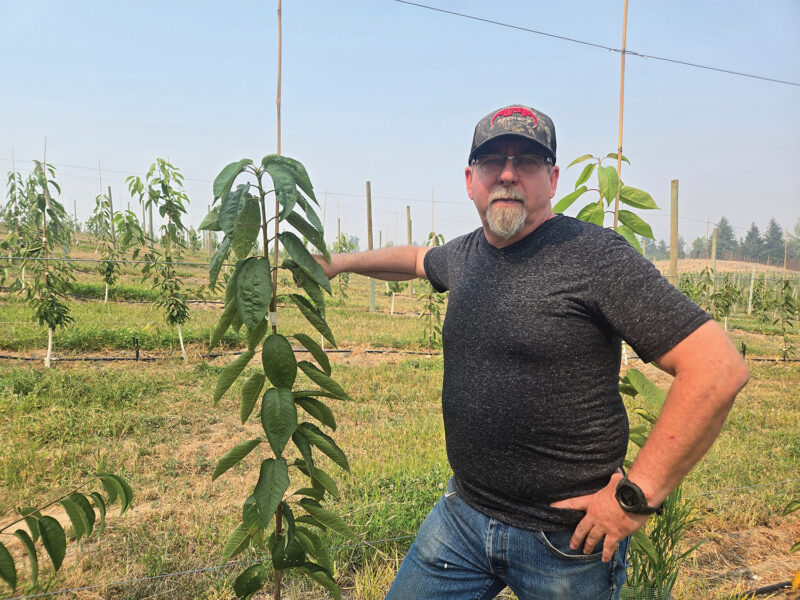
Shayne Witzke stands in the family orchard, which was leased out after three generations of apple production ended in 2025. Photo | Myrna Stark Leader

September 1, 2026 byMyrna Stark Leader

KELOWNA – When equipment was removing the apple trees from his orchard in spring 2025, Shayne Witzke largely stayed inside the family farmhouse, grieving the end to three generations of apple production.

The Kelowna orchard had earned industry awards for fruit quality and innovation, but with declining margins, external pressures such as loans, pests and extreme weather, and the passing of his father Brian, leasing the land was the realistic succession plan.

Witzke grew up working alongside his father on the 30-acre Kelowna orchard his grandfather Henry purchased in 1946. Originally planted to apples and cherries, the farm began focusing solely on apple production in 1981. Shayne came on board in 1996 after studying horticulture at College of the Rockies in Creston.

“Dad purchased another seven acres across the road from our 30-acre property, so it seemed like the right time,” Witzke explains, sitting in the kitchen of the farmhouse his parents built in the 1960s.

Northview Orchards Ltd. developed a reputation for innovation and top-quality fruit. After visiting Europe in the 1980s and seeing new orchard advancements, Brian Witzke adopted high-density plantings. In 1992, Brian and his wife Dorothy received the BC Fruit Growers’ Association’s Golden Apple award recognizing fruit quality and horticultural excellence.

The family shipped their fruit to the former BC Tree Fruits Cooperative but left in the early 2020s, fearing harm to their farm’s reputation and foreseeing the organization’s demise. They began marketing their fruit independently, relying on established customer relationships and a reputation for quality. In 2021, Shayne was also awarded the Golden Apple.

Over the years, the farm supported his parents and Witzke. He tried off-farm jobs twice to create more income, but those were short-lived.

At his urging, he and his dad hired four temporary foreign workers from Mexico to help with labour. Several returned annually and attended Brian’s celebration of life alongside family in 2024.

“They were quickly trained, consistent and reliable compared to the average Canadian transient farm workers of the past,” says Witzke.

Over the years, the family repeatedly invested in new varieties promoted as the industry’s future, only to have market expectations shift or the varieties produce less optimally than hoped.

“Mom and Dad were progressive enough to try, but they took arrows to the back. Our extended family, the industry, all they saw was, ‘they’re making all kinds of big money,’ but they didn’t see the whole picture,” Witzke says.

Even premium apple varieties like Ambrosia and Honeycrisp rarely result in the financial returns consumers assume growers receive.

“$500 a bin is the highest we’ve ever been paid on average for our high-end products, even in later years, with Honeycrisp,” Witzke says. “We had only one year where we got $1 a pound. That, on a  product where the apple trees take three to five years to produce and 50% of the fruit hits the ground as culls.”

The majority of profits went to servicing debt, including replant loans; anything left over was reinvested into the orchard. Shayne continues to repay a loan from Farm Credit Canada that was originally several hundred thousand dollars.

In the late 1990s, Shayne purchased his mother’s shares in the farm, making him and his father full partners. But this initial step in succession accelerated with his father’s death in 2024.

The Witzkes had regularly talked about succession, including a couple of weeks before his father’s death.

With no wife or children, the younger Witzke faced the options of selling, downsizing the farm to make the operation more manageable or leasing it to other growers.

“I had a heart-to-heart with my accountant shortly after Dad’s passing. She said if I continued farming, within five years I’d be so far in debt I’d never crawl out,” he says. “I walked to the spot in the orchard where I’d found my deceased grandfather 30 years earlier and cried, facing one of the toughest decisions of my life.”

Rising production costs, labour uncertainty, increasing regulatory requirements and lower prices from retailers struggling to maintain their own margins and address society’s and governments’ desire to keep food cheap convinced Witzke that farming was no longer financially sustainable.

Witzke and his lawyer ultimately negotiated a multi-decade lease agreement with a large local cherry operation.

“In spring 2025, our award-winning apple orchard was removed in just a few weeks while I mostly hid away in the house and cried,” says the 50-year-old.

Witzke encourages young farmers to pursue education, develop skills outside agriculture and gain experience in that business before fully committing to farming. He’s currently taking online courses to return to the off-farm workforce.

He also recommends working closely with accountants, lawyers and financial advisors and maintaining at least a basic understanding of business management.

While he considers himself good with money, Witzke says the lease isn’t enough to fund the rest of his life. He stresses the importance of putting money into investments to create longer-term, personal financial stability while farming.

Witzke says wills and open and honest discussions are essential.

“I know so many farmers who hesitate, trying to protect their children from the realities of the world,” he says. “That is detrimental. Even young kids understand there’s issues and underlying stressors on the farm.”

Witzke also encourages farmers to build friendships, hobbies and community connections outside agriculture. Counselling has helped him process the loss of his father and letting go of farming.

Although he has no immediate plans to sell the land – the only home he’s ever known – Witzke believes the agriculture sector, governments and society need to talk about and normalize profitability for farms, without farmers having to sell their land.

“People are comfortable talking about sustainability,” he says. “They’re not nearly as comfortable talking about profitability.”

All content on this website is copyrighted, and cannot be republished or reproduced without permission.

Related Posts

You may be interested in these posts from the same category.

Generational change for finances

Next Post: ALC opposes province’s rule change »

© 2026 COUNTRY LIFE IN BC - ALL RIGHTS RESERVED