
• Menu
  • Skip to primary navigation
  • Skip to main content
  • Skip to primary sidebar

Country Life In BC Logo

The agricultural news source in British Columbia since 1915

  • Headlines
  • Calendar
  • Subscribe
  • Advertise
  • About
  • Archives
  • Contact
  • Search
  • Headlines
  • Calendar
  • Subscribe
  • Advertise
  • About
  • Archives
  • Contact
  • Search

Primary Sidebar

Originally published:

JANUARY 2023
Vol. 109 Issue 1

Subscribe Now!

Sign up for free weekly FARM NEWS UPDATES

Loading form…

Your information will not be
shared or sold ever

Stories In This Edition

BC leads AI case count

Winter harvest

Eby appoints new ag minister

Generational change in BC potato busienss

Editorial: Good news, bad news

Back 40: Give us this day our daily bread

Viewpoint: Changing the playing field for farmers

Popham ends terms with strong ambitions

Higher food prices make little difference to farmers

Growers fail to block co-op consolidation

Sidebar: Co-op nomination process sidelines critics

Ag Briefs: Former BCFGA president, co-op chair dies

Ag Briefs: New chairs announced

Ag Briefs: COVID-19 response reviewed

BC loses a champion of agriculture

Canadian diary sector positioned well for growth

Honoured

Dairy producers raise alarm on costs

Flower growers shutter auction gallery

Sidebar: Talking turkey about flower sales

Risk management plans make safety sense

Biodynamic workshops receive funding

Producers reflect on past, plan for future

Pacific Agriculture Show on track for 2023

Sidebar: Stand up for the BCAC gala

Provincial priorities in focus at ag show

Berried treasure …

Islands farm show gears up for next month in Duncan

New opportunities but little progress for meat capacity

Roll call

Sidebar: Hub money

Meat producers need to focus on cost management

Greenhouse extends growing season, sales

Plant physiologist heads up BC grape research

Work-life balance is a fallacy for farmers

Pilot helps UBCO’s Feed BC initiative grow

Sidebar: Other factors at play

Drones provide a high-level view of scorch

Farm Story: Mum’s the word on fellow farmers

Bees better kept at a distance

Sidebar: Survey says

Woodshed: Kenneth’s MacGyver moment fails him

Climate, food secuirty motivate change

Jude’s Kitchen: Adventure with your new kitchen gadgets

More Headlines

Follow us on Facebook

Comments Box SVG iconsUsed for the like, share, comment, and reaction icons

6 days ago

A BC Forest Practices Board investigation has found overgrazing has damaged grasslands in the Coutlee Range Unit near Merritt — and the range-use plan meant to prevent it was unenforceable. With complaints about overgrazing on the rise and grasslands covering just 1% of BC's land mass, the findings raise fresh questions about how the province manages one of its most vulnerable — and valuable — food-producing ecosyste#BCAg#BCAg ... See MoreSee Less

Link thumbnail

Board finds overgrazing rules unenforceable unmeasurable

www.countrylifeinbc.com

MERRITT – A BC Forest Practices Board investigation has found instances of non-compliance related to overgrazing have damaged open grasslands in the Mine pasture, part of the Coutlee Range Unit near...
View Comments
  • Likes: 6
  • Shares: 6
  • Comments: 6

Comment on Facebook

Several ranchers in recent years have gone into temporary non use on that range , so that means the grass should grow. But drought conditions/lack of rain and snow don’t allow that to happen . Dried up springs , creeks waterholes in various pastures add to over grazing where there is water , as livestock and everything else stay close to the water source . So even though less cattle are on it , over grazing appears. There is a large volume of horses on it 365 days/year which is wrong ! They pull grass right out of the ground when it’s just trying to grow ,, opens the door for weeds to grow in. That don’t help it. Aging infrastructure ( fences) laying on the ground, pipe line building , ( lack of commitment to fence maintenance) amongst all users contributes also to over grazing. Recreational atv users leaving gates open between pastures allows livestock to go back or ahead in pastures also expidites over grazing. Logging ( bcts) has no problem laying out cut locks on both sides of a fence , then it gets smashed down during logging and they don’t take responsibility to stand it back up or clean the cattle gaurds out when they are done , that happened 4 years ago on pasture 5 up there . I bet it is still not fixed . There are lots of contributing factors to the problem.

Tragedy of the commons.

I looked through the report. I saw nothing about the effects of noxious weeds on productive grasslands. This particular area is vulnerable because of the Ministry’a efforts to diversify the use of the Grasslands.

This pasture is under tremendous pressure not only from cattle but from irresponsible local residents who treat it as a landfill dumping all manner of household debris here. And don't even get me started on the mud bogging and camping in sensitive riparian areas. The feral horses are in this pasture 365 days a year just hammering it. Would sure be nice to see some enforcement action on people who are intentionally ripping up the grasslands and riparian areas. Cattle could be a valuable resource for rebuilding soils and native grasses in this area with the help of electric fencing and/or e-collars. The humans will be harder to manage.

The Forest and Range Practices Act was written by lawyers for global forest licencee shareholders. Results-based = unenforceable.

Also, can we talk about the impact of a pipeline being built through the middle of this field for multiple years?

View more comments

1 week ago

East Kootenay rancher Randy Reay is digging a new well after two natural water sources dried up on his Crown tenures. A new Living Lakes Canada assessment found 15% of mapped aquifers in the region are high-priority for monitoring, yet 80% of those go unmonitored. With over 48% of BC's provincial observation wells reporting below-normal groundwater levels, ranchers and researchers are sounding the alarm on water security. The story is in our March edition, and we've posted it to our website thi#BCAgk.

#BCAg
... See MoreSee Less

Link thumbnail

Water woes: groundwater under pressure across BC

www.countrylifeinbc.com

JAFFRAY – As a young boy growing up in the Kootenay-Boundary region, Randy Reay never expected to run out of water. But this year, in mid-February, his fields are bare. There is no snow halfway up t...
View Comments
  • Likes: 8
  • Shares: 7
  • Comments: 1

Comment on Facebook

Jaffrey is in the east Kootenays not kooteney boundary

2 weeks ago

BC farmers are bracing for prolonged higher input costs as war in the Middle East drives up fuel and fertilizer prices. Nitrogen fertilizer costs were already climbing before the Iran conflict began, with prices still roughly 60% above pre-pandemic levels. Farm Credit Canada warns that unlike 2022, strong commodity prices may not offset rising costs this time. Local suppliers expect supply challenges and further price increases ahead.

#BCAg
... See MoreSee Less

Link thumbnail

Fertilizer prices on the rise

www.countrylifeinbc.com

War in the Middle East has delivered a generational shock to energy prices, meaning BC farmers can expect a prolonged period of higher costs not just for fuel but also for fertilizer.
View Comments
  • Likes: 2
  • Shares: 1
  • Comments: 0

Comment on Facebook

2 weeks ago

... See MoreSee Less

View Comments
  • Likes: 1
  • Shares: 0
  • Comments: 0

Comment on Facebook

2 weeks ago

Cameron Stockdale is the new executive director of provincial farm safety organization AgSafeBC. Find out more in this week's Farm News Update from Country Life in B#BCAg#BCAg ... See MoreSee Less

Link thumbnail

New leadership at AgSafe BC

www.countrylifeinbc.com

Cameron Stockdale is the new executive director of provincial farm safety organization AgSafeBC, succeeding Wendy Bennett. Bennett left AgSafeBC in September 2025, following 12 years with the…
View Comments
  • Likes: 5
  • Shares: 1
  • Comments: 0

Comment on Facebook

Subscribe | Advertise

The agricultural news source in British Columbia since 1915
  • Email
  • Facebook

Pilot helps UBCO’s Feed BC initiative grow

Aggregation creates opportunities for more suppliers

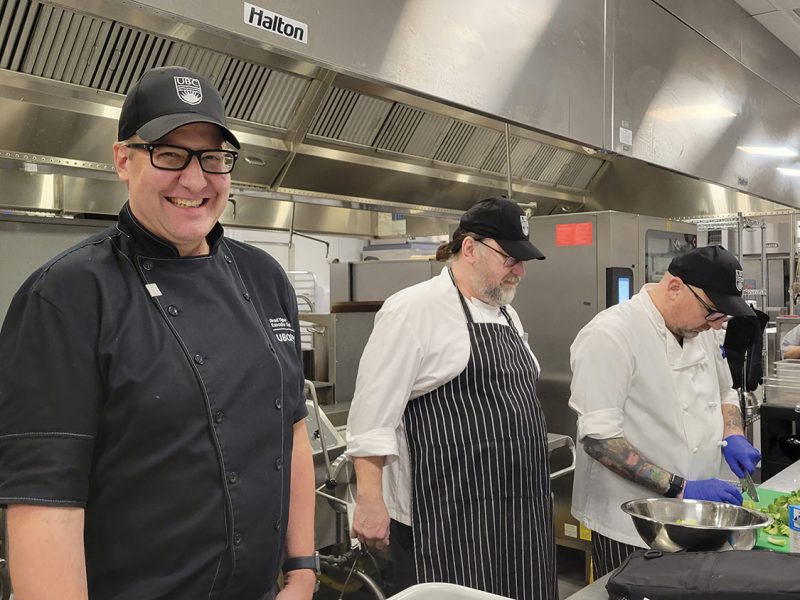
UBC Okanagan executive chef Brad Vigue is working hard to source more locally produced food as part of UBCO’s participation in Feed BC and a pilot program with the North Okanagan Land to Table Network. MYRNA STARK LEADER

January 1, 2023 byMyrna Stark Leader

KELOWNA – A year-old pilot program at UBC Okanagan is showing that providing more locally sourced foods for students takes resources well as commitment.

Since September 2021, UBC has been working with the North Okanagan Land to Table Network to bring more local food to campus.

A participant in the province’s Feed BC program, which aims to increase local purchasing by provincially-funded institutions, the school currently sources between 30% and 35% of its produce from local suppliers, a marginal increase from 2021. However, there is potential for growth given that a typical UBCO student with a meal plan eats about 720 times during the school year.

“Some of the best product in the world grows within 30 kilometres of Kelowna so I’m always exploring,” says UBCO executive chef Brad Vigue, who grew up in Salmon Arm. “My goal is 50% of produce purchased locally by 2024.”

One of the first partnerships under the pilot was with Shuswap Organics in Enderby, which supplies UBCO with almost all of its potatoes, carrots, cabbage, and Brussels sprouts.

“In 2022, because our catering program ran over summer, we started buying from Shuswap in mid-July and can do so as long as products keep in storage, which can be February or March, depending on the item,” says Vigue.

Shuswap Organics owners Owen Madden and Emily Jubenvill have been farming about five years. To meet UBCO’s needs, they also started aggregating produce from other growers, including Mara Valley Produce in Grindrod, Loveland Acres in Salmon Arm, Pilgrim’s Produce in Armstrong, Wild Flight Farm in Mara, and Green Croft Gardens in Grindrod.

By working together, smaller local growers are able to meet UBCO’s needs while avoiding a series of small deliveries that can be logistically impractical and too labour-intensive for UBCO.

“Farms we’re aggregating from are in the one to 15-acre range,” says Jubenvill. “There’s lots of room to grow the amount of product sold. The university has real purchasing power and every dollar made at the farm is staying here in the community.”

Jubenvill says working with UBCO is an example of how small to medium-sized farmers who want to work with large facilities can do so.

“It’s possible to source locally, not only in our short growing season, but also by expanding capacity for winter storage enabling produce year-round. If we can grow the marketplace pie, it makes it viable for new farmers to start up,” she notes.

Partnership instrumental

Vigue says the school’s partnership with NOLTN, founded to help small to medium-sized farmers move beyond direct sales and farmers markets, has been instrumental in making connections with local suppliers.

NOLTN director Liz Blakeway says the developing relationships between UBCO and local producers are a big step towards regaining the infrastructure needed for local sourcing.

“There’s been a long-term de-investment in local food supply, supply chains and processing, which is a very real challenge,” she says. “We’ve largely lost local food infrastructure.”

UBCO has also partnered with Curlew Orchard in Vernon for organic apples grown on six acres. They also worked intermittently with

D Dutchmen Dairy Ltd. in Sicamous and Kyla King of Rad Jamz in West Kelowna for jams and jellies, as well as with a few local cured meat producers for charcuterie.

But meat supplies are an issue, especially for niche products like halal-certified meat – an integral component of butter chicken, which creates the longest line at UBCO’s dining hall when it’s on the menu.

“We are sourcing chicken from Vancouver because we want our poultry to be halal,” says Vigue. “While there’s really good high-volume poultry producers in the Okanagan, they aren’t halal.”

It’s the type of barrier he feels the university could help change.

“Local providers are motivated to find a way to work together. It’s in our shared best interests. I would rather buy from the farm that’s close than shipped from Vancouver, especially when we saw the impact of last winter’s road shutdowns disrupting supply chain routes. The more local we are, the more resilient,” says Vigue.

But keeping students who want more meal variety and more internationally influenced foods means food items and volumes required change when UBCO’s menus change. Gathering potential farm and food partners takes time, and a lack of staff to seek out suppliers and make arrangements complicates the task.

“The Okanagan produces beautiful pears available summer through the following spring. We should be buying them. We have farms within 10 kilometres, but it takes time to figure out aggregation, delivery and storage,” says Vigue.

While sourcing locally takes more effort, Vigue knows it’s worth it.

“When we got the first delivery of Shuswap product,

I was like a kid in a candy store running around with handfuls of carrots going, ‘Just try them. Don’t ask any questions. Just taste this. This is why we buy local,’” he says.

Related Posts

You may be interested in these posts from the same category.

Plan drafted for BX Ranchlands

BC leads food price increases

Previous Post: « Generational change for finances
Next Post: BC vine damage discussed »

Copyright © 2026 Country Life in BC · All Rights Reserved