
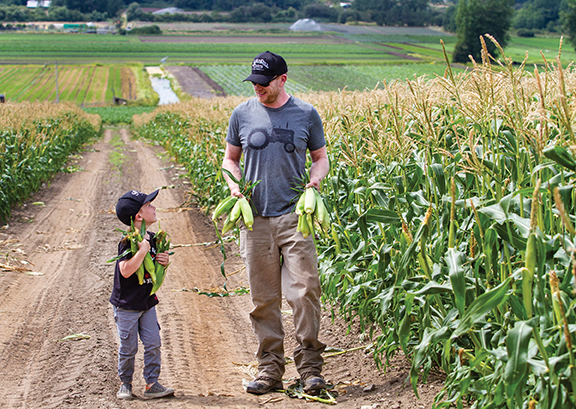
SAANICHTON – Growers in Central Saanich say proposed changes to local zoning bylaws that will align them more closely with new provincial regulations designed to increase housing options within the Agricultural Land Reserve will eat up productive farmland.
“I’m really against the proposed changes,” says Katy Connelly of Sea Dog Farm in Saanichton, who grows vegetables, herbs, tree fruits, berries, cut flowers and cannabis with her husband Shawn on a five-acre property in the ALR.
Under new regulations that took effect December 31, 2021, properties within the ALR were allowed to have a small, secondary residence with approval from local government without the need for an application to the Agricultural Land Commission.
These changes followed pushback from small farmers regarding regulations that gave force and effect to Bill 52, passed in 2018, which effectively banned second residences within the ALR unless for farm use and approved by the ALC.
The rules adopted in 2021 restored the ability to have a second residence, regardless of use.
“The additional residence can be used for housing extended family, agritourism accommodation, housing for farm labour or a rental property for supplemental income,” the province said in announcing the changes in July 2021. “There is no longer a requirement that additional residences must be used by the landowner or immediate family members.”
Central Saanich is considering up to three dwellings units on a single property, including a principal dwelling, a secondary suite in the principal dwelling, and a detached accessory dwelling. Current agriculture zoning only allows for a secondary suite and within most of the rural estate zones, either a secondary suite or detached cottage or carriage house is permitted.
Approximately 1,097 Central Saanich properties will be affected: 487 zoned rural and 610 zoned agricultural.
The Connellys have faced challenges in finding and retaining farm workers due to the high cost of living in Greater Victoria and the region’s housing shortage.
A housing needs study in 2020 indicated Central Saanich would require 557 units of housing between 2020 and 2025 to meet anticipated growth, with a lack of affordable rental housing being a barrier to the recruitment and retention of workers.
“It’s more difficult to find employees, but that’s not a unique situation to farms. It’s a situation that’s throughout the peninsula because it’s so expensive to live here,” Connelly says. “There’s so little affordable housing out here and everybody has ‘help wanted’ signs out.”
While the couple have put up staff in camper vans, their concerns about land mismanagement cause them to oppose any housing allowance changes on Central Saanich farmland.
“There are [other] places where we can increase density that are already covered in foundations and houses and everything else and I just I don’t think farmland is the way to do it,” Connelly says. “It’s so easy to abuse it and so people will put all these homes on, but they’ll never farm the land. I think eventually we’d see the death of small farms because they would become rental properties and there’s nothing to stop people from doing that.”
Farmland lost
Clayton Fox of Silver Rill Corn in Saanichton agrees that increasing housing options on farmland in line with ALC regulations won’t protect farmland or necessarily contribute to local food security.
“A lot of the farm properties, specifically in this area, aren’t actually owned by farmers,” he says. “They will just build another carriage home and rent it out. In fact, this will just create more lost farmland.”
With Victoria being a
25-minute drive down the highway, the area is an ideal location to build estate homes on larger acreages near a large city centre.
“Central Saanich is following a trend that has been pushing actual farming out of the community for decades,” Fox says. “Because the area here is so close to Victoria in a very highly desirable place to live, it’s just been slowly changing to horse estates and stuff like that.”
Fox’s family established the farm in 1926 and he is raising the fifth generation. The housing changes could help if any of his three children are interested in taking over the farm one day, but Fox thinks the primary outcome of the housing allowance changes will be to generate supplemental income.
“If you had three additional rentals on a piece of farmland, you would rake in almost $70,000 a year in rent. That’s more than I make farming,” Connelly says. “All the farmers that I know, their kids don’t want to farm. The kids are at university. … They see how hard their folks work and I think the multi- generational farm is not the way of the future. There are people who want a farm, but it’s not necessarily these farmers’ kids.”
Additional buildings also increase a property’s value. So, new or existing farmers looking to enter or expand in the industry are priced even further out of the market, Connelly says.
“I think the rules should be more strict on farmland so that it’s easier for the young farmers who are all desperate for land to afford it,” she says.
Between October and December, Central Saanich surveyed the public on five proposed housing options: permit up to three dwellings on any rural or agricultural lot greater than 0.25 acres permit three dwellings on properties greater than one acre; size threshold to differ for properties having private on-site sewerage system or being connected to municipal services; permit three dwellings on larger rural and agricultural properties over five acres; or no net increase in housing. Recommendations will be presented to council early next year.
“About 60% of our land base is ALR, but then there’s another 12% that is rural and so some of those have similar kind of farming land use designations even though they’re not within the land reserve,” says Central Saanich councillor Niall Paltiel. “We want to kind of apply the same policy between the two.”
Land size and agronomic potential are factors that will be considered if the changes are passed, Paltiel says.
“If you have a property that’s only two acres and it’s in the ALR, is it reasonable to also expect that you have a carriage house when you have such a limited amount of arable land?” he asks. “[That’s] one of the questions that we’re trying to grapple with as a council. Is there an ability to develop a threshold within the bylaw so that there’s a minimum lot size that this applies to just so that we’re not sacrificing quality arable land, you know, in the name of trying to provide flexibility for housing?”
If changes are enacted, council wants to remove at least one barrier for producers to be successful in the Capital Regional District.
“Being that we do have such a large land base of properties within the Agricultural Land Reserve, we certainly want to be stepping up to the occasion and doing our level best to be good representatives, good stewards to the significant agricultural component we do have in our community,” Paltiel says.
Connelly recognizes the need for more housing, but looking to farmland is not the solution for Central Saanich, she says.
“We’re a stone’s throw from a huge subdivision. What if they all had a suite instead. It’s way more housing than we could fit here,” she says. We’re not way out in the sticks on 100 acres. … We’re on five acres and there isn’t enough room for more housing.”
 Nanaimo farmland vulnerable