
• Menu
  • Skip to primary navigation
  • Skip to main content
  • Skip to primary sidebar

Country Life In BC Logo

The agricultural news source in British Columbia since 1915

  • Headlines
  • Calendar
  • Subscribe
  • Advertise
  • About
  • Archives
  • Contact
  • Search
  • Headlines
  • Calendar
  • Subscribe
  • Advertise
  • About
  • Archives
  • Contact
  • Search

Primary Sidebar

Current Issue:

APRIL 2026
Vol. 112 Issue 4

Subscribe Now!

Sign up for free weekly FARM NEWS UPDATES

Loading form…

Your information will not be
shared or sold ever

Follow us on Facebook

Comments Box SVG iconsUsed for the like, share, comment, and reaction icons

11 hours ago

A Maple Ridge dairy producer has been fined $7,512, had his licence suspended for three months, and faces quota restrictions for two years after an undercover investigation confirmed raw milk was sold directly from the farm on three separate occasions.

#BCAg
... See MoreSee Less

Link thumbnail

Maple Ridge farm fined for raw milk sales

www.countrylifeinbc.com

Raw milk remains off the table for dairy producers, with the BC Milk Marketing Board (BCMMB) taking action against a Maple Ridge producer for illicit sales. An undercover investigation of Maple Ridge...
View Comments
  • Likes: 12
  • Shares: 12
  • Comments: 19

Comment on Facebook

Unpasteurized milk is sold in Europe. It's the only milk certain cheeses can be made from.

A person can shoot up government drugs in a playground but milk is the issue. 🙄

leave him the hell alone! if someone wants to buy raw milk at their own risk, let them. At least they can see where the milk came from

Rediculous

Some comments seem to be missing the point of the article. NO ONE was sick from the milk. It’s all about money. “By selling milk outside the regulated system, where revenues are pooled, the board claimed Stuyt had cost producers as a whole $195,185 and ordered him to repay this amount. It also ordered Stuyt to pay $33,266 to cover the cost of BCMMB’s investigation and hearings into the matter. The BC Dairy Association, which stood as an intervenor in the appeal before FIRB, said illicit raw milk sales are a direct threat to supply management.”

Yes we are NOT a capitalist economy in Canada

🐀

Government control at its finest .

to much government control!

Why can’t we let the consumer decide the risk? Alcohol, and safe injection sites are legal. But not raw milk, they don’t want us to have it because it’s a super food.

When will people wake up to the fact that that Health Canada doesn’t care about our health? They only care about profiteering off our bad health..

Corrupt government

Good grief. Don’t inspectors have better things to do?

Wow 😒😒

Ridiculous

Have you been inside a dairy barn Go lick the floor then drink the raw milk Cuz that’s what’s your doing Y’all need to give ur head a shake

What a travesty. We are Adults told by corrupt bribed morons, what we should eat or drink. But it is ok for taxpayers to pay for "safe" injection sites and killing unborn children, and child mutilation!!

How pathetic

What a waste of time and money.

View more comments

3 days ago

A draft update to the Code of Practice for the Care and Handling of Beef Cattle is now open for public comment until June 12. The code, one of 14 animal care codes developed and maintained by the National Farm Animal Care Council, is undergoing a routine 10-year review. "Your feedback will help shape the industry's guide to cattle welfare for the next decade," says Canadian Cattle Association policy manager Jessica Radau, urging producers to weigh in. For more information, visit tinyurl.com/58a3u9fz.

#BCAg
... See MoreSee Less

A draft update to the Code of Practice for the Care and Handling of Beef Cattle is now open for public comment until June 12. The code, one of 14 animal care codes developed and maintained by the National Farm Animal Care Council, is undergoing a routine 10-year review.  Your feedback will help shape the industrys guide to cattle welfare for the next decade, says Canadian Cattle Association policy manager Jessica Radau, urging producers to weigh in. For more information, visit https://tinyurl.com/58a3u9fz.

#BCAg
View Comments
  • Likes: 4
  • Shares: 2
  • Comments: 1

Comment on Facebook

I sat in the webinar yesterday by the Canadian Cattle Association. My initial concern was that this would be another "play" into the government's hands. It has been worked on by people that are actually in the Beef industry from Cow calf to feedlot. The thrust is an update of the 2013 Code of Practice which was reviewed in 2018. The changes are more a move from "left to the producers discretion" to clearer directions regarding pain management, proper transport of animals which are impaired and keeping cattle in in good condition. Much of what is recommended is what producers who care about animal husbandry already do. The important part is to GIVE THEM FEEDBACK good, bad or otherwise. The document is about 60 pages long, and I ran it through CHAT to see what had been changed. It is important to understand that the PUBLIC is invited to comment on the draft not just producers. Think about it... do you really want the public influencing how you manage your cattle. If you think that this is just one of those things, I have been following Bill 22 in Alberta which will grant the SPCA a proactive roll in entering farms and checking on animals. When I asked CHAT how the new bill relates to the Cattle Code, it came back that the Code although not a regulation will be able to be used as a guide by producers for backup in dealing with the SPCA regarding cattle conditions, sick animal handling etc. Take the time.... Go onto the Canadian Cattle Association website and speak to those parts that you wish to input.

4 days ago

According to the BC River Forecast Centre, the Okanagan snowpack stood at just 58% of normal on April 1 — the lowest reading since measurements began in 1980 — raising concerns about drought conditions in the region this summer. The rest of the province sits at 92% of normal.

#BCAg
... See MoreSee Less

According to the BC River Forecast Centre, the Okanagan snowpack stood at just 58% of normal on April 1 — the lowest reading since measurements began in 1980 — raising concerns about drought conditions in the region this summer. The rest of the province sits at 92% of normal.

#BCAg
View Comments
  • Likes: 3
  • Shares: 0
  • Comments: 0

Comment on Facebook

5 days ago

At her first AGM as executive director of BC Meats, held Saturday in Abbotsford, Jennifer Busmann spoke about her strong ties to agriculture and her optimism for the organization's future. Busmann has cattle of her own and came to the role with existing relationships with members and the board of directors that helped her feel integrated from the start. She stepped into the position in Februa#BCAg#BCAg ... See MoreSee Less

At her first AGM as executive director of BC Meats, held Saturday in Abbotsford, Jennifer Busmann spoke about her strong ties to agriculture and her optimism for the organizations future. Busmann has cattle of her own and came to the role with existing relationships with members and the board of directors that helped her feel integrated from the start. She stepped into the position in February.

#BCAg
View Comments
  • Likes: 6
  • Shares: 0
  • Comments: 0

Comment on Facebook

7 days ago

Shannon Wiggins of Headwind Farm in North Saanich is this year's Mary Forstbauer Grant recipient from the BC Association of Farmers Markets. The $500 grant will help Wiggins expand her plot at Sandown Centre for Regenerative Agriculture, growing more storage crops to extend her harvest season. Wiggins credits farmers markets with inspiring her own farming journey and commitment to building community through food. Congratulations!

tinyurl.com/45bdd#BCAg#BCAg
... See MoreSee Less

Shannon Wiggins of Headwind Farm in North Saanich is this years Mary Forstbauer Grant recipient from the BC Association of Farmers Markets. The $500 grant will help Wiggins expand her plot at Sandown Centre for Regenerative Agriculture, growing more storage crops to extend her harvest season. Wiggins credits farmers markets with inspiring her own farming journey and commitment to building community through food. Congratulations!

https://tinyurl.com/45bddtw8

#BCAg
View Comments
  • Likes: 50
  • Shares: 2
  • Comments: 3

Comment on Facebook

Wahoo! Congrats Shannon! I love your produce. Can’t wait for the radishes 🫜

Congratulations!

Well done!! 🩷🩷🩷

Subscribe | Advertise

The agricultural news source in British Columbia since 1915
  • Email
  • Facebook

Province’s peach supply down

August 24, 2022 byKate Ayers

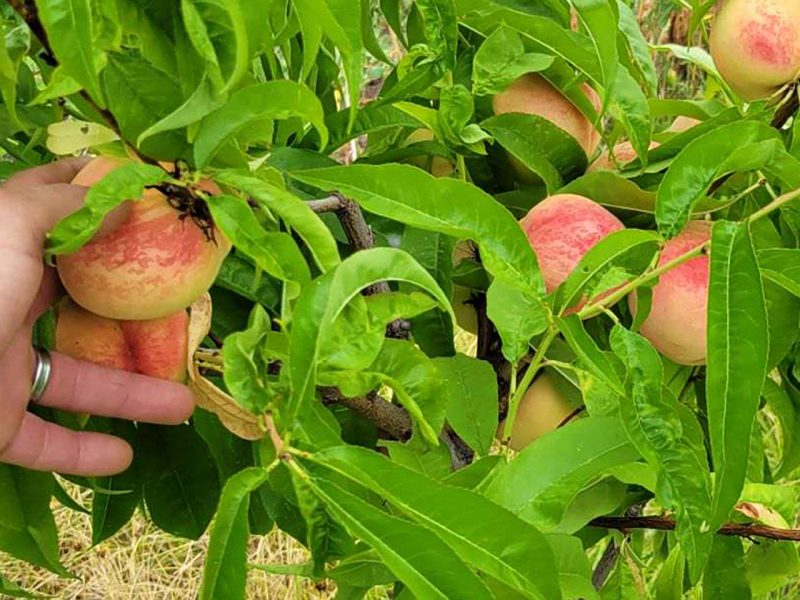
Cold winter weather and the cooler spring have profoundly affected the BC peach crops, with some producers reporting little or no production this year.

“A couple of the early varieties had blossoms and got pollinated. So, we had peaches on three types, a very light crop, but they are all finished now,” says Jennay Oliver of Paynter’s Fruit Market in West Kelowna.

Oliver’s orchard typically has 10 varieties of peaches. This year, its white-fleshed peaches, Red Globe and Harrow Diamond varieties were the only ones to pull through the winter.

“Everything else was totally wiped out,” she says.

Oliver attributes her peach crop’s decimation to last year’s frosty temperatures, which were intensified by one 24-hour period of intense winds.

“A lot of people were writing it up to the cold spring, but all of our buds were already dead by the time spring came around,” she says. “We had a really cold spell in December when the trees weren’t quite ready.”

BC growers harvested 6,166 tons of peaches in 2019, according to Statistics Canada. But the crop has fallen over the past two years and last year’s harvest was just 5,522 tons.

This year is slightly better than last year, but Oliver hopes for better growing conditions next year.

“The heat dome last year was terrible. That 45° was burning fruit and stopping production. I don’t know which year has been worse actually,” Oliver says. “Last year I remember being like, ‘I hope there is not another season like this again,’ but then this year, I hope there’s not another season like this one. It’s not fun to lose a crop of anything.”

Hoffman Orchards in Kelowna and Peter’s Orchards in Vernon also sustained significant losses in peaches.

Based on claims from insured growers, the BC Ministry of Agriculture and Food expects payouts will be on par with past years despite the significant losses.

“This year’s crop is significantly smaller than an average year and there have been 108 claims for peaches to date in 2022, about 20 more than an average year,” the ministry told Country Life in BC. “It is estimated about $450,000 will be paid out to insured peach growers in 2022, which is similar to an average year.”

Despite a lighter crop in the Okanagan, some areas still have some fruit for sale.

Paynter partners with a conventional farm in Osoyoos and an organic farm in Summerland, both of which reported hearty crops.

“It seems that everything north of Summerland has light crops but everything south of Summerland seem to have pretty good yields, at least the orchards we deal with,” Oliver says.

All content on this website is copyrighted, and cannot be republished or reproduced without permission.
Related Posts

You may be interested in these posts from the same category.

Peach report bullish on future opportunities

Previous Post: « Researchers probe blueberry disease
Next Post: Regional processing supported »

© 2026 COUNTRY LIFE IN BC - ALL RIGHTS RESERVED