
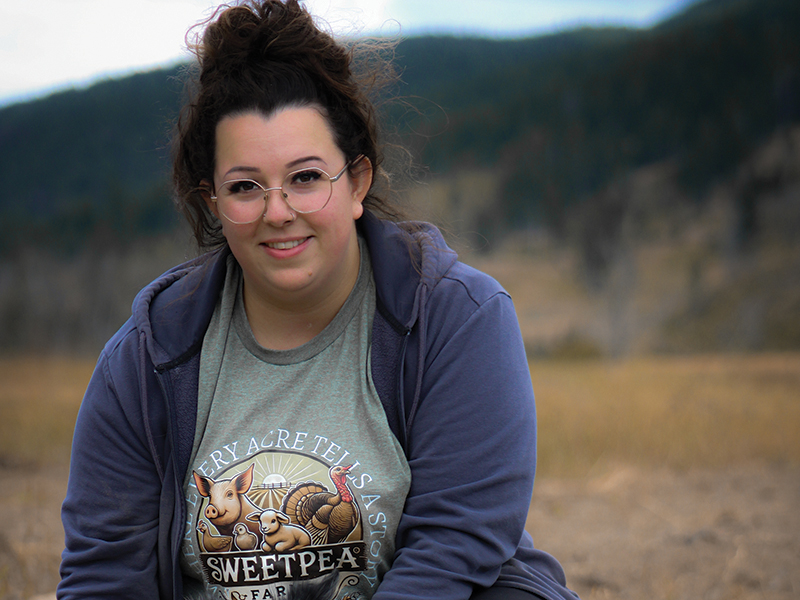
VERNON – Kaitlyne Peden wants to make a difference in how people perceive their food.
In her first full year operating Sweetpea Farms, the 25-year-old is raising chickens, turkeys and hogs on 15 acres of her parents’ 50-acre property on Westside Road outside Vernon.
“I started out because I wanted better quality meat for our family,” says Peden, who sees a market for meat produced outside large commercial operations.
Although she has no formal post-secondary education in agriculture, there’s a connection to her interest in meat, specifically hogs.
When she was very young, her father ran a 300-head hog operation at Cherryville. The collapse of the BC hog industry in the early 2000s prompted her father to change careers, but the memories stayed with her.
Peden is determined to make her meat business work, starting small and focusing on quality animal husbandry and sustainable practices. This year, she’s raising 100 broilers, 20 turkeys and 17 pigs, up from 30 chickens, six turkeys and five pigs last year.
The pigs are Yorkshire crosses, which mature in six to eight months.
“I raised the animals in 2024 mostly for us at first, to see if I liked doing this work as a job,” Peden explains.
She’s embraced solid farm business management practices, guided by a business plan drafted following a four-week startup program offered by Community Futures.
“They taught us the basics of starting your business, doing a business model canvas, learning about social media,” says Peden. “I found a really good social media connection from that experience.”
Business forecast projects in hand, she secured a Community Futures loan.
“My dad helped me get the loan,” remarks Peden. “We had to go through his name on the first one, then mine second, because I’m young and getting new business credit is hard.”
Her father, brother and boyfriend help build fences and shelters for the animals. But she’s priced the cost of her own labour into the cost of the meat.
She hopes keeping three pigs as breeders will help replenish her herd next year, an approach more economical than buying young pigs from others. She recently learned how to artificially inseminate pigs to avoid outsourcing that work.
There’s also the potential to add a few cattle to the farm. The property’s hillside, which was left much more open after the 2021 White Rock Lake fire, is suitable for grazing. (The fire also burned nine buildings on the property, including her parents’ and brother’s homes, but not hers.)
“I messaged a guy this morning who had a 720-pound heifer for which he wants $3,200. That’s too much for me, but I think in the fall I might find something more reasonable, cost-wise, because people will try and start offloading all their cattle, not wanting to feed them over the winter,” she says.
The pigs will be processed at Yankee Flats Meats in October, while JJ Family Farms is handling the chickens. She has yet to secure processing for the turkeys.
Peden praises both for accommodating smaller producers like herself because she knows trying to book time at larger facilities can be tough.
For now, she’s direct marketing, setting her prices by taking into account what others are charging and including her own cost of production. Ideally, she plans to market more individual cuts or cut meat boxes, producing a higher return compared to selling whole or half animals.
“I explain to people that you don’t get good quality food, animals raised where they have a good, happy life, without paying the price of that,” she says. “I come up against people all the time who say, ‘I’d love to shop from you, but I can’t afford you.’ I get it. I couldn’t afford to shop from myself, either, but this is the reality of small-scale farming and I do see people who are interested in how animals they eat are raised.”
She’d also like to sell at more farmers markets, but it means creating new labels for her meat products, costs that boost the retail price of the meat.
A self-professed quick problem solver, Peden is continuously learning and enjoying it. Key takeaways to date include the critical importance of planning and sticking to the plan as much as possible, holding others accountable to remain on schedule and only taking on what she’s comfortable with.
She says next year she’ll start 50 chickens rather than 100, a more easily manageable flock.
“I hate micromanaging, but you have to,” she says, adding that her dad would like her to pursue a Farmgate Plus licence so she can process her own animals.
On-farm processing would reduce her cost of production in the long run and potentially allow her to serve other small-scale producers. However, she sees the significant capital investment required, as well as how today’s regulations differ from her dad’s time in the industry, making it too big a step at this early stage.
In May, however, she stepped outside her comfort zone, pitching her business as one of 22 participants in the Community Futures Enterprise Challenge. She placed in the top five.
“It was the first year that the runner-ups got something. So, I have one month of advertising with Beach FM and a one-year Armstrong Chamber of Commerce membership,” she says.
She intends to use both in the future to advertise and to build her contact list. It’s a matter of timing and wanting to build cash flow, but understanding that advertising before she has meat ready doesn’t make sense or cents.
“I didn’t expect to be profitable this year, but I know I have to have my ducks in a row to ensure revenue,” she says.
Peden eventually wants to scale up her business, purchase her own property and lead workshops on animal husbandry and sustainable farming.
“I’d like to teach like-minded individuals like me about how they can raise meat and what it takes to do that. It’s important that we understand where our food comes from, and that we pay respect to where it comes from,” she says.
“It takes me about a week after the animals are processed to not feel a little sad, but I’m okay and I say my thanks to the earth and to my animals. Even vegans can pay respect to the plants they consume.”
 Apple marketing commission rejected