
• Menu
  • Skip to primary navigation
  • Skip to main content
  • Skip to primary sidebar

Country Life In BC Logo

The agricultural news source in British Columbia since 1915

  • Headlines
  • Calendar
  • Subscribe
  • Advertise
  • About
  • Archives
  • Contact
  • Search
  • Headlines
  • Calendar
  • Subscribe
  • Advertise
  • About
  • Archives
  • Contact
  • Search

Primary Sidebar

Originally published:

AUGUST 2025
Vol. 111 Issue 7

Subscribe Now!

Sign up for free weekly FARM NEWS UPDATES

Loading form…

Your information will not be
shared or sold ever

Stories In This Edition

Peek-a-boo

Hatching egg supplies tight

Farm losses driven by depreciation

On the rebound

Editorial: Growing concern

Back 40: Good neighbour, good night

Viewpoint: Retailer consolidation weakens the food system

Water shut-off orders loom as planning stalls

Greenhouse growers face new levy burden

Ag Briefs: Cabinet shuffle expands agriculture minister’s role

Ag Briefs: Apiarist John Boone dies

Ag Briefs: New nursery specialist appointed

Panel discussion identifies farming challenges

Consultation critical when markets move

Cherry field day showcases recent research

Fencing, hunting key to elk management

Here’s the beef

Land clearing with an eye to soil health

Irrigation gets efficient

Farmers urged to prepare for emergencies

More is better

Sweetpea Farms focuses on sustainable meat

Langley farms blend tradition with technnology

Foundation buys Pemberton farm

Farm Story: Weeding philosophical

Woodshed: Junkyard Frank falls for Newt’s movie star distraction

Langley couple defends farmers’ flying allies

Jude’s Kitchen: Choose local food to eat outdoors

All content on this website is copyrighted, and cannot be republished or reproduced without permission.

More Headlines

Follow us on Facebook

Comments Box SVG iconsUsed for the like, share, comment, and reaction icons

7 hours ago

A draft update to the Code of Practice for the Care and Handling of Beef Cattle is now open for public comment until June 12. The code, one of 14 animal care codes developed and maintained by the National Farm Animal Care Council, is undergoing a routine 10-year review. "Your feedback will help shape the industry's guide to cattle welfare for the next decade," says Canadian Cattle Association policy manager Jessica Radau, urging producers to weigh in. For more information, visit tinyurl.com/58a3u9fz.

#BCAg
... See MoreSee Less

A draft update to the Code of Practice for the Care and Handling of Beef Cattle is now open for public comment until June 12. The code, one of 14 animal care codes developed and maintained by the National Farm Animal Care Council, is undergoing a routine 10-year review.  Your feedback will help shape the industrys guide to cattle welfare for the next decade, says Canadian Cattle Association policy manager Jessica Radau, urging producers to weigh in. For more information, visit https://tinyurl.com/58a3u9fz.

#BCAg
View Comments
  • Likes: 2
  • Shares: 0
  • Comments: 1

Comment on Facebook

I sat in the webinar yesterday by the Canadian Cattle Association. My initial concern was that this would be another "play" into the government's hands. It has been worked on by people that are actually in the Beef industry from Cow calf to feedlot. The thrust is an update of the 2013 Code of Practice which was reviewed in 2018. The changes are more a move from "left to the producers discretion" to clearer directions regarding pain management, proper transport of animals which are impaired and keeping cattle in in good condition. Much of what is recommended is what producers who care about animal husbandry already do. The important part is to GIVE THEM FEEDBACK good, bad or otherwise. The document is about 60 pages long, and I ran it through CHAT to see what had been changed. It is important to understand that the PUBLIC is invited to comment on the draft not just producers. Think about it... do you really want the public influencing how you manage your cattle. If you think that this is just one of those things, I have been following Bill 22 in Alberta which will grant the SPCA a proactive roll in entering farms and checking on animals. When I asked CHAT how the new bill relates to the Cattle Code, it came back that the Code although not a regulation will be able to be used as a guide by producers for backup in dealing with the SPCA regarding cattle conditions, sick animal handling etc. Take the time.... Go onto the Canadian Cattle Association website and speak to those parts that you wish to input.

1 day ago

According to the BC River Forecast Centre, the Okanagan snowpack stood at just 58% of normal on April 1 — the lowest reading since measurements began in 1980 — raising concerns about drought conditions in the region this summer. The rest of the province sits at 92% of normal.

#BCAg
... See MoreSee Less

According to the BC River Forecast Centre, the Okanagan snowpack stood at just 58% of normal on April 1 — the lowest reading since measurements began in 1980 — raising concerns about drought conditions in the region this summer. The rest of the province sits at 92% of normal.

#BCAg
View Comments
  • Likes: 3
  • Shares: 0
  • Comments: 0

Comment on Facebook

2 days ago

At her first AGM as executive director of BC Meats, held Saturday in Abbotsford, Jennifer Busmann spoke about her strong ties to agriculture and her optimism for the organization's future. Busmann has cattle of her own and came to the role with existing relationships with members and the board of directors that helped her feel integrated from the start. She stepped into the position in Februa#BCAg#BCAg ... See MoreSee Less

At her first AGM as executive director of BC Meats, held Saturday in Abbotsford, Jennifer Busmann spoke about her strong ties to agriculture and her optimism for the organizations future. Busmann has cattle of her own and came to the role with existing relationships with members and the board of directors that helped her feel integrated from the start. She stepped into the position in February.

#BCAg
View Comments
  • Likes: 6
  • Shares: 0
  • Comments: 0

Comment on Facebook

4 days ago

Shannon Wiggins of Headwind Farm in North Saanich is this year's Mary Forstbauer Grant recipient from the BC Association of Farmers Markets. The $500 grant will help Wiggins expand her plot at Sandown Centre for Regenerative Agriculture, growing more storage crops to extend her harvest season. Wiggins credits farmers markets with inspiring her own farming journey and commitment to building community through food. Congratulations!

tinyurl.com/45bdd#BCAg#BCAg
... See MoreSee Less

Shannon Wiggins of Headwind Farm in North Saanich is this years Mary Forstbauer Grant recipient from the BC Association of Farmers Markets. The $500 grant will help Wiggins expand her plot at Sandown Centre for Regenerative Agriculture, growing more storage crops to extend her harvest season. Wiggins credits farmers markets with inspiring her own farming journey and commitment to building community through food. Congratulations!

https://tinyurl.com/45bddtw8

#BCAg
View Comments
  • Likes: 46
  • Shares: 2
  • Comments: 3

Comment on Facebook

Wahoo! Congrats Shannon! I love your produce. Can’t wait for the radishes 🫜

Congratulations!

Well done!! 🩷🩷🩷

6 days ago

New farmers can avoid costly mistakes by learning from those who've been there. At a Young Agrarians mixer in Penticton, five BC farmers shared hard-won lessons on pricing, pivoting, relationships and burnout. From coyote losses to business burnout, their message was clear: set prices that reflect true costs, make decisions quickly and don't let farming define your worth. Myrna Stark Leader's story appears in our April e-edition, now available to view online at: tinyurl#BCAg2uw53vvm

#BCAg
... See MoreSee Less

New farmers can avoid costly mistakes by learning from those whove been there. At a Young Agrarians mixer in Penticton, five BC farmers shared hard-won lessons on pricing, pivoting, relationships and burnout. From coyote losses to business burnout, their message was clear: set prices that reflect true costs, make decisions quickly and dont let farming define your worth. Myrna Stark Leaders story appears in our April e-edition, now available to view online at: https://tinyurl.com/2uw53vvm

#BCAg
View Comments
  • Likes: 15
  • Shares: 0
  • Comments: 0

Comment on Facebook

Subscribe | Advertise

The agricultural news source in British Columbia since 1915
  • Email
  • Facebook

Sweetpea Farms focuses on sustainable meat

Community Futures puts young farmer on path to success

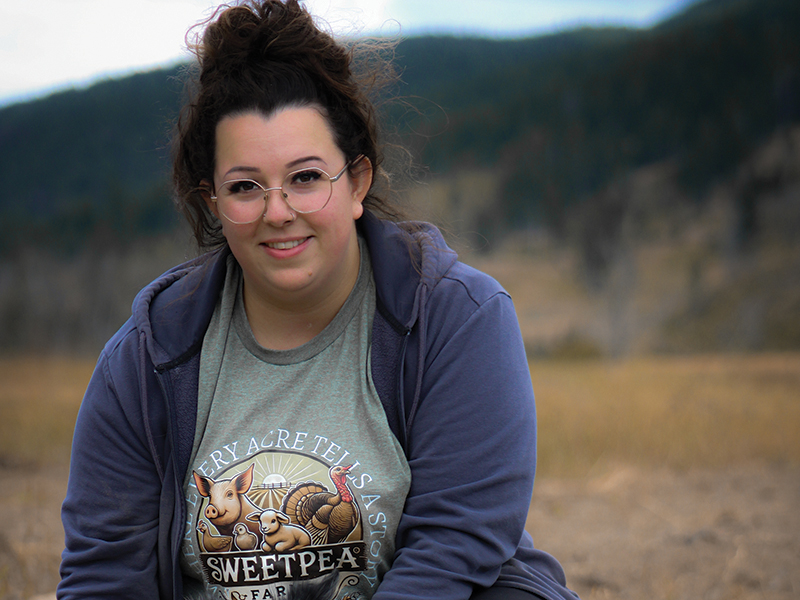
Kaitlyne Peden is dedicated to producing meat for people who want to know where their food comes from. SWEETPEA FARMS

August 5, 2025 byCommunity Futures Puts Young Farmer On Path To Success

VERNON – Kaitlyne Peden wants to make a difference in how people perceive their food.

In her first full year operating Sweetpea Farms, the 25-year-old is raising chickens, turkeys and hogs on 15 acres of her parents’ 50-acre property on Westside Road outside Vernon.

“I started out because I wanted better quality meat for our family,” says Peden, who sees a market for meat produced outside large commercial operations.

Although she has no formal post-secondary education in agriculture, there’s a connection to her interest in meat, specifically hogs.

When she was very young, her father ran a 300-head hog operation at Cherryville. The collapse of the BC hog industry in the early 2000s prompted her father to change careers, but the memories stayed with her.

Peden is determined to make her meat business work, starting small and focusing on quality animal husbandry and sustainable practices. This year, she’s raising 100 broilers, 20 turkeys and 17 pigs, up from 30 chickens, six turkeys and five pigs last year.

The pigs are Yorkshire crosses, which mature in six to eight months.

“I raised the animals in 2024 mostly for us at first, to see if I liked doing this work as a job,” Peden explains.

She’s embraced solid farm business management practices, guided by a business plan drafted following a four-week startup program offered by Community Futures.

“They taught us the basics of starting your business, doing a business model canvas, learning about social media,” says Peden. “I found a really good social media connection from that experience.”

Business forecast projects in hand, she secured a Community Futures loan.

“My dad helped me get the loan,” remarks Peden. “We had to go through his name on the first one, then mine second, because I’m young and getting new business credit is hard.”

Her father, brother and boyfriend help build fences and shelters for the animals. But she’s priced the cost of her own labour into the cost of the meat.

She hopes keeping three pigs as breeders will help replenish her herd next year, an approach more economical than buying young pigs from others. She recently learned how to artificially inseminate pigs to avoid outsourcing that work.

There’s also the potential to add a few cattle to the farm. The property’s hillside, which was left much more open after the 2021 White Rock Lake fire, is suitable for grazing. (The fire also burned nine buildings on the property, including her parents’ and brother’s homes, but not hers.)

“I messaged a guy this morning who had a 720-pound heifer for which he wants $3,200. That’s too much for me, but I think in the fall I might find something more reasonable, cost-wise, because people will try and start offloading all their cattle, not wanting to feed them over the winter,” she says.

The pigs will be processed at Yankee Flats Meats in October, while JJ Family Farms is handling the chickens. She has yet to secure processing for the turkeys.

Peden praises both for accommodating smaller producers like herself because she knows trying to book time at larger facilities can be tough.

For now, she’s direct marketing, setting her prices by taking into account what others are charging and including her own cost of production. Ideally, she plans to market more individual cuts or cut meat boxes, producing a higher return compared to selling whole or half animals.

“I explain to people that you don’t get good quality food, animals raised where they have a good, happy life, without paying the price of that,” she says. “I come up against people all the time who say, ‘I’d love to shop from you, but I can’t afford you.’ I get it. I couldn’t afford to shop from myself, either, but this is the reality of small-scale farming and I do see people who are interested in how animals they eat are raised.”

She’d also like to sell at more farmers markets, but it means creating new labels for her meat products, costs that boost the retail price of the meat.

A self-professed quick problem solver, Peden is continuously learning and enjoying it. Key takeaways to date include the critical importance of planning and sticking to the plan as much as possible, holding others accountable to remain on schedule and only taking on what she’s comfortable with.

She says next year she’ll start 50 chickens rather than 100, a more easily manageable flock.

“I hate micromanaging, but you have to,” she says, adding that her dad would like her to pursue a Farmgate Plus licence so she can process her own animals.

On-farm processing would reduce her cost of production in the long run and potentially allow her to serve other small-scale producers. However, she sees the significant capital investment required, as well as how today’s regulations differ from her dad’s time in the industry, making it too big a step at this early stage.

In May, however, she stepped outside her comfort zone, pitching her business as one of 22 participants in the Community Futures Enterprise Challenge. She placed in the top five.

“It was the first year that the runner-ups got something. So, I have one month of advertising with Beach FM and a one-year Armstrong Chamber of Commerce membership,” she says.

She intends to use both in the future to advertise and to build her contact list. It’s a matter of timing and wanting to build cash flow, but understanding that advertising before she has meat ready doesn’t make sense or cents.

“I didn’t expect to be profitable this year, but I know I have to have my ducks in a row to ensure revenue,” she says.

Peden eventually wants to scale up her business, purchase her own property and lead workshops on animal husbandry and sustainable farming.

“I’d like to teach like-minded individuals like me about how they can raise meat and what it takes to do that. It’s important that we understand where our food comes from, and that we pay respect to where it comes from,” she says.

“It takes me about a week after the animals are processed to not feel a little sad, but I’m okay and I say my thanks to the earth and to my animals. Even vegans can pay respect to the plants they consume.”

All content on this website is copyrighted, and cannot be republished or reproduced without permission.

Related Posts

You may be interested in these posts from the same category.

Previous Post: « Apple marketing commission rejected
Next Post: Food costs in Conservative crosshairs »

© 2026 COUNTRY LIFE IN BC - ALL RIGHTS RESERVED