
• Menu
  • Skip to primary navigation
  • Skip to main content
  • Skip to primary sidebar

Country Life In BC Logo

The agricultural news source in British Columbia since 1915

  • Headlines
  • Calendar
  • Subscribe
  • Advertise
  • About
  • Archives
  • Contact
  • Search
  • Headlines
  • Calendar
  • Subscribe
  • Advertise
  • About
  • Archives
  • Contact
  • Search

Primary Sidebar

Originally published:

NOVEMBER 2021
Vol. 107 Issue 11

Subscribe Now!

Sign up for free weekly FARM NEWS UPDATES

Loading form…

Your information will not be
shared or sold ever

Stories In This Edition

Down to the crunch

Producer prices on the rise

Feeling burned

Groundwater users could lose rights next year

The right thing

Editorial: Freedom worth having

Back 40: The battle continues long after the war is over

Viewpoint: Stories bridge the gap between producers, consumers

Growers wrestle with irrigation upgrades

Wildfire 2021

Abbotsford updates farmland policies

Stormy skies

Ag Briefs: Douglas Lake “right to roam” challenge dismissed

Ag Briefs: Creston food hub opens

Ag Briefs: Food processors receive funding

Ag Briefs: Vanderspek appointed

Summerland grape specialists retire

Grapevine virus spread threatens BC industry

Caught in the act

Abbotsford sheep grower honoured

Tag readers help with livestock recordkeeping

RegenBC kicks off agritech network

Producers silent on Columbia River Treaty impacts

Cranberry fields forever

Manitoba farmers make dreams a reality

Enderby dairy is anything but conventional

Improvement to classification services explored

Up close and personal

Partnering with farmers to reduce food loss

Sidebar: Upcycled food

Slow and steady wins the day for irrigation

Research: Study takes soil health to the next level

Nelson farm builds soil and local community

Cash flow analysis is key to resilience

New app zeroes in on reducing lost produce

Sidebar: Food hub offers room to grow

Farm Story: To hoard or not to hoard: that is the question

Bursary benefits rising farm professionals

Woodshed: So much for a little peace and quiet

Saanichton Farm receives Century Farm award

Jude’s Kitchen: Fall Flavours

More Headlines

Follow us on Facebook

Comments Box SVG iconsUsed for the like, share, comment, and reaction icons

2 days ago

Full-time students employed in BC agriculture during the summer season are eligible to apply for a bursary of up to $3,000. The bursary, administered by the Investment Agriculture Foundation, aims to increase youth and domestic seasonal worker employment in the ag sector. Funding is awarded on a first-come, first-serve basis. More information is available at tinyurl.com/5ef6pe3m

#BCAg IAF
... See MoreSee Less

Full-time students employed in BC agriculture during the summer season are eligible to apply for a bursary of up to $3,000. The bursary, administered by the Investment Agriculture Foundation, aims to increase youth and domestic seasonal worker employment in the ag sector. Funding is awarded on a first-come, first-serve basis. More information is available at https://tinyurl.com/5ef6pe3m

#BCAg IAF
View Comments
  • Likes: 13
  • Shares: 11
  • Comments: 0

Comment on Facebook

3 days ago

BC fruit and vegetable farmers are being asked to share their views on farming technology in a 10-minute survey from Royal Roads University and the University of the Fraser Valley. The survey looks at how fruit and vegetable farmers are adopting emerging farming technologies -- such as digital tools, “controlled environment agriculture systems” (greenhouses) and agri-genomics (DNA analysis) -- to cope with changing climate conditions. The survey takes about 10 minutes to complete, and participants will be eligible to win an assortment of $50-$200 gift cards.

insights.kaianalytics.com/s3/PAS2026
... See MoreSee Less

BC fruit and vegetable farmers are being asked to share their views on farming technology in a 10-minute survey from Royal Roads University and the University of the Fraser Valley. The survey looks at how fruit and vegetable farmers are adopting emerging farming technologies -- such as digital tools, “controlled environment agriculture systems” (greenhouses) and agri-genomics (DNA analysis) -- to cope with changing climate conditions. The survey takes about 10 minutes to complete, and participants will be eligible to win an assortment of $50-$200 gift cards. 

https://insights.kaianalytics.com/s3/PAS2026
View Comments
  • Likes: 5
  • Shares: 1
  • Comments: 0

Comment on Facebook

3 days ago

The District of Coldstream is proposing the creation of farm property tax subclasses to distinguish between small-scale and large-scale farm operations. Currently, all farms are classified as Class 9 regardless of size or infrastructure needs. The district argues larger farms require more municipal services and should be taxed accordingly. It plans to pitch its proposal at the Southern Interior Local Government Association convention in Revelstoke at the end of April. Support there could escalate the discussion to the Union of BC Municipalities convention next September in Vancouver.

#BCAg
... See MoreSee Less

The District of Coldstream is proposing the creation of farm property tax subclasses to distinguish between small-scale and large-scale farm operations. Currently, all farms are classified as Class 9 regardless of size or infrastructure needs. The district argues larger farms require more municipal services and should be taxed accordingly. It plans to pitch its proposal at the  Southern Interior Local Government Association convention in Revelstoke at the end of April. Support there could escalate the discussion to the Union of BC Municipalities convention next September in Vancouver. 

#BCAg
View Comments
  • Likes: 12
  • Shares: 2
  • Comments: 11

Comment on Facebook

Which municipal services do they require more of? Even larger farms typically still have only one or possibly two dwellings. Most have their own well and septic, and I suppose it depends on location, but most rural properties don't have garbage pick up either. And whether 20 driveways or one join the road, the cost to plow that road is the same. I no longer live within a municipality so of course there could be costs I've overlooked that are contributing to the District's proposal.

Large farms put more back into the community too.

The larger farms are the only farms paying wages, allowing people to spend money in their communities, the beauty of a network of small business. Small farms more often then not, is a single transaction, a hobby. Large- buy feed, raise cow, calf is born, sell calf, pay wage(support livlihoods), buy fence posts, buy more feed and so forth. Feeding the community. Small- Buy feed, raise cow, kill cow, eat cow.

And this is why farmers left California. British Columbia is no different

I am not sure how to post the actual Resolution that Council Pat Cochrane put forward but here is the link to the special meeting they are holding to pass the resolution: www.coldstream.ca/government-bylaws/news-alerts/notice-special-council-meeting-3.

Why not find ways to bring in more business's and audit municipal spending and regulate short term rentals (because Coldstream has essentially zero places to stay technically, insane) instead of raising taxes arbitrarily because "bigger costs more"

Attending that meeting, they claimed that “large farms” use more municipal services, yet Cochrane consistently stated he was going after “smaller estate properties not actively farming.” This is not only contradictory but misinformed. It would take him but three door knocks before he learned that the “estate farms” not actively farming are typically leased to a larger conglomerate to maintain farm classification. “Rural living at its finest,” though it seems not a soul on council is well-versed in this wheelhouse. What’s worse is that they somehow don’t think it’s necessary to bring in a single subject expert before blindly tossing around recommendations and solutions to problems that don’t really exist—or at least not as they perceive them. Don’t get me started on their rhetoric comparing the value of class 9 properties to other residential classes, when even my 12 year old understands that the values are drastically different when one property can be subdivided, and an ALR property cannot. Forever to the left of the point.

They want to tax a large farm more? Do people realize that farmers aren't becoming rich. Also, a small or hobby farm isn't contributing much to the local economy or community. This doesn't make sense. If we don't support our farmers. We need them. We can't import all our food.

What bs. I can't do a water and sewer hook up for an agricultural building, (a farm vegie stand) on a 160 acre farm in downtown Kelowna because there is already one at the far end of the lot for the principal residence. What extra infrastructure would they be talking about. Our irrigation is by licensed ground water well put in, powered and serviced by me. Any change in tax code should be on farm estates that do bogus farm gate sales at the minimum requirement, not viable commercial farming enterprizes that employ and contribute economic benefits to so many other businesses

Instead of increasing property taxes on large farms, I think governments need to revise the threshold needed for a property to qualify for farm status. That threshold has not changed in over 20 years and many non farmers are taking advantage of the ridiculously low threshold that was intended for real farmers.

And then you tax the farmers more and wonder why food prices keep going up. Why is it that the only thing government does is find more reasons and ways to tax people?

View more comments

4 days ago

The Township of Langley Farm and Ranch Exhibition Society is hosting a public open house this evening to gather input on plans to transform the historic Belmont Farm into an agricultural exhibition, education and heritage hub. Farmers, ranchers, and community members are invited to share their feedback. The open house is at the George Preston Rec Centre, 6-8 pm.

Township of Langley Farm and Ranch Exhibition Society
#BCAg
... See MoreSee Less

The Township of Langley Farm and Ranch Exhibition Society is hosting a public open house this evening to gather input on plans to transform the historic Belmont Farm into an agricultural exhibition, education and heritage hub. Farmers, ranchers, and community members are invited to share their feedback. The open house is at the George Preston Rec Centre, 6-8 pm. 

Township of Langley Farm and Ranch Exhibition Society 
#BCAg
View Comments
  • Likes: 23
  • Shares: 0
  • Comments: 2

Comment on Facebook

Me too :(

Shucks, would have liked to attend but just seeing this now.

4 days ago

The sold-out Southern Interior Horticulture show continues today. Education sessions range from rodent control to new tree fruit varieties, with the afternoon devoted to improving spraying techniques for orchardists and vineyard managers. When not listening to speakers, producers are checking the trade show.

#BCAg
... See MoreSee Less

The sold-out Southern Interior Horticulture show continues today. Education sessions range from rodent control to new tree fruit varieties, with the afternoon devoted to improving spraying techniques for orchardists and vineyard managers. When not listening to speakers, producers are checking the trade show.

#BCAg
View Comments
  • Likes: 9
  • Shares: 0
  • Comments: 0

Comment on Facebook

Subscribe | Advertise

The agricultural news source in British Columbia since 1915
  • Email
  • Facebook

To hoard or not to hoard: that is the question

November 1, 2021 byAnna Helmer

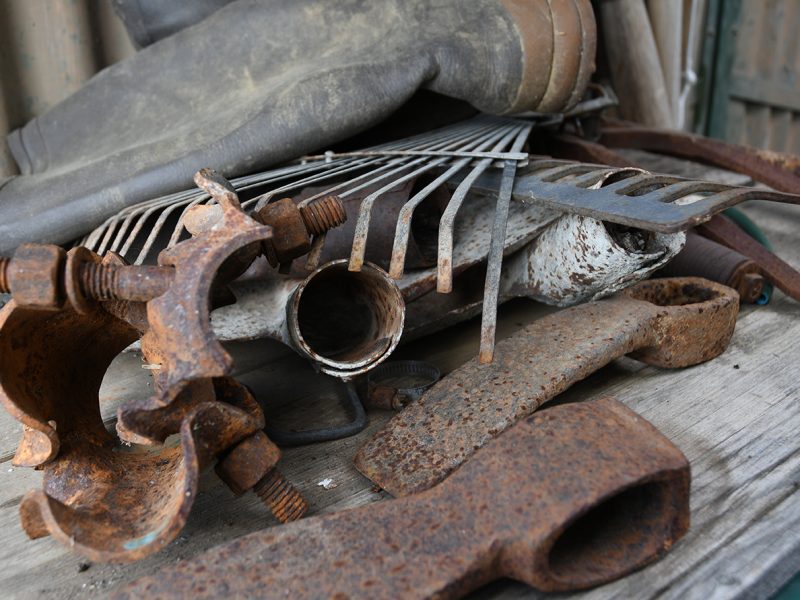
It could be said, so I’ll say it here, that it’s quite likely farmers come in two types: those who save their scrap metal, and those who do not. Obviously, there are myriad further sub-types. Farmers are a complicated, thoughtful, diverse and stereotype-busting bunch and I would be the last to publicly suggest otherwise. On my farm, however, it seems we are divided by our approach to metal.

Metal is the inevitable issue of farming with all this necessary metal equipment. Left behind following modifications, strip downs and breakdowns, it seems metal begets metal. Scrap metal. Call it what you will, I don’t want to part with any of it, a position reinforced almost regularly when a new purpose is found for previously useless pieces of metal. I don’t know what the future looks like. I must keep it all.

It gets stashed. I hoard with relish and use with triumph. My personal inventory, the metal I have been involved in scrapping, is pleasingly diverse and extensive. Ranging from the smallest bits to large – in all their enormous, cumbersome and weighty glory – I even remember where most if it originated. There are shelves stuffed with nuts and bolts and random cuts. There are two or three diminishing digger chains, the links gradually being re-purposed as trellising stakes in the greenhouse and gardens. Several historical hydraulic cylinders are almost certainly stacked in a corner I haven’t been back to for a few years. A rather extensive selection of broken S-tines, bent cultivator tools and cracked cast iron items requiring repiling reside there as well. Discs with broken bearing centres are starting to line the barn walls, and old potato planter and harvester gears are in a bin so heavy it might never move again.

This year, I was very pleased to use the good end of a length of a long-ago driven-upon water pipe, which I had poked into the bushes at the time both to hide the evidence and to save for later use. I dragged it out, cut off the crushed part, and attached the remaining six feet to the line. The muddy bank on the swimming hole was thusly cleared, thereby allowing clear water to gush forth.

Good thing I kept that broken pipe, right? All you metal-throwing-out-farmer-people who cavorted in a swimmable pond during a heat wave should be thankful.

I anticipate going through the usual middle-aged creative welding phase which I hope will consume the whacks of handle-less shovels, spades, forks and rebar tidbits I have saved for this eventuality. At least, I hope it does because I need to get ahead of the growing inventory. It is a troubling fact that the other type of farmer, the one who does not save scrap metal, exists on my farm. They are active, enterprising and tend to sneak my metal off for recycling.

Anyways, I digress. What I really wanted to talk about is social media and how to constructively manage its shockingly addictive nature. Kidding. I have no idea how to do that.

I would also like to mention fall farming and how thankful I am that it has arrived. A day rarely passed in this rain-less summer, as successive heat waves followed the heat dome, where I didn’t wistfully reflect on the inevitable yet impossibly distant arrival of autumn. Not to sound too dreary about it, but I held fast to the vision of a cold, wet fall.

Sure enough, the fields are getting too muddy to work, raindrops are rolling down my neck and I am contending with cold fingers in inadequate work gloves.

It’s really all I dreamed of.

Anna Helmer’s farms in Pemberton with her family of several types.

Related Posts

You may be interested in these posts from the same category.

Previous Post: « Wildfire 2021: ‘They keep locals in the dark. That is really problematic.’
Next Post: Helping cattle keep their cool in the heat »

Copyright © 2026 Country Life in BC · All Rights Reserved