
CRESTON – Planning work currently underway for the Goat River watershed holds promise for a proactive approach to watershed restoration, setting an example for other areas of the province.
Most efforts to develop watershed plans in BC have been in response to regulatory actions. Over the last seven years, the province has issued repeated temporary protection orders on the Salmon, Koksilah and Bessette watersheds.
The BC Cattlemen’s Association and local groups are spearheading projects in the Salmon and Bessette areas, and a government-to-government process is underway between the Cowichan Tribes and the province in the Koksilah.
That is not the case for the Goat River.
“We have not yet been in crisis,” explains Paris Marshall Smith, sustainability and resilience supervisor for the Regional District of Central Kootenay (RDCK). “We are seeing a growing situation of water scarcity and are wanting to be proactive and build strong community response in preparation for difficult conversations to come. Water scarcity concerns have come from residents and producers, who were noticing lower late-summer flows, earlier freshet and less reliable wells.”
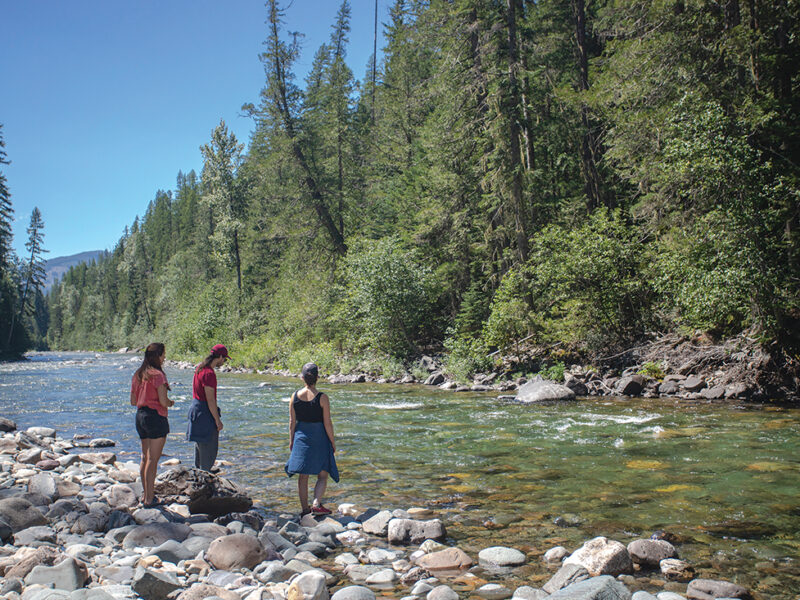
The Goat River is a 65-kilometre glacier-fed system that begins in the Purcell Mountains north of Hwy 3 and flows southwest through the farming community of Erickson to join the Kootenay River just below Creston. Aside from a small dam supplying power to Creston, the river flows free.
The benchlands between Creston and Erickson are BC’s third-largest tree-fruit production region after the Okanagan and Similkameen valleys, and water security has long been a key concern.
“Agriculture is the largest water user in the Goat River watershed,” says Danny Turner, a newly elected RDCK director who grows cherries, strawberries and blueberries at Just a Mere Farms on the Erickson bench. “We are also the largest economy in the area, worth between $75 [million] and $100 million.”
Other major water users include RDCK Water Services, local irrigation and improvement districts, the Columbia Brewery and Creston Golf Club.
Turner says the agriculture sector would like to see a 50- to 100-year watershed plan, with farmers part of the process and the solution.
“We are not just users; we need to be seen as partners with [RDCK Water Services],” he says. “Having agriculture at the table for when we do get to the strategy and solutioning phases will be the way that we will come to a solution that works for everyone.”
Taking the lead
In May 2024, the Lower Kootenay Band (yaqan nuʔkiy) and RDCK wrote the BC Ministry of Water, Land and Resource Stewardship (WLRS), saying they wanted to lead the planning process and asked for support.
“WLRS agreed, recognizing the need for a new, collaborative approach to watershed stewardship in the valley,” Marshall Smith says.
A scoping process began in summer 2025 with a public survey followed by a series of open houses in October. Direct producer engagement took place earlier this year, led by a coordinator who visited farms and had one-on-one conversations with growers.
The engagement led to a report identifying seven themes: changing water conditions, water availability, infrastructure, land use, governance, communication and local adaptation.
Marshall Smith says agricultural producers’ key concerns centred on the timing of water flow more than total supply, along with infrastructure and delivery problems, risks to perennial crops like cherries and apples, and a preference for incentive-based approaches over restrictions.
In February of this year, the province wrote to the RDCK and yaqan nuʔkiy proposing a series of discussions. A working group co-led by RDCK, yaqan nuʔkiy and the province was struck to identify solutions and consider a path forward.
The working group was scheduled to wrap up at the end of October and present its findings to each leadership group, but Marshall Smith says it’s still too early to discuss solutions.
“Some people have the expectation that we were presenting a plan, but that was not our intention,” she explains. “There really is an interest to flush out every possible tool that could respond to this situation.”
With board approval, RDCK and yaqan nuʔkiy will move into the next phase of the process and begin developing a formal water sustainability plan under the Water Sustainability Act.
Though the parties have accomplished a good deal in 18 months, RDCK community resilience coordinator Camille LeBlanc says the current work advances conversations that began in 2018.
“Our strength lies in the relationships that have developed between Paris the yaqan nuʔkiy and the RDCK board,” she says. “We have had strong public engagement as well.”
Commitment from RDCK has also been key, Marshall Smith points out.
“It’s been an incredible amount of work, but we have been able to do all of this work in-house rather than going out to consultants,” she says. “And I think that just strengthens everything.”
All content on this website is copyrighted, and cannot be republished or reproduced without permission.
