• Menu
  • Skip to primary navigation
  • Skip to main content
  • Skip to primary sidebar

Country Life In BC Logo

The agricultural news source in British Columbia since 1915

  • Headlines
  • Calendar
  • Subscribe
  • Advertise
  • About
  • Archives
  • Contact
  • Search
  • Headlines
  • Calendar
  • Subscribe
  • Advertise
  • About
  • Archives
  • Contact
  • Search

Primary Sidebar

Originally published:

FEBRUARY 2020
Vol. 106 Issue 2

Subscribe Now!

Sign up for free weekly FARM NEWS UPDATES

Select list(s) to subscribe to


By submitting this form, you are consenting to receive marketing emails from: Country Life in BC. You can revoke your consent to receive emails at any time by using the SafeUnsubscribe® link, found at the bottom of every email. Emails are serviced by Constant Contact
Your information will not be
shared or sold ever

Stories In This Edition

Perfect pruning

Open ears

Tough talk on animal activists

Peace, Cariboo top 2019 farm and ranch sales

Duckin’ a snow storm

Editorial: Change of heart

Back 40: Retirement is inevitable but less so for farmers

Viewpoint: Leading a decade of growth in organics

Banding together to attract domestic workers

Ag council helps avert seasonal worker delays

Dairy producers urged to polish public image

Snow day

New certification program launched for plant exporters

New executive director for COABC appointed

Ag Briefs: BC dairies push back on Class 7 proposal

Ag Briefs: Agri Innovation projects announced

Ag Briefs: Province selects Ruckle managers

Partnerships facilitate Langley learning farm

Feed BC program good in theory but has limitations

Opportunities and challenges

Halal demand rising in Western Canada

Trespass incident boosts public awareness

Sheep killings raise concerns in Lower Mainland

Pruning priorities different for FV grapegrowers

Farm plans offer new opportunities for rnachers

Number crunchers

Ranchers, foresters learn to share the road

Raise your claves so buyers play with a full deck

Boosting calf health starts before birth

Reseeding part of range restoration

Capacity crowd at Interior soils conference

Global blueberry growers look at substrate potential

Saving the peatlands

Blueberry breeding focuses on quality, exports

Research promises to help control SWD

Novel cherry trellising system saves money

Research: The effects of separating cows and calves

Farm News: Buckling down for winter conference season

Black walnuts are an option for water-logged land

Researcher provides deworming tips for sheep

Wasabi a hot option for wellness products

Technology key to tree fruit industry’s future

New broiler barn boosts comfort for birds

Woodshed Chronicles: Junkyard Frank’s plan is played to perfection

Give your marriage a relationship check-up

Bursary fund welcomes applications

Apple of your eye

More Headlines

Follow us on Facebook

Comments Box SVG iconsUsed for the like, share, comment, and reaction icons

7 days ago

... See MoreSee Less

View Comments
  • Likes: 4
  • Shares: 0
  • Comments: 0

Comment on Facebook

7 days ago

On the last day of the BC Organic Conference, Thursday, Molly Thurston of Pearl Agricultural Consulting helped growers learn how to manage bugs such as codling moth, wireworm, and rootworm in organic growing systems. Her talk alongside Renee Prasad included hands-on activities in which participants checked out various traps and examined pests under microscopes. Be sure to look for more upcoming ag events on our online calendar at www.countrylifeinbc.com/calendar/

#BCAg
... See MoreSee Less

On the last day of the BC Organic Conference, Thursday, Molly Thurston of Pearl Agricultural Consulting helped growers learn how to manage bugs such as codling moth, wireworm, and rootworm in organic growing systems. Her talk alongside Renee Prasad included hands-on activities in which participants checked out various traps and examined pests under microscopes. Be sure to look for more upcoming ag events on our online calendar at www.countrylifeinbc.com/calendar/

#BCAg
View Comments
  • Likes: 15
  • Shares: 0
  • Comments: 0

Comment on Facebook

1 week ago

Well-known organic farmer and podcaster Jordan Marr gets interviewed by Country Life in BC’s own columnist and potato mavin Anna Helmer during the opening session of the BC Organic Conference at Harrison Hot Springs yesterday. Sessions run today (Wednesday) and Thursday and include organic and regenerative growing practices and expanding and advocating for the organic sector, all under the background of the newly launched Organic BC banner.

#BCAg
... See MoreSee Less

Well-known organic farmer and podcaster Jordan Marr gets interviewed by Country Life in BC’s own columnist and potato mavin Anna Helmer during the opening session of the BC Organic Conference at Harrison Hot Springs yesterday. Sessions run today (Wednesday) and Thursday and include organic and regenerative growing practices and expanding and advocating for the organic sector, all under the background of the newly launched Organic BC banner.

#BCAg
View Comments
  • Likes: 37
  • Shares: 2
  • Comments: 1

Comment on Facebook

Interested in finding out more about this

3 weeks ago

Today, we remember those who sacrificed their lives or their well-being for our freedom. Lest we forget. ... See MoreSee Less

Today, we remember those who sacrificed their lives or their well-being for our freedom. Lest we forget.
View Comments
  • Likes: 8
  • Shares: 0
  • Comments: 0

Comment on Facebook

1 month ago

FarmFolk CItyFolk is hosting its biennial BC Seed Gathering in Harrison Hot Springs November 27 and 28. Farmers, gardeners and seed advocates are invited to learn more about seed through topics like growing perennial vegetables for seed, advances in seed breeding for crop resilience, seed production as a whole and much more. David Catzel, BC Seed Security program manager with FF/CF will talk about how the Citizen Seed Trail program is helping advance seed development in BC. Expect newcomers, experts and seed-curious individuals to talk about how seed saving is a necessity for food security. ... See MoreSee Less

Link thumbnail

BC Seed Gathering - FarmFolk CityFolk

farmfolkcityfolk.ca

Save the date for our upcoming 2023 BC Seed Gathering happening this November 3rd and 4th at the Richmond Kwantlen Polytechnic University campus.
View Comments
  • Likes: 1
  • Shares: 0
  • Comments: 0

Comment on Facebook

Subscribe | Advertise

The agricultural news source in British Columbia since 1915
  • Email
  • Facebook

Black walnuts are an option for water-logged land

Processing capacity critical to scaling up new venture

February 1, 2020 byMyrna Stark Leader

KELOWNA – After 10 years in the growing phase, a Kelowna agro-forestry producer is gathering the seeds of her labour and looking at increasing processing capability for herself and others.

Twenty years ago, Brenda Dureault, then a nurse, moved to a 26-acre property owned by her father to raise her children. Curly Frog Farm, as she named it, was a pasture with a natural pond. After purchasing the land in 2009, she increased her farming focus and searched for products she could self-manage and were tolerant of water because the creek flowing through her land regularly submerges a sizeable chunk of the farm.

“We’ve canoed over this land,” Dureault says, pointing to logs water-lifted from pond areas and deposited among her trees.

The creek is classified as environmentally sensitive, so there’s little opportunity to block or divert the water. Determined to find a workable crop, she planted black walnuts, a native North American species suggested by the BC Ministry of Forests, Lands, Natural Resource Operations and Rural Development. After germinating the seed herself, she planted the first rows in 2009-10.

Black walnuts have long taproots. In addition to their ability to draw up water, the nuts have a unique flavour and nutritional qualities, as well as producing high-value hardwood lumber if the trees are straight and free of defects.

Dureault has continually collected seed from the best trees and conducted selective breeding in the small greenhouse attached to her home to improve the quality of her nuts and the potential for the trees to eventually be logged for timber. She also wants them to be resilient to climate change.

Optimum land use

Making the best use of the land, she interspersed the walnut trees with Christmas trees, which will be ready for cutting in 2020. She also grows berries, herbs, willows for crafts (which she sells at markets and online), as well as pawpaw trees. She’s planted 400 pawpaws, many on chinampas, an ancient Aztec way of growing on land with high water tables.

“Mine were built a few years ago in a wetlands

co-operative project with the BC Wildlife Federation. We excavated soils two feet to create long narrow canals with mounds adjacent. The canals fill with water creating wetlands and the strips of higher ground brought more land for productive agriculture,” says Dureault, who’s still waiting for the pawpaws to bear fruit.

Waiting is not the case, however, with the nuts. Her maturing trees yielded about 600 pounds of hulled black walnuts last year; full production can be up to 1,500 pounds per acre.

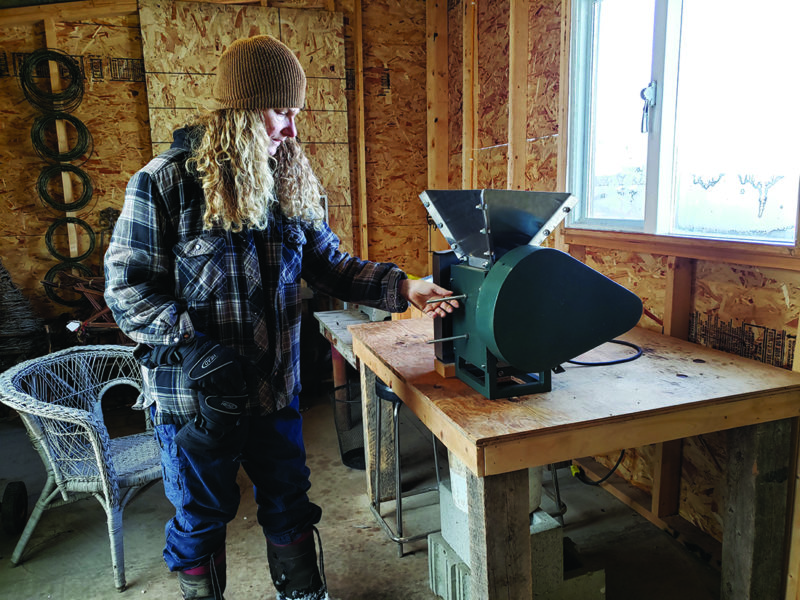
Unlike the English walnuts most people are familiar with, black walnuts are encased in a hull and have an extremely hard shell. With smaller quantities, Dureault used a hand-cracker as well as an electric nutcracker made by a local friend to break the nuts apart and harvest the meat. It works well with softer shelled nuts but the black walnuts had to go through the electric cracker four to five times to sufficiently break them, a time-consuming process producing about 8 to 12 ounces of nuts an hour.

“I separate the nutmeat by dumping cracked nuts onto a box outfitted with two different-sized removable screens to sift out the small nut pieces. Then I have to put the leftovers back into the cracker for re-cracking,” explains Dureault. “It’s not economically feasible to process black walnuts by hand as the foundation for a profitable business. I’d like to set up a professional, small-scale commercial nut processing facility to add value to my own crop as well as provide a service to other local nut growers. There are about a dozen growers in the Okanagan Valley who have shown interest in my ability to help them with processing nuts.”

Processing challenges

While the 40 hazelnut growers in BC send their nuts to Fraser Valley Hazelnuts for processing, part of the supply chain for Oregon processors, no similar facility exists for black walnut growers. Dureault reached out to Fraser Valley Hazelnuts, which told her it only processes hazelnuts.

Most equipment is designed for large-scale operations or other walnuts, and is too costly for operations the size of Curly Frog, so Dureault approached UBC Okanagan.

UBCO consistently looks for real-life projects for senior engineering students to tackle, solving a challenge from concept and design to finished product. Dureault hoped students could develop equipment that could process 75 to 100 pounds (or more) of black walnuts an hour. This included a machine to hull and clean the nuts, a cracking machine capable of cracking 600 to 900 lbs of black walnuts an hour and a sorting machine to separate shell from nutmeat once they are cracked.

Student Alex Russell stepped up and worked on the project with a team of students.

“I picked this project from 40 options because with farming, you actually needed to create a tangible thing. And we were also helping someone in the community,” says Russell.

“It’s definitely an improvement and cracks English walnuts beautifully. Some fine-tuning is needed to size the machine to crack smaller nuts like hazelnuts and more engineering is required to determine motor size and RPM to achieve the force of 500 foot-pounds required to crack black walnuts,” says Dureault showing off her new equipment.

Unfortunately, time constraints only let the students build the cracker the first year so she’s gone back.

“The second project is a machine that separates nutmeat from shell as well as to fine-tune/modify the cracker. I’m told they have a prototype already built and tested on English walnuts,” Dureault says.

Dureault encourages other producers to look at students who can offer a fresh perspective, especially when a project’s scope is beyond their capabilities or annual farm income is below the $30,000 required to obtain matching funds from the province.

“I’d like to set up a professional, small-scale commercial nut processing facility to add value to my own crop as well as provide a service to other local nut growers. There are about a dozen growers in the Okanagan Valley who have shown interest in my ability to help them with processing nuts,” she says.

Working with the students taught her more critical thinking and problem solving, how to communicate her ideas and patience. She says it’s a slower process, but economical. As the client, she also owns the design rights and blueprints for her new machine and she made new friends and connections.

“It gives me hope that there are young people interested in agriculture,” she says. “One of the students told me that this project was one of the hardest to do but had the most learning opportunity as it was all hands-on and relevant.’”
Related Posts

You may be interested in these posts from the same category.

IAF elects new executive

Bee

Agri-Innovation projects announced

Agritech faces mixed attitudes

Peace funds start flowing

BC agritech attracting major partners

Cash for innovation

Drone

Innovation challenge relaunched

Previous Post: « Halal demand rising
Next Post: Ingratta heads dairy commission »

Copyright © 2025 Country Life in BC · All Rights Reserved