• Menu
  • Skip to primary navigation
  • Skip to main content
  • Skip to primary sidebar

Country Life In BC Logo

The agricultural news source in British Columbia since 1915

  • Headlines
  • Calendar
  • Subscribe
  • Advertise
  • About
  • Archives
  • Contact
  • Search
  • Headlines
  • Calendar
  • Subscribe
  • Advertise
  • About
  • Archives
  • Contact
  • Search

Primary Sidebar

Current Issue:

FEBRUARY 2026
Vol. 112 Issue 2

Subscribe Now!

Sign up for free weekly FARM NEWS UPDATES

Loading form…

Your information will not be
shared or sold ever

Follow us on Facebook

Comments Box SVG iconsUsed for the like, share, comment, and reaction icons

2 days ago

Full-time students employed in BC agriculture during the summer season are eligible to apply for a bursary of up to $3,000. The bursary, administered by the Investment Agriculture Foundation, aims to increase youth and domestic seasonal worker employment in the ag sector. Funding is awarded on a first-come, first-serve basis. More information is available at tinyurl.com/5ef6pe3m

#BCAg IAF
... See MoreSee Less

Full-time students employed in BC agriculture during the summer season are eligible to apply for a bursary of up to $3,000. The bursary, administered by the Investment Agriculture Foundation, aims to increase youth and domestic seasonal worker employment in the ag sector. Funding is awarded on a first-come, first-serve basis. More information is available at https://tinyurl.com/5ef6pe3m

#BCAg IAF
View Comments
  • Likes: 13
  • Shares: 11
  • Comments: 0

Comment on Facebook

3 days ago

BC fruit and vegetable farmers are being asked to share their views on farming technology in a 10-minute survey from Royal Roads University and the University of the Fraser Valley. The survey looks at how fruit and vegetable farmers are adopting emerging farming technologies -- such as digital tools, “controlled environment agriculture systems” (greenhouses) and agri-genomics (DNA analysis) -- to cope with changing climate conditions. The survey takes about 10 minutes to complete, and participants will be eligible to win an assortment of $50-$200 gift cards.

insights.kaianalytics.com/s3/PAS2026
... See MoreSee Less

BC fruit and vegetable farmers are being asked to share their views on farming technology in a 10-minute survey from Royal Roads University and the University of the Fraser Valley. The survey looks at how fruit and vegetable farmers are adopting emerging farming technologies -- such as digital tools, “controlled environment agriculture systems” (greenhouses) and agri-genomics (DNA analysis) -- to cope with changing climate conditions. The survey takes about 10 minutes to complete, and participants will be eligible to win an assortment of $50-$200 gift cards. 

https://insights.kaianalytics.com/s3/PAS2026
View Comments
  • Likes: 5
  • Shares: 1
  • Comments: 0

Comment on Facebook

3 days ago

The District of Coldstream is proposing the creation of farm property tax subclasses to distinguish between small-scale and large-scale farm operations. Currently, all farms are classified as Class 9 regardless of size or infrastructure needs. The district argues larger farms require more municipal services and should be taxed accordingly. It plans to pitch its proposal at the Southern Interior Local Government Association convention in Revelstoke at the end of April. Support there could escalate the discussion to the Union of BC Municipalities convention next September in Vancouver.

#BCAg
... See MoreSee Less

The District of Coldstream is proposing the creation of farm property tax subclasses to distinguish between small-scale and large-scale farm operations. Currently, all farms are classified as Class 9 regardless of size or infrastructure needs. The district argues larger farms require more municipal services and should be taxed accordingly. It plans to pitch its proposal at the  Southern Interior Local Government Association convention in Revelstoke at the end of April. Support there could escalate the discussion to the Union of BC Municipalities convention next September in Vancouver. 

#BCAg
View Comments
  • Likes: 12
  • Shares: 2
  • Comments: 11

Comment on Facebook

Which municipal services do they require more of? Even larger farms typically still have only one or possibly two dwellings. Most have their own well and septic, and I suppose it depends on location, but most rural properties don't have garbage pick up either. And whether 20 driveways or one join the road, the cost to plow that road is the same. I no longer live within a municipality so of course there could be costs I've overlooked that are contributing to the District's proposal.

Large farms put more back into the community too.

The larger farms are the only farms paying wages, allowing people to spend money in their communities, the beauty of a network of small business. Small farms more often then not, is a single transaction, a hobby. Large- buy feed, raise cow, calf is born, sell calf, pay wage(support livlihoods), buy fence posts, buy more feed and so forth. Feeding the community. Small- Buy feed, raise cow, kill cow, eat cow.

And this is why farmers left California. British Columbia is no different

I am not sure how to post the actual Resolution that Council Pat Cochrane put forward but here is the link to the special meeting they are holding to pass the resolution: www.coldstream.ca/government-bylaws/news-alerts/notice-special-council-meeting-3.

Why not find ways to bring in more business's and audit municipal spending and regulate short term rentals (because Coldstream has essentially zero places to stay technically, insane) instead of raising taxes arbitrarily because "bigger costs more"

Attending that meeting, they claimed that “large farms” use more municipal services, yet Cochrane consistently stated he was going after “smaller estate properties not actively farming.” This is not only contradictory but misinformed. It would take him but three door knocks before he learned that the “estate farms” not actively farming are typically leased to a larger conglomerate to maintain farm classification. “Rural living at its finest,” though it seems not a soul on council is well-versed in this wheelhouse. What’s worse is that they somehow don’t think it’s necessary to bring in a single subject expert before blindly tossing around recommendations and solutions to problems that don’t really exist—or at least not as they perceive them. Don’t get me started on their rhetoric comparing the value of class 9 properties to other residential classes, when even my 12 year old understands that the values are drastically different when one property can be subdivided, and an ALR property cannot. Forever to the left of the point.

They want to tax a large farm more? Do people realize that farmers aren't becoming rich. Also, a small or hobby farm isn't contributing much to the local economy or community. This doesn't make sense. If we don't support our farmers. We need them. We can't import all our food.

What bs. I can't do a water and sewer hook up for an agricultural building, (a farm vegie stand) on a 160 acre farm in downtown Kelowna because there is already one at the far end of the lot for the principal residence. What extra infrastructure would they be talking about. Our irrigation is by licensed ground water well put in, powered and serviced by me. Any change in tax code should be on farm estates that do bogus farm gate sales at the minimum requirement, not viable commercial farming enterprizes that employ and contribute economic benefits to so many other businesses

Instead of increasing property taxes on large farms, I think governments need to revise the threshold needed for a property to qualify for farm status. That threshold has not changed in over 20 years and many non farmers are taking advantage of the ridiculously low threshold that was intended for real farmers.

And then you tax the farmers more and wonder why food prices keep going up. Why is it that the only thing government does is find more reasons and ways to tax people?

View more comments

4 days ago

The Township of Langley Farm and Ranch Exhibition Society is hosting a public open house this evening to gather input on plans to transform the historic Belmont Farm into an agricultural exhibition, education and heritage hub. Farmers, ranchers, and community members are invited to share their feedback. The open house is at the George Preston Rec Centre, 6-8 pm.

Township of Langley Farm and Ranch Exhibition Society
#BCAg
... See MoreSee Less

The Township of Langley Farm and Ranch Exhibition Society is hosting a public open house this evening to gather input on plans to transform the historic Belmont Farm into an agricultural exhibition, education and heritage hub. Farmers, ranchers, and community members are invited to share their feedback. The open house is at the George Preston Rec Centre, 6-8 pm. 

Township of Langley Farm and Ranch Exhibition Society 
#BCAg
View Comments
  • Likes: 23
  • Shares: 0
  • Comments: 2

Comment on Facebook

Me too :(

Shucks, would have liked to attend but just seeing this now.

4 days ago

The sold-out Southern Interior Horticulture show continues today. Education sessions range from rodent control to new tree fruit varieties, with the afternoon devoted to improving spraying techniques for orchardists and vineyard managers. When not listening to speakers, producers are checking the trade show.

#BCAg
... See MoreSee Less

The sold-out Southern Interior Horticulture show continues today. Education sessions range from rodent control to new tree fruit varieties, with the afternoon devoted to improving spraying techniques for orchardists and vineyard managers. When not listening to speakers, producers are checking the trade show.

#BCAg
View Comments
  • Likes: 9
  • Shares: 0
  • Comments: 0

Comment on Facebook

Subscribe | Advertise

The agricultural news source in British Columbia since 1915
  • Email
  • Facebook

Bylaws seek to silence Salt Spring roosters

Hobby farmers not protected by province’s Right to Farm Act

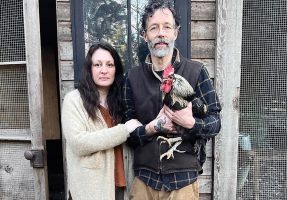
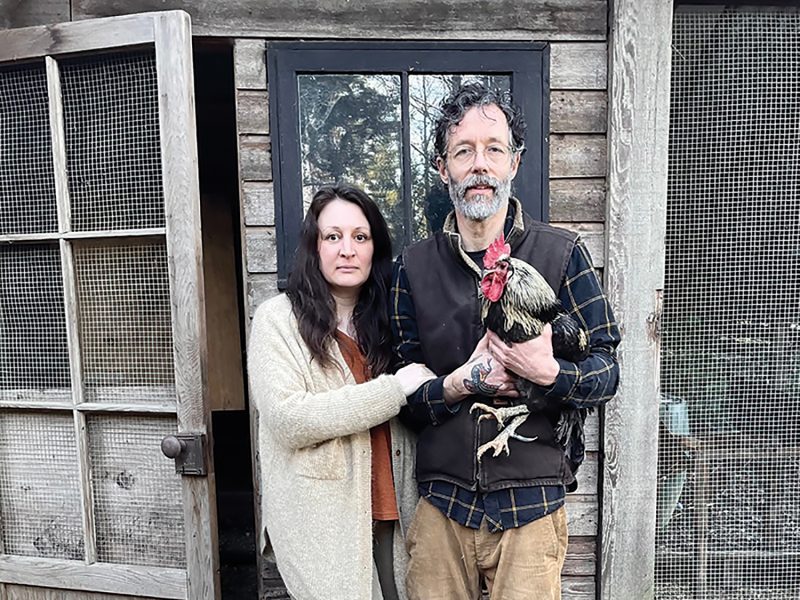
The Capital Regional District has taken Alia Elaraj and CJ McNichol of Salt Spring Island to court over noise complaints about their roosters. SUBMITTED

April 10, 2024 bySandra Tretick

SALT SPRING ISLAND – On an island that proudly features a rooster crowing contest at its annual fall fair, real roosters have ruffled enough feathers in the community that the issue has landed a local couple in court.

Following a three-year campaign of complaints by the neighbours of CJ  McNichol and Alia Elaraj to silence the couple’s roosters, the Capital Regional District is now asking a judge to rule on the matter.

McNichol was initially charged with seven counts under the district’s Animal Regulation and Impounding Bylaw because his rooster disturbed his neighbours. Two charges have since been dropped.

The couple have expressed frustration that the complaints continue despite spending “thousands of dollars” on mitigation efforts. They built a new, better insulated coop away from the property lines, tried rooster collars, blacked out the coop and swapped out noisier roosters for ones they hoped would be quieter.

“We’ve already been told that nothing we do is good enough,” she says.

McNichol and Elaraj live on one acre in an area of similar properties zoned rural. Agriculture is a permitted use under the local land use bylaws, which was part of the property’s attraction. They keep Sebastapol geese and currently have 20 heritage Silverudd hens and three roosters.

Elaraj believes they are being singled out.

“We’re not the only people with roosters on our street,” she adds.

Pecking order

In the last three years, the BC Farm Industry Review Board (FIRB) received three rooster-related noise complaints, all of them from Salt Spring. This comprised 25% of all noise complaints over the period, with the rest related to helicopters, wind turbines and other mechanical noises from farm operations.

FIRB chair Peter Donkers dismissed all three Salt Spring rooster complaints because the farms in question were classed as hobby farms. They didn’t meet the threshold to be considered farm businesses, a prerequisite for proceeding to a FIRB ruling.

Donkers recommended the complainants pursue common law remedies or take up noise complaints with the local government.

This provides little assurance for hobby farmers like Elaraj and McNichol. One of the FIRB decisions was for a complaint filed against them.

Elaraj admits they don’t have farm status yet, because of the high sales threshold for a one-acre lot.

“We would need $10,000. How do we get to that mark?” she says. “I’ve been hesitant to continue to invest in our birds, because this has been going on so long. It’s really hard to think that, at any time, your livelihood could be taken away by complaints.”

The BC Ministry of Agriculture notes that the Farm Practices Protection (Right to Farm) Act only provides protection from nuisance lawsuits from neighbours for farms located outside of the ALR on land zoned for agriculture.

In a statement, the ministry says: “These farms must still comply with local government nuisance bylaws. All farms, no matter the size, should practice ‘good neighbour farming’ and are expected to make changes to mitigate issues if a complaint is made, even if they are following normal farm practices and are in the ALR.”

On Salt Spring Island, zoning falls to the Islands Trust but nuisance noise falls under the jurisdiction of the Capital Regional District. This division of responsibility can be confusing to residents and Islands Trust bylaw compliance and enforcement manager Warren Dingman says they have received complaints about roosters.

In the last three years, there have been two from Salt Spring and one from Mayne Island.

CRD staff declined to answer questions about the number of complaints it gets while the matter is before the courts, but McNichol says the complaints against them “would be in the hundreds.”

Who rules the roost?

After FIRB quashed the Salt Spring rooster complaints, the matter was taken up by the CRD. In 2022, hobby farmer Ashleigh Roslinky challenged her tickets in court.

“She was allowed to go in front of a judge and dispute the tickets,” says Elaraj. “The judge told the CRD legal to tread carefully on people’s rights.”

McNichol says he received the summons to court before they could mount the same challenge and he suspects that the CRD is using this to set a precedent.

Rather than walk on eggshells, the couple decided to go public about the issue following their first day in court in January, and this led to an outpouring of support. Coined “rooster wars” on social media and in the local newspaper, the Poultry Club of Salt Spring has taken up their cause and launched a Save Our Roosters campaign.

“That’s when this started to take fire, because I think people were recognizing, finally, how dangerous this type of ruling could be for the rest of the community,” says McNichol. “This topic of gentrification and trying to strip farming rights is not an exclusive thing. It’s happening across the province.”

CRD chief administrative officer Ted Robbins said in an email to a Salt Spring Poultry Club member that the CRD “respects the rights of all residents in our Electoral Areas, and we strive to find collaborative ways to resolve issues before they escalate.” He added that enforcement measures were pursued in this situation when mitigation proved unsatisfactory to all parties.

McNichol is concerned because Salt Spring’s farming community falls under CRD bylaws set by urban Victoria standards, instead of being more closely aligned to a farming district like the Cowichan Valley.

“I’ve got a Freedom of Information request in to connect the dots,” says McNichol, who adds that after the first day in court he was handed three additional tickets for offences from last September. “There’s a general concern around why the CRD is handling this the way it is and where they’re going with it. People would like some answers.”

Originally scheduled to last one day in January, the trial ran over and is set to resume on March 25 in Victoria Provincial Court. After initially representing himself, McNichol has now retained a lawyer thanks to funds raised by the community for his legal defence. If found guilty, he faces up to $10,000 in fines.

Salt Spring Island Farmers’ Institute president Terry Clement said the board heard from McNichol and Elaraj at its March meeting and subsequently discussed the issue.

“Unfortunately, the Farmers and Womens Institutes Act does not provide any mechanism whereby we can take an official position,” said Clement.

Nevertheless, the institute’s board intends to pursue some broader issues with other organizations that can. These could include: What constitutes farming? Where can farming take place? And what reasonable expectations property owners living adjacent to a farm should have.

UPDATE: The March 25 court date was adjourned; a new date has not yet been posted.

Related Posts

You may be interested in these posts from the same category.

Sheep commission considered

Comeau reappointed to milk board

Milk board undertakes review

Cocksure court naysays rooster

BC Milk caught out

BC FIRB challenges WMP plans

BC FIRB gets a good egg

AI response in spotlight

Whistleblowers at FIRB, ALC protected

Chicken growers on watch for avian influenza

BC Veg consultation ends

Wind machines in Surrey face blowback

Previous Post: « Haskaps hold potential for northern growers
Next Post: Farm input costs ease »

Copyright © 2026 Country Life in BC · All Rights Reserved