
• Menu
  • Skip to primary navigation
  • Skip to main content
  • Skip to primary sidebar

Country Life In BC Logo

The agricultural news source in British Columbia since 1915

  • Headlines
  • Calendar
  • Subscribe
  • Advertise
  • About
  • Archives
  • Contact
  • Search
  • Headlines
  • Calendar
  • Subscribe
  • Advertise
  • About
  • Archives
  • Contact
  • Search

Primary Sidebar

Originally published:

FEBRUARY 2024
Vol. 110 Issue 2

Subscribe Now!

Sign up for free weekly FARM NEWS UPDATES

Loading form…

Your information will not be
shared or sold ever

Stories In This Edition

Green is gold

Water fines upped

Farm class numbers drop

Snowpack lows raise grower fears for summer

Editorial: Abundance and well-being

Back 40: An economy adrift in troubled waters

Viewpoint: There has to be a better way to manage water

Pitt Meadows ag strategy is action-based

Tesche take over as GM for fruit growers

Ag Briefs: BC potato harvest up 10% versus 2022

Ag Briefs: PRFA president brings fresh outlook

Ag Briefs: Nanaimo farm saved

Fruit sector has two years to take the reins

BC Fruit Works labour-matching tool paused

Okanagan grapes hit hard by Arctic outflow

Corn rootworm requires diligence and control

Population trends create new opportunities

Telus dials in new safety tools for agriculture

Living Wage’ certification out of reach for many

Cariboo potato a case study in local resilience

Arrow Lakes project revitalizing agriculture

Silvopasture a new frontier with deep roots

Getting through winter when feed is short

Details count

Salt Spring couple presses on with olive dream

Metchosin farm transitions to new owners

Farm Story: No crying over spilt spuds

Woodshed Chronicles: Henderson (finally) takes time for soul-searching

Cosmopolitan flavours lead chef to farming

Steak and potatoes, dressed up for fare

All content on this website is copyrighted, and cannot be republished or reproduced without permission.

More Headlines

Follow us on Facebook

Comments Box SVG iconsUsed for the like, share, comment, and reaction icons

12 hours ago

A draft update to the Code of Practice for the Care and Handling of Beef Cattle is now open for public comment until June 12. The code, one of 14 animal care codes developed and maintained by the National Farm Animal Care Council, is undergoing a routine 10-year review. "Your feedback will help shape the industry's guide to cattle welfare for the next decade," says Canadian Cattle Association policy manager Jessica Radau, urging producers to weigh in. For more information, visit tinyurl.com/58a3u9fz.

#BCAg
... See MoreSee Less

A draft update to the Code of Practice for the Care and Handling of Beef Cattle is now open for public comment until June 12. The code, one of 14 animal care codes developed and maintained by the National Farm Animal Care Council, is undergoing a routine 10-year review.  Your feedback will help shape the industrys guide to cattle welfare for the next decade, says Canadian Cattle Association policy manager Jessica Radau, urging producers to weigh in. For more information, visit https://tinyurl.com/58a3u9fz.

#BCAg
View Comments
  • Likes: 3
  • Shares: 0
  • Comments: 1

Comment on Facebook

I sat in the webinar yesterday by the Canadian Cattle Association. My initial concern was that this would be another "play" into the government's hands. It has been worked on by people that are actually in the Beef industry from Cow calf to feedlot. The thrust is an update of the 2013 Code of Practice which was reviewed in 2018. The changes are more a move from "left to the producers discretion" to clearer directions regarding pain management, proper transport of animals which are impaired and keeping cattle in in good condition. Much of what is recommended is what producers who care about animal husbandry already do. The important part is to GIVE THEM FEEDBACK good, bad or otherwise. The document is about 60 pages long, and I ran it through CHAT to see what had been changed. It is important to understand that the PUBLIC is invited to comment on the draft not just producers. Think about it... do you really want the public influencing how you manage your cattle. If you think that this is just one of those things, I have been following Bill 22 in Alberta which will grant the SPCA a proactive roll in entering farms and checking on animals. When I asked CHAT how the new bill relates to the Cattle Code, it came back that the Code although not a regulation will be able to be used as a guide by producers for backup in dealing with the SPCA regarding cattle conditions, sick animal handling etc. Take the time.... Go onto the Canadian Cattle Association website and speak to those parts that you wish to input.

2 days ago

According to the BC River Forecast Centre, the Okanagan snowpack stood at just 58% of normal on April 1 — the lowest reading since measurements began in 1980 — raising concerns about drought conditions in the region this summer. The rest of the province sits at 92% of normal.

#BCAg
... See MoreSee Less

According to the BC River Forecast Centre, the Okanagan snowpack stood at just 58% of normal on April 1 — the lowest reading since measurements began in 1980 — raising concerns about drought conditions in the region this summer. The rest of the province sits at 92% of normal.

#BCAg
View Comments
  • Likes: 3
  • Shares: 0
  • Comments: 0

Comment on Facebook

2 days ago

At her first AGM as executive director of BC Meats, held Saturday in Abbotsford, Jennifer Busmann spoke about her strong ties to agriculture and her optimism for the organization's future. Busmann has cattle of her own and came to the role with existing relationships with members and the board of directors that helped her feel integrated from the start. She stepped into the position in Februa#BCAg#BCAg ... See MoreSee Less

At her first AGM as executive director of BC Meats, held Saturday in Abbotsford, Jennifer Busmann spoke about her strong ties to agriculture and her optimism for the organizations future. Busmann has cattle of her own and came to the role with existing relationships with members and the board of directors that helped her feel integrated from the start. She stepped into the position in February.

#BCAg
View Comments
  • Likes: 6
  • Shares: 0
  • Comments: 0

Comment on Facebook

5 days ago

Shannon Wiggins of Headwind Farm in North Saanich is this year's Mary Forstbauer Grant recipient from the BC Association of Farmers Markets. The $500 grant will help Wiggins expand her plot at Sandown Centre for Regenerative Agriculture, growing more storage crops to extend her harvest season. Wiggins credits farmers markets with inspiring her own farming journey and commitment to building community through food. Congratulations!

tinyurl.com/45bdd#BCAg#BCAg
... See MoreSee Less

Shannon Wiggins of Headwind Farm in North Saanich is this years Mary Forstbauer Grant recipient from the BC Association of Farmers Markets. The $500 grant will help Wiggins expand her plot at Sandown Centre for Regenerative Agriculture, growing more storage crops to extend her harvest season. Wiggins credits farmers markets with inspiring her own farming journey and commitment to building community through food. Congratulations!

https://tinyurl.com/45bddtw8

#BCAg
View Comments
  • Likes: 46
  • Shares: 2
  • Comments: 3

Comment on Facebook

Wahoo! Congrats Shannon! I love your produce. Can’t wait for the radishes 🫜

Congratulations!

Well done!! 🩷🩷🩷

6 days ago

New farmers can avoid costly mistakes by learning from those who've been there. At a Young Agrarians mixer in Penticton, five BC farmers shared hard-won lessons on pricing, pivoting, relationships and burnout. From coyote losses to business burnout, their message was clear: set prices that reflect true costs, make decisions quickly and don't let farming define your worth. Myrna Stark Leader's story appears in our April e-edition, now available to view online at: tinyurl#BCAg2uw53vvm

#BCAg
... See MoreSee Less

New farmers can avoid costly mistakes by learning from those whove been there. At a Young Agrarians mixer in Penticton, five BC farmers shared hard-won lessons on pricing, pivoting, relationships and burnout. From coyote losses to business burnout, their message was clear: set prices that reflect true costs, make decisions quickly and dont let farming define your worth. Myrna Stark Leaders story appears in our April e-edition, now available to view online at: https://tinyurl.com/2uw53vvm

#BCAg
View Comments
  • Likes: 15
  • Shares: 0
  • Comments: 0

Comment on Facebook

Subscribe | Advertise

The agricultural news source in British Columbia since 1915
  • Email
  • Facebook

Cariboo potato a case study in local resilience

Banned seed variety finds a following in small plots

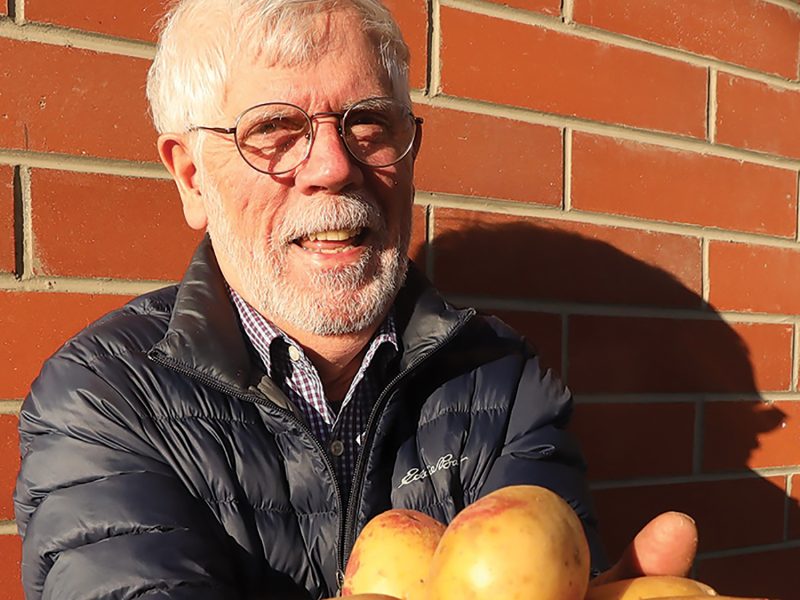
Blushed with success, the Cariboo potato is a favourite of Rob Diether even though it can't be grown commercially. SUBMITTED

February 1, 2024 byKelly Sinoski

100 MILE HOUSE – A co-op farmer near 100 Mile House is seeing renewed interest in the Cariboo potato nearly 50 years after it was outlawed as a commercial seed spud.

Rob Diether, a member of the Community Enhancement and Economic Development Society (CEEDS), has been growing the hardy yellow potato with pink eyes at the Horse Lake Community Co-Op since 1983 after he and a few others got their hands on the outlawed spud.

“We just kept growing them and producing and saving more and more seed,” Diether says. “We don’t grow a lot but it’s perfect for the Cariboo climate and over the years the farm co-op has grown several tons of the tuber. They are wonderful; a kind of creamy potato with slightly yellow flesh.”

The potato was a product of the potato breeding program at Agriculture and Agri-Food Canada’s Fredericton research station. It was tested in the Cariboo seed control area between McLeese Lake and Williams Lake in the 1960s and did extremely well, Diether says, earning itself the Cariboo name by an federal researcher in Prince George.

But by 1976, the Cariboo was deregistered as a commercial seed variety because its tubers clung to the vines, which included thick, feathery foliage.

“It was not a viable variety for commercial purposes because the plants were known to get caught up in the harvesting machinery,” according to the Canadian Food Inspection Agency (CFIA).

Decertification came with the threat of a $10,000 fine for those who flouted the law. Although no fines have been issued at this point, the CFIA acknowledges that it’s a possibility if the decertified potatoes are sold for seed.

“Since the Cariboo (potato) was deregistered in 1976, it is currently an unregistered variety and its continued production (depending on the size of the field) and sale of seed could result in the CFIA having to take steps to enforce the Seed Act and Regulations which may include fines,” the CFIA said in an email to Country Life in BC.

AAFC controls what seed varieties can be grown in the country to ensure all seeds are certified for disease resistance, insects and other issues. CFIA says commercial growers can still register a variety with CFIA or under the CFIA’s Garden Variety Program. Home growers can also apply to have the Cariboo added to the list of approved garden varieties.

Bill Zylmans, who sits on the BC Vegetable and Potato Association and BC Certified Seed Potatoes Growers Association in Delta, says Diether isn’t a problem, partly because his farm is far from commercial growers and partly because the Cariboo potato never saw a hugely productive yield.

“He isn’t a threat to the industry,” Zylmans says. “There are more of these kinds of varieties. It only comes into play if he turns it around and calls it a seed potato. This man is just having his fun, doing his thing way out there.”

If anything, Diether has reminded the public about the potato’s versatility – and why it deserves to be on the dinner plate.

Diether was inundated with calls and emails from people across the country looking for the outlawed tuber after he told CBC how he and some friends went in search of the Cariboo potato in the early 1980s.

It took them three years to get four Cariboo potatoes, which they mostly used for seed in the co-op garden.

“I don’t know what it is about potatoes. People are really interested,” Diether says.

Zylmans was at a potato conference in Toronto when the story came out, and says he was confronted by people asking him about the “rabble-rousers in BC.”

“It’s made a lot of people think,” Zylmans says. “Potatoes are a very diverse product that gives you a good balance of vitamins and minerals. There isn’t a vegetable out there that has as many uses as the potato.”

Diether, who shares Zylmans’ love of the potato, says he has no plans to stop growing the Cariboo variety even though it has other issues besides commercial harvesting. It must be hilled as much as possible and kept in a cold, dark space, he says, as it is light sensitive and turns green easily.

But he believes it’s important to have a diversity of potatoes and the Cariboo is perfect for the home garden.

“You can reach down and loosen up the soil and when you pull up the plant, the tubers are all connected to the vine,” Diether says. Plus, he adds, “It’s BC and it’s got the name Cariboo. There’s no such thing as a Cariboo carrot that I’m aware of.”

All content on this website is copyrighted, and cannot be republished or reproduced without permission.

Related Posts

You may be interested in these posts from the same category.

Previous Post: « Grapegrowers discuss freeze event
Next Post: CanadaGAP participation drops »

© 2026 COUNTRY LIFE IN BC - ALL RIGHTS RESERVED