
• Menu
  • Skip to primary navigation
  • Skip to main content
  • Skip to primary sidebar

Country Life In BC Logo

The agricultural news source in British Columbia since 1915

  • Headlines
  • Calendar
  • Subscribe
  • Advertise
  • About
  • Archives
  • Contact
  • Search
  • Headlines
  • Calendar
  • Subscribe
  • Advertise
  • About
  • Archives
  • Contact
  • Search

Primary Sidebar

Current Issue:

DECEMBER 2025
Vol. 111 Issue 11

Subscribe Now!

Sign up for free weekly FARM NEWS UPDATES

Select list(s) to subscribe to


By submitting this form, you are consenting to receive marketing emails from: Country Life in BC. You can revoke your consent to receive emails at any time by using the SafeUnsubscribe® link, found at the bottom of every email. Emails are serviced by Constant Contact
Your information will not be
shared or sold ever

Follow us on Facebook

Comments Box SVG iconsUsed for the like, share, comment, and reaction icons

6 days ago

... See MoreSee Less

View Comments
  • Likes: 4
  • Shares: 0
  • Comments: 0

Comment on Facebook

7 days ago

On the last day of the BC Organic Conference, Thursday, Molly Thurston of Pearl Agricultural Consulting helped growers learn how to manage bugs such as codling moth, wireworm, and rootworm in organic growing systems. Her talk alongside Renee Prasad included hands-on activities in which participants checked out various traps and examined pests under microscopes. Be sure to look for more upcoming ag events on our online calendar at www.countrylifeinbc.com/calendar/

#BCAg
... See MoreSee Less

On the last day of the BC Organic Conference, Thursday, Molly Thurston of Pearl Agricultural Consulting helped growers learn how to manage bugs such as codling moth, wireworm, and rootworm in organic growing systems. Her talk alongside Renee Prasad included hands-on activities in which participants checked out various traps and examined pests under microscopes. Be sure to look for more upcoming ag events on our online calendar at www.countrylifeinbc.com/calendar/

#BCAg
View Comments
  • Likes: 15
  • Shares: 0
  • Comments: 0

Comment on Facebook

1 week ago

Well-known organic farmer and podcaster Jordan Marr gets interviewed by Country Life in BC’s own columnist and potato mavin Anna Helmer during the opening session of the BC Organic Conference at Harrison Hot Springs yesterday. Sessions run today (Wednesday) and Thursday and include organic and regenerative growing practices and expanding and advocating for the organic sector, all under the background of the newly launched Organic BC banner.

#BCAg
... See MoreSee Less

Well-known organic farmer and podcaster Jordan Marr gets interviewed by Country Life in BC’s own columnist and potato mavin Anna Helmer during the opening session of the BC Organic Conference at Harrison Hot Springs yesterday. Sessions run today (Wednesday) and Thursday and include organic and regenerative growing practices and expanding and advocating for the organic sector, all under the background of the newly launched Organic BC banner.

#BCAg
View Comments
  • Likes: 37
  • Shares: 2
  • Comments: 1

Comment on Facebook

Interested in finding out more about this

3 weeks ago

Today, we remember those who sacrificed their lives or their well-being for our freedom. Lest we forget. ... See MoreSee Less

Today, we remember those who sacrificed their lives or their well-being for our freedom. Lest we forget.
View Comments
  • Likes: 8
  • Shares: 0
  • Comments: 0

Comment on Facebook

1 month ago

FarmFolk CItyFolk is hosting its biennial BC Seed Gathering in Harrison Hot Springs November 27 and 28. Farmers, gardeners and seed advocates are invited to learn more about seed through topics like growing perennial vegetables for seed, advances in seed breeding for crop resilience, seed production as a whole and much more. David Catzel, BC Seed Security program manager with FF/CF will talk about how the Citizen Seed Trail program is helping advance seed development in BC. Expect newcomers, experts and seed-curious individuals to talk about how seed saving is a necessity for food security. ... See MoreSee Less

Link thumbnail

BC Seed Gathering - FarmFolk CityFolk

farmfolkcityfolk.ca

Save the date for our upcoming 2023 BC Seed Gathering happening this November 3rd and 4th at the Richmond Kwantlen Polytechnic University campus.
View Comments
  • Likes: 1
  • Shares: 0
  • Comments: 0

Comment on Facebook

Subscribe | Advertise

The agricultural news source in British Columbia since 1915
  • Email
  • Facebook

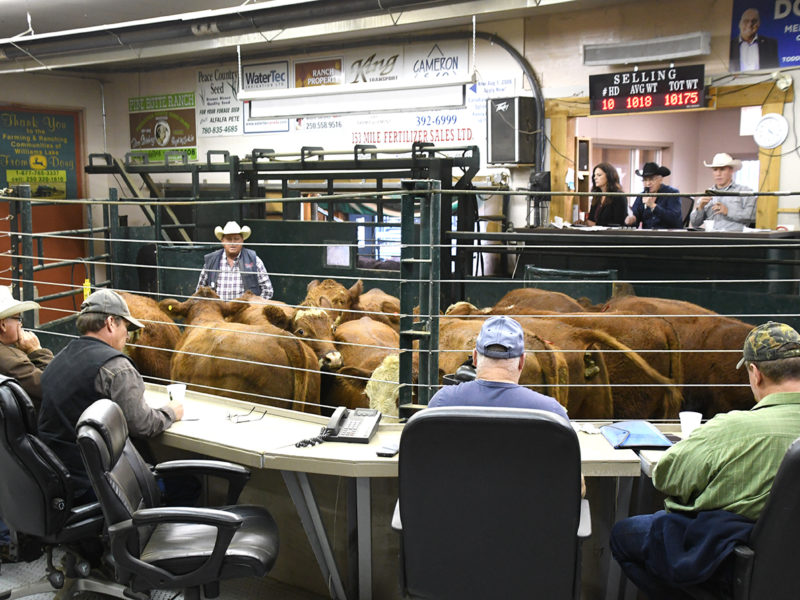
Cattle head to market

Liz Twan / File photo

August 23, 2023 byTom Walker

A fire sale is never a good sign, but that’s what’s happening in the beef sector as hundreds of animals move to market early this summer in advance of a winter where available forage is expected to be expensive, if it can be had at all.

“There’s a shortage of feed with the drought and the fires, and ranchers don’t have the money to pay $350-$400 for ton of hay,” says BC Livestock Co-op marketing specialist Darrell Comazzetto.

Sales numbers through the BC Livestock Co-op yard in Kamloops have been huge, Comazzetto says, noting that sellers are “mostly the smaller guys who don’t have the money or access to pasture or hay production.”

The co-op saw hundreds of animals sold in two sales at the end of July, and activity has continued strong into August. Wildfires at the end of last week saw the co-op to schedule a sale in Kamloops this week to assist ranchers “with evacuated cattle who need to sell.”

“Last week (August 15) we had 1,100 animals and at Tuesday’s sale (August 22), another 220,” Comazzetto says. “Last August a sale would be around 180 animals.”

The majority of animals that moved through the yard were cow-calf pairs, with a selection of calves and yearlings.

The good news is that ranchers are seeing prices Comazzetto has never seen before.

“It’s just wild. Under 300 lb steers were over $5.00 a pound and heifers over $4.00; 600-weight calves went for up to $3.65- $3.70,” he says. “Even the cows paid well, up to $1.50.”

There is, of course, a down side as ranchers will have to work to rebuild their herds.

“These are genetic lines that guys have built up over 10 to 15 years,” Comazzetto notes. “Older guys in their 70s are saying that given all the government regulations, difficulty finding range hands and the lack of government help, to hell with it! It’s time to quit.”


Related Posts

You may be interested in these posts from the same category.

Previous Post: « BC Tree CEO on leave
Next Post: Wildfires rip through Southern Interior »

Copyright © 2025 Country Life in BC · All Rights Reserved