• Menu
  • Skip to primary navigation
  • Skip to main content
  • Skip to primary sidebar

Country Life In BC Logo

The agricultural news source in British Columbia since 1915

  • Headlines
  • Calendar
  • Subscribe
  • Advertise
  • About
  • Archives
  • Contact
  • Search
  • Headlines
  • Calendar
  • Subscribe
  • Advertise
  • About
  • Archives
  • Contact
  • Search

Primary Sidebar

Current Issue:

JUNE 2026
Vol. 112 Issue 6

Subscribe Now!

Sign up for free weekly FARM NEWS UPDATES

Loading form…

Your information will not be
shared or sold ever

Follow us on Facebook

Comments Box SVG iconsUsed for the like, share, comment, and reaction icons

19 hours ago

... See MoreSee Less

View Comments
  • Likes: 0
  • Shares: 0
  • Comments: 0

Comment on Facebook

24 hours ago

A $2.5-million provincial program is helping Fraser Valley egg and poultry producers defend their flocks against avian influenza. The Novel Tools and Technologies Program supported 29 farms last year with air filtration and UV light systems — and more than 80% would recommend the technology to others. Applications for the current round, supporting approximately 50 farms, are open June 1–30. Fraser Valley, Langley and Surrey farms are eligible.

#BCAg
... See MoreSee Less

A $2.5-million provincial program is helping Fraser Valley egg and poultry producers defend their flocks against avian influenza. The Novel Tools and Technologies Program supported 29 farms last year with air filtration and UV light systems — and more than 80% would recommend the technology to others. Applications for the current round, supporting approximately 50 farms, are open June 1–30. Fraser Valley, Langley and Surrey farms are eligible.

#BCAg
View Comments
  • Likes: 8
  • Shares: 0
  • Comments: 0

Comment on Facebook

2 days ago

The sod for the seven FIFA World Cup matches beginning this Saturday at BC Place was grown by Bos Sod Farms in Abbotsford. During a tour of the Bos family's turf farm hosted by the Abbotsford Chamber of Commerce last week, Bert Bos said getting the hybrid of 95% real grass and 5% artificial turf just right was a learning experience. "That hybrid component makes it very robust," he says. "There's a whole battery of testing they do."

#BCAg
... See MoreSee Less

The sod for the seven FIFA World Cup matches beginning this Saturday at BC Place was grown by Bos Sod Farms in Abbotsford. During a tour of the Bos familys turf farm hosted by the Abbotsford Chamber of Commerce last week, Bert Bos said getting the hybrid of 95% real grass and 5% artificial turf just right was a learning experience. That hybrid component makes it very robust, he says. Theres a whole battery of testing they do. 

#BCAg
View Comments
  • Likes: 62
  • Shares: 2
  • Comments: 4

Comment on Facebook

Way to grow!

Congratulations So proud of you

Why not just bring FIFA to sumas prairie.

100%

3 days ago

BC fruit growers and ranchers are bracing for a crisis after the Regional District of North Okanagan demanded a 70% cut in agricultural water use amid critically low reservoir levels. The BC Fruit Growers Association warns losses in the Vernon area could reach $250 million in crop and tree losses. Growers hope today's meeting with RDNO will chart a path forwar#BCAg#BCAg ... See MoreSee Less

Link thumbnail

Vernon growers address drought

www.countrylifeinbc.com

Growers blindsided by last week’s demand from the Regional District of North Okanagan for a 70% cut in agricultural water use hope a June 10 meeting with RDNO will chart a positive path forward.
View Comments
  • Likes: 11
  • Shares: 25
  • Comments: 6

Comment on Facebook

So let’s cut the water for the ones growing the food that feed the people. Makes total sense 🙄

Hey let's put up an AI Center in the OKANAGAN, we don't need water for FOOD! #ThatAnnouncementWillBeNext

Time for the city folks to stand up for the farmers and realize how devistating these changes will be. Definitely golf courses and city green space need to be shut off before food supply does.

All the golf courses had better have turned all their irrigation off before any primary producers are forced to.

no people or no food, tough choices

crazy shit, shut down nthe golf courses, nom water for them

View more comments

4 days ago

BC Agriculture Minister Lana Popham is hinting at upcoming announcements on food processing within the Agricultural Land Reserve and flood mitigation support. Speaking at the Abbotsford Chamber's Agriculture Bus Tour June 5, she signalled policy changes may be coming "in the next few weeks." On flooding, she says progress over the past four months has been significant. "We're very confident compared to where we were six months ago."

#BCAg
... See MoreSee Less

BC Agriculture Minister Lana Popham is hinting at upcoming announcements on food processing within the Agricultural Land Reserve and flood mitigation support. Speaking at the Abbotsford Chambers Agriculture Bus Tour June 5, she signalled policy changes may be coming in the next few weeks. On flooding, she says progress over the past four months has been significant. Were very confident compared to where we were six months ago.

#BCAg
View Comments
  • Likes: 12
  • Shares: 0
  • Comments: 4

Comment on Facebook

So are these actual farmers or just some university students who THINK they can save the world .

I’m still waiting for Ms Popham to accept one of my 86 invitations to meet with me to discuss the ALR dumping ground next to my house. Maybe 87 will be the charm? Lana Popham

Lana is a joke. She came up here to the NP promising to do Everything in her power along with Whoregan and the rest of them, to stop the FLOODING OF 10,000 ACRES of PRIME CLASS 1 FIELD TO PLATE FOOD PRODUCING LAND, in the Peace Valley. But she was just like the rest of the puppets looking for her election and Ag Minister postition. Yep they LIED, they had the chance but not. Now our Northern Food security is threatened and the beautiful limited land is gone under 60 meters of water and the landslides to follow. How is it the Valley, that used to be a vibrant Wetland, floods and yet there is a shortage of fresh WATER for Vancouver? The entire region of Richmond is below sea level, why not FLOOD some of that with the LARGE AMOUNTS OF FRWSH WATER pouring off of the Mountainsides in the Valley, store and and USE it for your new Data centers....

useless ndp

Subscribe | Advertise

The agricultural news source in British Columbia since 1915
  • Email
  • Facebook

Clifton Ranch sustainability recognized

June 19, 2019 //  by Cathy

The grasslands of the South Okanagan are, according to BC Parks, “one of the four most-endangered ecosystems in Canada.” They’re so significant that discussions to gather them into a national park reserve are in the works.

But protecting grasslands doesn’t necessarily mean fencing them off from cattle, as the Clifton family of Keremeos has shown.

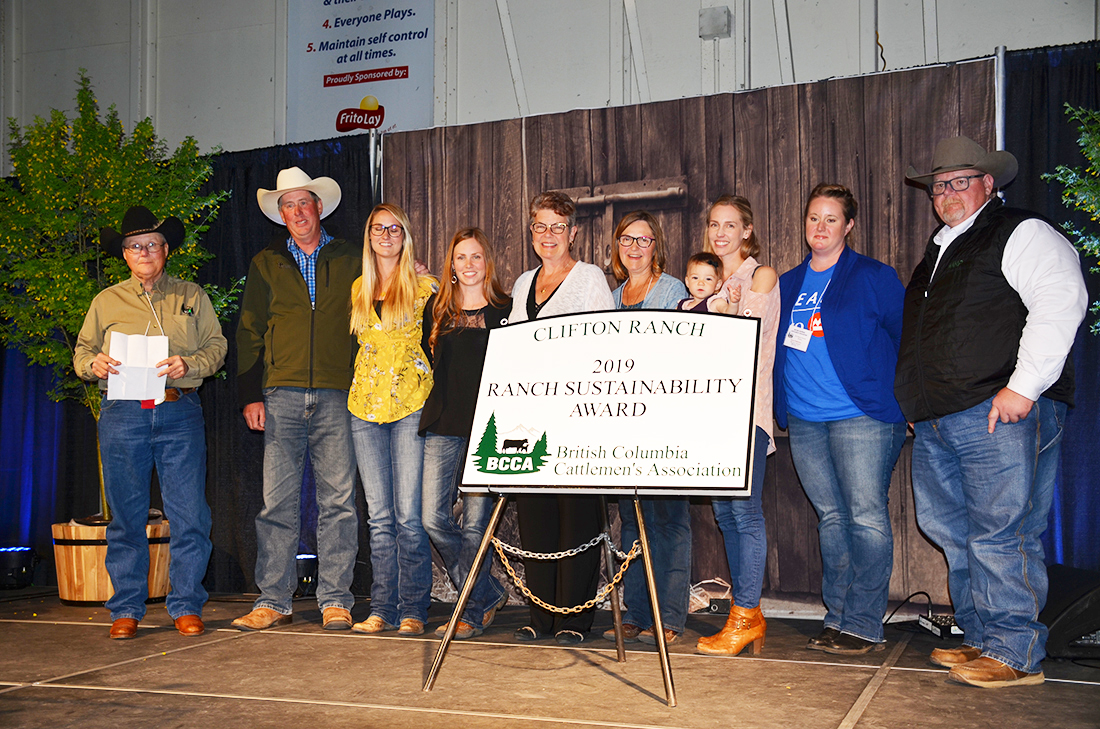
During the BC Cattlemen’s Association annual general meeting in Williams Lake at the end of May, the family-run Clifton Ranch receive the association’s ranch sustainability award. The award considers a ranch’s livestock management practices, land stewardship, animal care, benefit to the environment and contributions to the livestock industry or the local community.

“This year’s recipient was selected for their outstanding commitment to sustainability,” says Renee Ardill, chair of the BCCA environmental stewardship committee. “They are recognized for the large number of species at risk that they support on their landscape, the water developments they have created, and the partnerships they have built to better manage the land.”

One of those partnerships is with the Nature Trust of BC.

“We have land adjacent to an area at White Lake that the Nature Trust of BC had bought to preserve,” explains Wade Clifton in a video BCCA produced to highlight the ranch’s achievements. “They had fenced it off. There were going to be no cattle on the land and they were going to let it go back to a more natural state.”

The ranch was looking to expand its grazing area, however, and started a dialogue with the trust.

“Nature Trust realized that what they were doing wasn’t working,” says Clifton. “We wondered if we were crazy, but we started going to meetings with biologists who said the cattle shouldn’t be there, they will wreck this.”

Careful management of rotational grazing, sometimes only two or three weeks every two years, began to restore the grasslands.

“We were actually able to stimulate the native grasses and take out some of the weeds,” says Clifton. “The land is changing from a spear grass to more of a native species of blue bunchgrass.”

Keeping cattle off the land may not support the native species at risk, says Clifton.

“The cattle have been part of that ecosystem for over 100 years,” he notes. “The reason that most of the species that live there now are there is because of the ecosystem that the cattle have contributed to.”

Biologists now support a system that integrates grazing rather than rejects cattle.

“They see the benefits and understand the cattle are now part of the ecosystem,” says Clifton.

The video documenting the ranch’s practices is available at [https://vimeo.com/339163285].


SIGN UP FOR FREE FARM NEWS UPDATES DELIVERED TO YOUR INBOX EVERY WEDNESDAY MORNING.


All content on this website is copyrighted, and cannot be republished or reproduced without permission.
Related Posts

You may be interested in these posts from the same category.

Clifton Ranch aims for better beef, habitat

Previous Post: « TB trace-out completed
Next Post: Ottawa funds young workers »

© 2026 COUNTRY LIFE IN BC - ALL RIGHTS RESERVED