
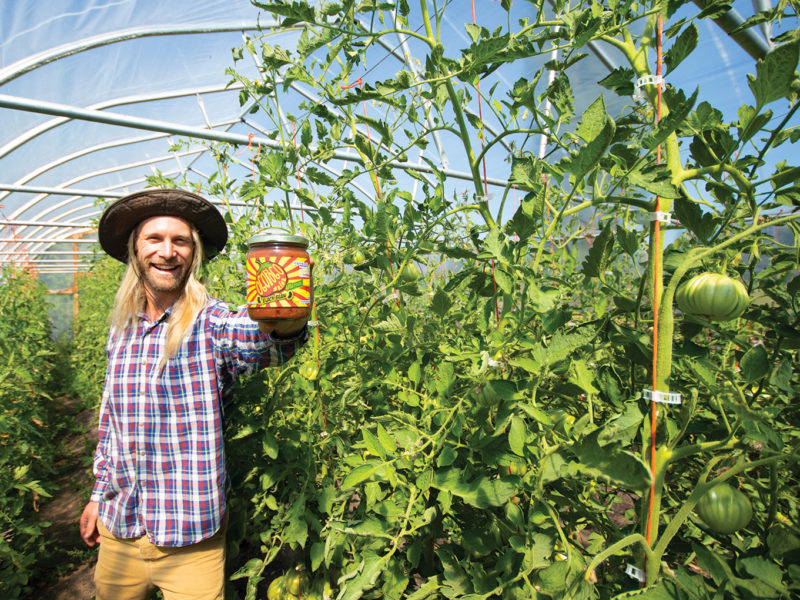
KELOWNA – Tyler Chartrand saw a hole in the market he decided to fill. Since 2014, he’s been growing tomatoes and peppers and processing them to make Ogopogo Salsa.
The business idea came to him while he was pursuing an accounting degree at Okanagan College. During an entrepreneurship class, students were tasked with creating a full business plan. Part of his research included learning that salsa was outselling ketchup in the US.
“The other two guys in my group dropped the class so I had free rein. I’d always made salsa with my family in year-supply batches. We had a good recipe and it was a tradition. I didn’t see anybody making it and selling it locally,” says Chartrand.
With a completed business plan in hand, he built a 12×12-foot kitchen in his parent’s basement. He designed the kettle and baskets which were fabricated at a local welding shop. Then he skipped his first month of classes the following September to make salsa.
The venture reached a milestone last September, moving from selling at Kelowna’s farmers market to having the salsa on shelves at local grocers Nature’s Fare, Peter’s Independent Grocer and Paynter’s Fruit Market, a seasonal fruit and vegetable stand in West Kelowna. He also started selling online.
Chartrand grows about 4,000 pounds of tomatoes and 1,000 pounds of peppers on just under an acre of land provided free of charge by Anne Dyck. She and her grown children live on her 15-acre parcel in Kelowna’s Lower Mission neighbourhood, a parcel in the Agricultural Land Reserve that’s mostly been used for hay. Where Chartrand grows was always garden but Dyck’s children were never interested in farming, nor are her grandchildren. So, when Chartrand approached her, even though she didn’t know him, she agreed to let him use the land in return for some fresh produce.
“I was so encouraged to see a young person interested in the land,” says Dyck. “And he’s such a hard worker. He didn’t really know much about growing but he’s not afraid to approach other growers and learn. He’s such a sweetheart.”
Chartrand calls Dyck’s contribution a blessing. Without it, his current business model wouldn’t be profitable since it’s funded by savings.
“I’m pretty risk-adverse, so the business is in the green. But if I had to pay for the land, I probably would have dropped out of the farming business in the first couple years due to the labour involved, the learning curve of failed crops and the cost to keep going,” he says.
Although his father grew up on a farm, his dad had a teaching career so everything Chartrand has learned about farming has been through trial and error, YouTube, and connecting with other local growers like Jennay Oliver, owner of Paynter’s Fruit Market.
“I called her once to ask her how to change the rototiller on the tractor,” he says of Oliver, whose family has been growing in the Okanagan since 1926.
Seed starter
Chartrand grows his plants from seed. Greenhouse and field tomatoes include varieties like Oxheart, San Marzano and others geared towards sauce making. He also grows a mix of hot and sweet peppers.
Peaches for the peach salsa are sourced from Paynter’s as well as Crosby Organics in Kelowna.
Recognizing that great soil is the foundation of his business, Chartrand will focus on soil health this year.
“I’ve partnered up with Optimize Organics. They’ve got their compost tea brewing and are just total nerds on the soil science and microbe synergies. So, I’m very excited to do as much soil-building as possible,” he says. “Getting healthy soil is years in the making but I’m genuinely most thrilled about that this season. It’s part of investing in the future.”
Chartrand works as a builder in the off season, skills he also applies to his farm. In 2014, he built a 500-square foot commercial kitchen/processing facility at his home, a big update from the original basement kitchen.
“My favourite part of the process is the blanching of peaches or tomatoes, because I have this crane now. I can pick up 100 pounds, put it in the boiling water, take it out, take it over to my cold sink bath and it just tilts and everything pours in. In my first kitchen, it was a lot of me scooping and lifting things above my shoulders manually. The iteration process has been a neat journey on the processing side. I also understand now why there isn’t a local salsa. It’s easy to make hundreds of jars but it’s hard to make thousands,” he admits.
His new kitchen allows him to process 240 jars in an eight or nine-hour day compared to about 200 in a 14-hour day in the former space. Last year, he made 5,000 jars of salsa, up from 700 in 2014. His ultimate goal is to produce 10,000 jars a year.
Chartrand is grateful for friends who want to come help in the garden and get paid by the hour. He says he planted the whole acre a few times but was unable to manage the field work and processing at the same time.
“Last year is the first year I was able to really capture everything that I grew, whereas years before, as it turns out, it’s easy to grow a ton of food but trying to time everything like harvesting and processing has been challenging. I’ve made a lot of compost over the years so, you know, it’s not a bad thing,” he says with a laugh.
Although the farmers market was a good way to introduce his product to consumers, especially when people could taste-test the product, Chartrand knows he needs to find new markets if he wants to grow the business.
“I’m slowly getting that mindset in gear but marketing is a full-time thing. As well, I want to grow at a pace I can manage financially and from a growing and processing side,” he says.
Chartrand continues to be motivated at the prospect of building a business that outlives him, one with more employees and bigger production. But he’s taking it one step at a time.
“I graduated, became a live-in caregiver and was able to afford a house in Kelowna before the market went crazy,” he says. “I had this idea of urban homesteading, living more self-sufficiently within an urban setting as opposed to out in the bush. Ogopogo Salsa is recession-proof in the sense that all the overhead costs have been kept under my own living expenses. The factory in my backyard. It’s under my control, and it’s food which everyone needs.”
 Producers beef up support for Island cattle