
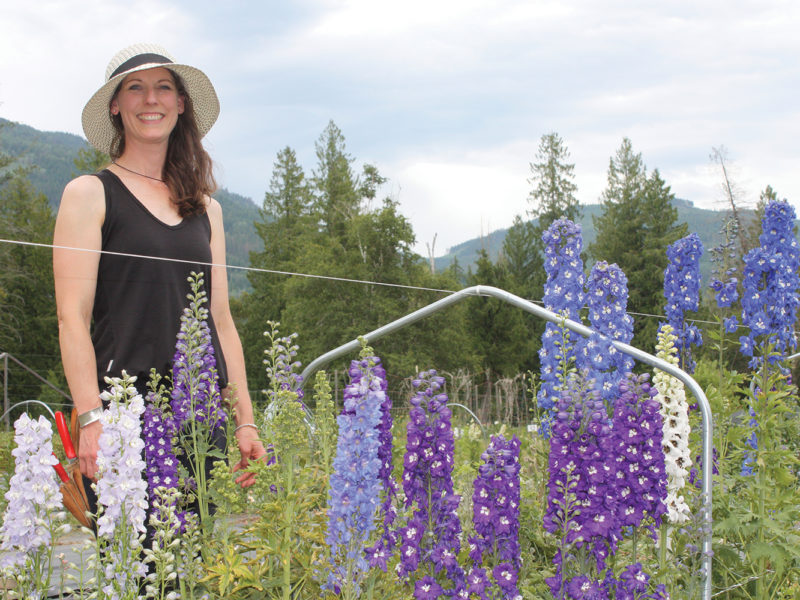
ENDERBY – Operating a flower farm is a dream come true for Nadine Charlton, even if it’s not all sunshine and roses.
Charlton began Blumen Fields Flower Farm on Mabel Lake Road, six minutes east of Enderby, in 2018, one year after purchasing the 54-acre property with husband Chris and her parents.
The farm fulfills Charlton’s passion for sustainability and provides an outlet for her creative talent, honed over 20 years as an interior designer.
The farm has literally grown up around the family as colourful blooms and foliage slowly replaced a five-acre field that sat fallow for at least 20 years.
Growing up on a grain farm in northern Alberta, Charlton is no stranger to hard work but transforming five acres into a working flower farm over the past five years using no-till techniques and natural pest and disease control methods has been an eye-opener.
“This is more work than I think anyone could have imagined it would be,” she says. “I grow over 450 varieties of flowers … and every one has different requirements for everything – from seeding to fertilizing to when to harvest to the bugs that go with it. It’s a lot to try and manage.”
She uses no pesticides, herbicides or fungicides and the soil is remediated via occultation using black silage tarps.
“While the crop dies down, the micro-organisms then come up to eat the crop and produce a healthier soil,” she says. “I don’t have to worry about any compaction by doing that. I don’t have to bring in extra amendments, which is very important to me.”
Portions of the field not yet under cultivation are cover-cropped in fall rye, with Charlton taking over sections as required. She lays out the fields using the architectural design program AutoCAD, a tool familiar from her work as an interior designer.
“I knew that I wanted to increase every year but I’m definitely just letting the market dictate how much I’m increasing,” she notes. “I map out how many of each plant I think I’m going to need for the following year based on how many stems they put up and then I’ll determine how many I need and then it comes to working with AutoCAD to put them in rows.”
She grows all her annuals and most of her perennials from seed and starts the shrubbery as bare-root plants.
As a master gardener with an eye for design, Charlton looks for unique, trendy and colourful blooms and foliage.
The field is alive in colour and texture that includes perennials, thousands of annuals planted successionally to ensure blooms throughout the summer, rows of peonies, lilies and roses in a rainbow of colours, different grasses and shrubs.
Charlton endured a number of setbacks including a wind storm in the first year that took out a large tree providing the only shade for her hydrangeas. Hungry deer necessitated taller fencing.
This winter, she lost the eucalyptus she had overwintering for the past three years.
Although mild with little snow, the winter also wrought havoc on her roses, taking out a large portion of the 500 plants that are the bread-and-butter of weddings.
“They take about three years before they start producing. I’ve got this cost in the ground that I’m waiting on. I cut from them fabulously last year and then a lot of them, probably about 60% to 70%, were wiped out this year. It’s a big deal,” she says.
She also encountered a mite that destroyed about 300 white delphinium seedlings within a week while not touching any of those planted at the same time in an adjacent row.
She called the BC Ministry of Agriculture, Food and Fisheries, which took samples.
“At this point, they think it was the mite but mites are not supposed to kill the plant,” she says, noting that mites typically prey on other insects. “They can’t figure it out.”
She is currently awaiting results from a mite expert in Ontario.
Charlton takes a hands-on approach to dealing with pests that threaten her very lucrative dahlia crop.
“There’s about three or four bugs that just love to ravage dahlias and the only way I can organically keep them as a perfect flower is to place a little organza bag on them while they’re still in bud,” she says. “The flower then opens in the organza bag the bugs can’t get into. Anything left is devoured or stained or bitten.”
The learning curve rose sharply last spring when the pandemic hit and weddings were cancelled.
Most of Charlton’s spring flowers went into the compost but the year was not as bad as expected.
“It turned out that as COVID went on and on and on and people were stuck in their houses, people wanted flowers in their houses. That’s the same reason houseplants took off.”
Charlton sells to about 45 florists and floral designers from Salmon Arm to Penticton. She also does wedding packages for venues and sells at the local farmers market, her farm gate and to a limited number of subscribers.
“I have 20 subscriptions right now. I’m careful to keep it at a pretty exclusive number because I sell to so many florists, I need to be careful that I am always kind of managing inventory in both directions.”
Providing only locally grown, in-season flowers can be difficult when up against a market inundated by flowers grown and shipped across the world.
She says her clients continue to use her flowers because she can provide blooms too delicate to ship and her flowers simply last longer.
“Most flowers that are coming from around the world have been cut for at least a week before it will ever get to a florist. Most are closer to two weeks. You can only expect so much from a flower,” Charlton says. “Mine gets harvested one day and it’s at the florist the next day. The amount of time it’s got for the vase life for the client is vastly different.”
Work to prove the reliability and quality of her flowers has paid off for Charlton in the form of a loyal clientele.
Floral designer Sarah Keegstra of Kaye Fleur in Vernon has used Charlton’s fresh and dried flowers for almost three years in each of the approximately 15 weddings she does annually.
She says Charlton’s sustainable approach to farming is an extra draw for her customers and allows her to elevate her designs.
“Nadine’s flowers are so gorgeous and really vast in variety. She is always growing and expanding her flower field to include new textures and all kinds of colour ranges,” Keegstra adds. “She truly is one of the best in the business.”
Anxious to keep and grow her client base, Charlton is constantly working to stretch her season.
She currently harvests until October, plants her first seeds in mid-December, and harvests her first tulips in mid-January.
“I’m scheming on how to get flowers for those (missing) months. I would like to be able to provide fresh flowers all year long that is still not flown in, they’re still locally grown. That’s my goal. Now I’m at about nine months.”
 Provincial meat licensing overhaul effective October