
VERNON – With limited provincial resources, haskap berry producers must forge their own paths toward business viability and success through value-added products and direct-to-consumer marketing.
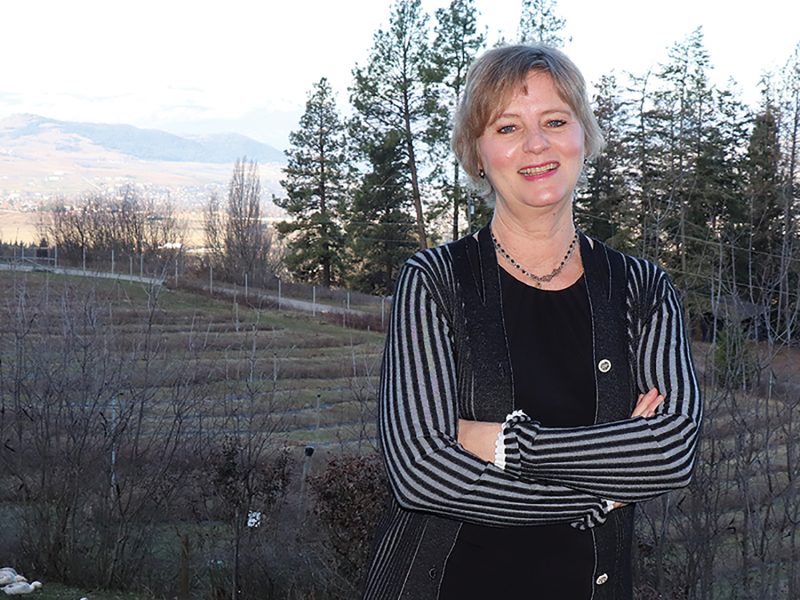
“I didn’t want to make a mistake and pick something that’s really hard, which is kind of ironic because I ended up with something really hard,” says Indigo Valley Farm owner Amber Stamm’ler. “It was supposed to be my part-time job … but it quickly turned out to be not at all what I had expected. It is like a full-time job plus more.”
Haskaps grow wild in most provinces, excluding BC, but the wild fruit is not suitable for consumption or harvest. Commercial cultivation in Canada began in Alberta in the 1950s.
In 2007, the University of Saskatchewan released commercial varieties that are much sweeter, easier to grow and more suitable for harvest than their wild counterparts.
In BC, most haskaps were planted in 2015 or later, according to a BC Haskap Association survey of growers in 2019. The association has since dissolved.
Haskaps ripen in mid June and taste like a mixture of blueberry and raspberry. The berries can be consumed fresh, frozen or in a wide range of processed products, including juice, wine, candies and jams.
Stamm’ler is a first-generation farmer with previous experience bringing fruit spreads to market. When the opportunity arose to pivot from processing to growing, she took it.
In 2014, she and her family moved from Ontario to Vernon and bought a property with three acres of horse pasture. After extensive research, she identified haskaps as the easiest fruit to establish and maintain. Coincidentally, a local grower held a haskap seminar in nearby Salmon Arm around that same time.
To Stamm’ler’s surprise, when she finally had a crop of haskaps in 2018, it turned out she needed to do all her own processing and marketing. When a retailer deal fell through, she froze and began processing the berries in her home kitchen to make such products as sauce, jam, juice, tea and chocolate.
Even with farming experience, Kristin Atherton of Chetwynd’s Hasberry Farms says the crop requires some trial and error.
“It was partly experimentation, partly hopeful, partly educated guess,” Atherton says of how her family started growing haskaps.
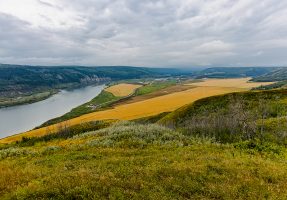
Atherton, along with her brother and parents, bought acreage and planted their first crop of haskaps in 2018. A few years earlier, a local school had a haskap berry research project that the family supported. Through this project, they discovered the hardiness of the fruit and its ability to thrive in the northern environment so began their own research into potential markets and business viability. One of the larger haskap farms in BC, Hasberry Farms has 30 acres of berries which equals roughly 30,000 plants, and six varieties.
400 acres in cultivation
The BC Haskap Association survey indicated approximately 400 acres of haskaps in BC in 2018.
“In 2018, the BC Haskap Association had 34 grower members including a handful of large-scale producers in the Okanagan and Peace Region, each with [between] 15 and 30 acres,” it reported, adding that many BC haskap producers have less than 10 acres.
Atherton has relied on provincial agronomists, local business organizations, social media and YouTube to grow the family operation.
“It has been very difficult [determining] how to learn, who to learn from and trying to find the right people to get support in the right areas,” Atherton says. “There are not a lot of people that are growing haskaps. There are a few people that are ahead of us … and so you know you can make connections but then we’re all kind of struggling to figure it out.”
Indeed, Stamm’ler and Atherton faced the reality of developing their own products and building their own markets.
“We realized that especially being in the north and being a small community, logistics are hard for shipping frozen, especially getting started in small quantities; it’s just not financially viable,” Atherton says. “That’s why we really wanted to do processed products.”
Family support and collaboration make a difference as well as scale and mechanization.
Atherton’s father modified a bush berry harvester to mechanically harvest the haskaps, her mother contributes to product development and market research and her brother tends to the plants. Atherton completes paperwork and helps wherever she can on the farm.
Stamm’ler has done everything by hand and largely on her own, which has resulted in large time, labour and financial investments.
Atherton and her family have been able to expand their product reach throughout Hudson Hope, Fort St. John, Dawson Creek, Prince George and Chetwynd.
“U-pick is good. We’ve sold a lot through U-pick. … But it’s not enough for long term viability,” Atherton says. “We really needed a way that was feasible to get started on a smaller scale and then be able to expand as we were able to scale up. We needed to be able to process smaller quantities and keep our profit margin so that we can be sustainable long term.”
Since 2018, the family have processed the berries at a local commercial kitchen. In November, they received a $50,000 boost from the BC Hydro Peace Agricultural Compensation Fund to build an on-farm processing centre.
“It should help us increase our production dramatically from what we’re doing right now,” Atherton says. The family’s main products are juice and jam. Their goal is to have the facility ready by April before farming operations begin for the year.
“I’m really proud of the innovation that we’ve done. And starting something totally new in the Peace Region on a larger scale and sticking to it. It’s been a long road so far,” Atherton says.
Looking ahead, Atherton hopes the family can expand their haskap acreage and reach stores beyond the Peace.
“That will come with being able to process more,” she says.
Stamm’ler hopes to turn a profit this year after investing in plants, netting, deer fencing and irrigation infrastructure. She sells her products online and at farmers markets.
“It was the customers that kept me going because they were so enthusiastic and appreciative of the products that I’m making and the berries I was providing. They were telling me to keep going,” Stamm’ler says.
For those considering growing haskaps, “think 100 times before you actually do this,” Stamm’ler explains.
“Know who you’re going to be selling to and all that before you even do anything, because otherwise you’re going to end up with a bunch of berries and nobody to sell to,” she says. “Have a plan [with] everything thought out.”
 Province to oversee livestock welfare