• Menu
  • Skip to primary navigation
  • Skip to main content
  • Skip to primary sidebar

Country Life In BC Logo

The agricultural news source in British Columbia since 1915

  • Headlines
  • Calendar
  • Subscribe
  • Advertise
  • About
  • Archives
  • Contact
  • Search
  • Headlines
  • Calendar
  • Subscribe
  • Advertise
  • About
  • Archives
  • Contact
  • Search

Primary Sidebar

Originally published:

MARCH 2025
Vol. 111 Issue 3

Subscribe Now!

Sign up for free weekly FARM NEWS UPDATES

Loading form…

Your information will not be
shared or sold ever

Stories In This Edition

Tariff Shock

Room to grow

Province delivers for fruit growers

BC honours its ag leaders at annual gala

Editorial: Good neighbours

Back 40: Political landscapes, and our own backyard

Viewpoint: Avian influenza is here to stay

Regulations frustrate on-farm water stewardship

Sidebar: Study says process takes too long

Bessette Creek irrigators band together

Show and tell

Ag Briefs: Chick shortage for broilers

Delta events centre quashed

Letters: Feeling connected

Letters: The good old days

Premier’s task force to boost sector

Dairy industry calls for unity amid trade threats

Mainland Milk Producers prepare for growth

Grape job

Vet urges dairies to be vigilant against HPAI

Winery banned from hiring temporary foreign workers

Grapevine losses continue to mount

Ranchers pack early calf survival forum

Good job

Auctioneer calls it a day

Food hub slated to open in Rock Creek

Cattlemen examine production costs

Emergency processing could be a trailer away

Cattle talk

New at-risk species tool launching this spring

Happy Hills looks beyond the challenges

BC potato trial joins national data bank

Farm Story: My computer wants to write farm stories

Farm tours showcase South Island agriculture

Brian Hughes remembered as organic advocate

Hazelnuts enjoy strong picing as global production falls

Chilliwack group wants agriculture back at fairgrounds

Woodshed: The Duke and Kenneth get off to a rocky start

Beef tasting helps raise profile of 4-H

Jude’s Kitchen: Try healthier Tex-Mex flavours

More Headlines

Follow us on Facebook

Comments Box SVG iconsUsed for the like, share, comment, and reaction icons

2 days ago

Full-time students employed in BC agriculture during the summer season are eligible to apply for a bursary of up to $3,000. The bursary, administered by the Investment Agriculture Foundation, aims to increase youth and domestic seasonal worker employment in the ag sector. Funding is awarded on a first-come, first-serve basis. More information is available at tinyurl.com/5ef6pe3m

#BCAg IAF
... See MoreSee Less

Full-time students employed in BC agriculture during the summer season are eligible to apply for a bursary of up to $3,000. The bursary, administered by the Investment Agriculture Foundation, aims to increase youth and domestic seasonal worker employment in the ag sector. Funding is awarded on a first-come, first-serve basis. More information is available at https://tinyurl.com/5ef6pe3m

#BCAg IAF
View Comments
  • Likes: 13
  • Shares: 11
  • Comments: 0

Comment on Facebook

3 days ago

BC fruit and vegetable farmers are being asked to share their views on farming technology in a 10-minute survey from Royal Roads University and the University of the Fraser Valley. The survey looks at how fruit and vegetable farmers are adopting emerging farming technologies -- such as digital tools, “controlled environment agriculture systems” (greenhouses) and agri-genomics (DNA analysis) -- to cope with changing climate conditions. The survey takes about 10 minutes to complete, and participants will be eligible to win an assortment of $50-$200 gift cards.

insights.kaianalytics.com/s3/PAS2026
... See MoreSee Less

BC fruit and vegetable farmers are being asked to share their views on farming technology in a 10-minute survey from Royal Roads University and the University of the Fraser Valley. The survey looks at how fruit and vegetable farmers are adopting emerging farming technologies -- such as digital tools, “controlled environment agriculture systems” (greenhouses) and agri-genomics (DNA analysis) -- to cope with changing climate conditions. The survey takes about 10 minutes to complete, and participants will be eligible to win an assortment of $50-$200 gift cards. 

https://insights.kaianalytics.com/s3/PAS2026
View Comments
  • Likes: 5
  • Shares: 1
  • Comments: 0

Comment on Facebook

3 days ago

The District of Coldstream is proposing the creation of farm property tax subclasses to distinguish between small-scale and large-scale farm operations. Currently, all farms are classified as Class 9 regardless of size or infrastructure needs. The district argues larger farms require more municipal services and should be taxed accordingly. It plans to pitch its proposal at the Southern Interior Local Government Association convention in Revelstoke at the end of April. Support there could escalate the discussion to the Union of BC Municipalities convention next September in Vancouver.

#BCAg
... See MoreSee Less

The District of Coldstream is proposing the creation of farm property tax subclasses to distinguish between small-scale and large-scale farm operations. Currently, all farms are classified as Class 9 regardless of size or infrastructure needs. The district argues larger farms require more municipal services and should be taxed accordingly. It plans to pitch its proposal at the  Southern Interior Local Government Association convention in Revelstoke at the end of April. Support there could escalate the discussion to the Union of BC Municipalities convention next September in Vancouver. 

#BCAg
View Comments
  • Likes: 12
  • Shares: 2
  • Comments: 11

Comment on Facebook

Which municipal services do they require more of? Even larger farms typically still have only one or possibly two dwellings. Most have their own well and septic, and I suppose it depends on location, but most rural properties don't have garbage pick up either. And whether 20 driveways or one join the road, the cost to plow that road is the same. I no longer live within a municipality so of course there could be costs I've overlooked that are contributing to the District's proposal.

Large farms put more back into the community too.

The larger farms are the only farms paying wages, allowing people to spend money in their communities, the beauty of a network of small business. Small farms more often then not, is a single transaction, a hobby. Large- buy feed, raise cow, calf is born, sell calf, pay wage(support livlihoods), buy fence posts, buy more feed and so forth. Feeding the community. Small- Buy feed, raise cow, kill cow, eat cow.

And this is why farmers left California. British Columbia is no different

I am not sure how to post the actual Resolution that Council Pat Cochrane put forward but here is the link to the special meeting they are holding to pass the resolution: www.coldstream.ca/government-bylaws/news-alerts/notice-special-council-meeting-3.

Why not find ways to bring in more business's and audit municipal spending and regulate short term rentals (because Coldstream has essentially zero places to stay technically, insane) instead of raising taxes arbitrarily because "bigger costs more"

Attending that meeting, they claimed that “large farms” use more municipal services, yet Cochrane consistently stated he was going after “smaller estate properties not actively farming.” This is not only contradictory but misinformed. It would take him but three door knocks before he learned that the “estate farms” not actively farming are typically leased to a larger conglomerate to maintain farm classification. “Rural living at its finest,” though it seems not a soul on council is well-versed in this wheelhouse. What’s worse is that they somehow don’t think it’s necessary to bring in a single subject expert before blindly tossing around recommendations and solutions to problems that don’t really exist—or at least not as they perceive them. Don’t get me started on their rhetoric comparing the value of class 9 properties to other residential classes, when even my 12 year old understands that the values are drastically different when one property can be subdivided, and an ALR property cannot. Forever to the left of the point.

They want to tax a large farm more? Do people realize that farmers aren't becoming rich. Also, a small or hobby farm isn't contributing much to the local economy or community. This doesn't make sense. If we don't support our farmers. We need them. We can't import all our food.

What bs. I can't do a water and sewer hook up for an agricultural building, (a farm vegie stand) on a 160 acre farm in downtown Kelowna because there is already one at the far end of the lot for the principal residence. What extra infrastructure would they be talking about. Our irrigation is by licensed ground water well put in, powered and serviced by me. Any change in tax code should be on farm estates that do bogus farm gate sales at the minimum requirement, not viable commercial farming enterprizes that employ and contribute economic benefits to so many other businesses

Instead of increasing property taxes on large farms, I think governments need to revise the threshold needed for a property to qualify for farm status. That threshold has not changed in over 20 years and many non farmers are taking advantage of the ridiculously low threshold that was intended for real farmers.

And then you tax the farmers more and wonder why food prices keep going up. Why is it that the only thing government does is find more reasons and ways to tax people?

View more comments

4 days ago

The Township of Langley Farm and Ranch Exhibition Society is hosting a public open house this evening to gather input on plans to transform the historic Belmont Farm into an agricultural exhibition, education and heritage hub. Farmers, ranchers, and community members are invited to share their feedback. The open house is at the George Preston Rec Centre, 6-8 pm.

Township of Langley Farm and Ranch Exhibition Society
#BCAg
... See MoreSee Less

The Township of Langley Farm and Ranch Exhibition Society is hosting a public open house this evening to gather input on plans to transform the historic Belmont Farm into an agricultural exhibition, education and heritage hub. Farmers, ranchers, and community members are invited to share their feedback. The open house is at the George Preston Rec Centre, 6-8 pm. 

Township of Langley Farm and Ranch Exhibition Society 
#BCAg
View Comments
  • Likes: 23
  • Shares: 0
  • Comments: 2

Comment on Facebook

Me too :(

Shucks, would have liked to attend but just seeing this now.

4 days ago

The sold-out Southern Interior Horticulture show continues today. Education sessions range from rodent control to new tree fruit varieties, with the afternoon devoted to improving spraying techniques for orchardists and vineyard managers. When not listening to speakers, producers are checking the trade show.

#BCAg
... See MoreSee Less

The sold-out Southern Interior Horticulture show continues today. Education sessions range from rodent control to new tree fruit varieties, with the afternoon devoted to improving spraying techniques for orchardists and vineyard managers. When not listening to speakers, producers are checking the trade show.

#BCAg
View Comments
  • Likes: 9
  • Shares: 0
  • Comments: 0

Comment on Facebook

Subscribe | Advertise

The agricultural news source in British Columbia since 1915
  • Email
  • Facebook

Hazelnuts enjoy strong pricing as global production falls short

Recovery in sight as BC industry harvests new varieties

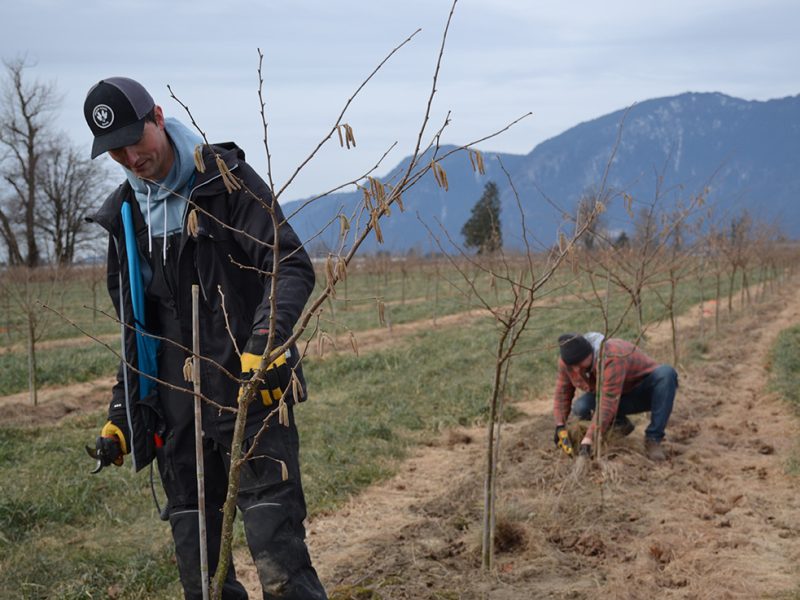
Production volumes are set to increase as BC hazelnut orchards mature following replanting with varieties resistant to Eastern Filbert Blight. Photo | Ronda Payne

March 1, 2025 byRonda Payne

ABBOTSFORD – Production volumes are rising as BC hazelnut orchards mature following replanting with varieties resistant to Eastern Filbert Blight.

“We’re about 10 years in after replanting … and we’re starting to see a lot of good yields,” says Steve Hope, co-owner of Fraser Valley Hazelnuts in Chilliwack, who delivered the hazelnut market outlook during the Lower Mainland Horticultural Conference at the Pacific Agriculture Show in Abbotsford, January 24. “Now we’re starting to see the fruits of all that labour.”

Hope credits the BC Hazelnut Renewal Program for the resurgence, but it has been far from an instant recovery.

In the early 2000s, BC produced about 2.5 million pounds of hazelnuts. In 2024, growers gathered 272,000 pounds. The largest harvest of the past 16 years, it remained a far cry from the volumes of yore.

Still, the pace of growth since 2020 is encouraging.

Fraser Valley Hazelnuts, the only commercial processing facility in BC, handles about 85% of the province’s hazelnuts. It received 35,000 pounds in 2020.

“That was the first year where we saw the majority of our intake be from the new varieties,” Hope says.

The volume of nuts from new, resistant varieties doubled in 2021 to 72,810 pounds, and in 2022, Fraser Valley Hazelnuts received 116,000 pounds then 148,000 pounds in 2023.

“We are definitely on the up trend in BC,” he says. “With 500 or so acres planted and starting to produce, we expect these numbers are going to start growing by 10% to 15% to 30% year-over-year depending on where we get with weather and … farming practices.”

Recovery has brought the challenge of expanding processing lines to accommodate both current harvests as well as future volumes.

“When we went from 40,000 to 100,000 pounds it was overnight and we struggled to keep up,” says Hope. “We’ve had 35% to 50% growth year-over-year for the past three and we’re expecting the same to continue. What we have to do now is try to figure out what we’re going to do with these nuts.”

Fraser Valley Hazelnuts is providing a local option for growers, who used to ship more than half their crop to Oregon. This is helping Fraser Valley growers see a better return, especially important when farm properties average $100,000 an acre.

BC growers sell hazelnuts in one of three ways: farmgate, which can see in-shell nuts fetch $6 to $10 a pound; receiving stations like Fraser Valley Hazelnuts, which pays market prices plus a bonus and takes on the risk of selling; or marketing the nuts independently.

“There have been a lot of success stories about people marketing their own product,” says Hope. “It’s time-consuming. It could be potentially expensive, but there could be good return that way.”

Fraser Valley Hazelnuts has been undertaking business development to grow domestic markets and maximize grower returns, but international forces are also helping.

“Luckily for us, this year, Turkey had a terrible crop,” Hope says.

As the largest region in the world producing hazelnuts, Turkey is the key influence on global prices. Production in 2024 was 25% lower than expected, at less than 600,000 tons.

“It’s driven up the market price,” Hope says, noting that BC pricing is based off Oregon. “We get a price roughly in October or November and that’s your base field price. Then they release a bonus price once all the processing is done in Oregon and shipped to their prospective customers. We get a bonus price in February or March. It leaves us, as a processor, in a guessing game.”

According to the Amity, Oregon-based Hazelnut Bargaining Association, 2024 field prices averaged US$1.14 per pound, 25% higher than in 2023.

Weather-related events and stink bug issues have hampered hazelnuts in Turkey and Italy, and if that trend continues, it will push BC grower returns higher.

Hope says Fraser Valley Hazelnuts sent about a quarter of its nuts to Oregon last year but is trying to open up more local markets to maximize returns. Buy BC promotions have also highlighted the product for consumers.

“In the past few years, we’ve been paying between 5% and 15% more than what the market rate is to our farmers because we’ve been able to keep it local,” he says.

While local markets are great, Hope is aware that as nut volumes increase, those markets may not be prepared to take on the full crop. Expanding local opportunities may not always line up with the crop.

“If we have an issue with too much of a crop, for us to send nuts down to Oregon is a great avenue.”

In-shell nuts are about 15% of the BC market, raw or roasted kernels are about 60% and 25% is value-added products like chocolate-covered hazelnuts or providing the nuts as an ingredient.

If Turkish yields recover, there will be an increased focus on selling filberts within the province.

“The outlook is good. The industry is growing. The demand has never been higher,” Hope says.

The biggest challenge Hope sees is getting retailers to accept buying BC-grown nuts at $6 a pound, which they can sell for $9 a pound, as opposed to Turkish nuts that come in at $3 a pound and sell for $6 a pound.


Related Posts

You may be interested in these posts from the same category.

Reports back significant hazelnut potential

Eastern Filbert Blight threatens to resurface

Hazelnut funding renewed

Previous Post: « Summer school cultivates future farmers
Next Post: Metro Vancouver invites DCC feedback »

Copyright © 2026 Country Life in BC · All Rights Reserved