
• Menu
  • Skip to primary navigation
  • Skip to main content
  • Skip to primary sidebar

Country Life In BC Logo

The agricultural news source in British Columbia since 1915

  • Headlines
  • Calendar
  • Subscribe
  • Advertise
  • About
  • Archives
  • Contact
  • Search
  • Headlines
  • Calendar
  • Subscribe
  • Advertise
  • About
  • Archives
  • Contact
  • Search

Primary Sidebar

Originally published:

AUGUST 2021
Vol. 107 Issue 8

Subscribe Now!

Sign up for free weekly FARM NEWS UPDATES

Select list(s) to subscribe to


By submitting this form, you are consenting to receive marketing emails from: Country Life in BC. You can revoke your consent to receive emails at any time by using the SafeUnsubscribe® link, found at the bottom of every email. Emails are serviced by Constant Contact
Your information will not be
shared or sold ever

Stories In This Edition

Heat Wave

Night moves

Record temps kill poultry

High heat, low moisture vexes ranchers

Editorial: Unprecedented

Back forty: Summer means being prepared for wildfires

Viewpoint: Overheated markets make farming harder

Province allows secondary homes in the ALR

National farm building code set for update

Grain producers refocus on advocacy, research

Ag Briefs: BC Blueberry Council gets new chair

Ag Briefs: Islands Trust defers policy statement

Ag Briefs: BCAC’s consumer research yields four key findings

Provincial meat licensing overhaul effective October

Farm fresh

New tech could build a better cattle fence

Buchler recognized for practices, generosity

First certified sustainable wine makes debut

Ag targetted to reduce emissions in Clean Air Plan

Helping cattle keep their cool in the heat

Free recycling of ag plastics for northern BC

Pesiticide colleciton returns to the southern interior

Indigienous farms plow new ground with funding

It’s easy being green

Flower farm meets growing demand

New resources support small-lot pork producers

BC going full boar against feral pigs

Cannabis grower has the ‘happiest worms’

AEMCoP updates take effect

Forging new successes with the family farm

Cutworm study looks at damage below ground

Beet growers see red over leaf miner

Armyworm pressure low

Research: Research explores scrapie resistance in goats

Sidebar: Scrapie eradication tips

Woodshed: Graduation plans sworn to secrecy

Cherry grower diversifies as orchard declines

Jude’s Kitchen: Eats for a hot summer day

Farm Story: Reaping more by sowing elss makes perfect sense

More Headlines

Follow us on Facebook

Comments Box SVG iconsUsed for the like, share, comment, and reaction icons

7 days ago

... See MoreSee Less

View Comments
  • Likes: 4
  • Shares: 0
  • Comments: 0

Comment on Facebook

7 days ago

On the last day of the BC Organic Conference, Thursday, Molly Thurston of Pearl Agricultural Consulting helped growers learn how to manage bugs such as codling moth, wireworm, and rootworm in organic growing systems. Her talk alongside Renee Prasad included hands-on activities in which participants checked out various traps and examined pests under microscopes. Be sure to look for more upcoming ag events on our online calendar at www.countrylifeinbc.com/calendar/

#BCAg
... See MoreSee Less

On the last day of the BC Organic Conference, Thursday, Molly Thurston of Pearl Agricultural Consulting helped growers learn how to manage bugs such as codling moth, wireworm, and rootworm in organic growing systems. Her talk alongside Renee Prasad included hands-on activities in which participants checked out various traps and examined pests under microscopes. Be sure to look for more upcoming ag events on our online calendar at www.countrylifeinbc.com/calendar/

#BCAg
View Comments
  • Likes: 15
  • Shares: 0
  • Comments: 0

Comment on Facebook

1 week ago

Well-known organic farmer and podcaster Jordan Marr gets interviewed by Country Life in BC’s own columnist and potato mavin Anna Helmer during the opening session of the BC Organic Conference at Harrison Hot Springs yesterday. Sessions run today (Wednesday) and Thursday and include organic and regenerative growing practices and expanding and advocating for the organic sector, all under the background of the newly launched Organic BC banner.

#BCAg
... See MoreSee Less

Well-known organic farmer and podcaster Jordan Marr gets interviewed by Country Life in BC’s own columnist and potato mavin Anna Helmer during the opening session of the BC Organic Conference at Harrison Hot Springs yesterday. Sessions run today (Wednesday) and Thursday and include organic and regenerative growing practices and expanding and advocating for the organic sector, all under the background of the newly launched Organic BC banner.

#BCAg
View Comments
  • Likes: 37
  • Shares: 2
  • Comments: 1

Comment on Facebook

Interested in finding out more about this

3 weeks ago

Today, we remember those who sacrificed their lives or their well-being for our freedom. Lest we forget. ... See MoreSee Less

Today, we remember those who sacrificed their lives or their well-being for our freedom. Lest we forget.
View Comments
  • Likes: 8
  • Shares: 0
  • Comments: 0

Comment on Facebook

1 month ago

FarmFolk CItyFolk is hosting its biennial BC Seed Gathering in Harrison Hot Springs November 27 and 28. Farmers, gardeners and seed advocates are invited to learn more about seed through topics like growing perennial vegetables for seed, advances in seed breeding for crop resilience, seed production as a whole and much more. David Catzel, BC Seed Security program manager with FF/CF will talk about how the Citizen Seed Trail program is helping advance seed development in BC. Expect newcomers, experts and seed-curious individuals to talk about how seed saving is a necessity for food security. ... See MoreSee Less

Link thumbnail

BC Seed Gathering - FarmFolk CityFolk

farmfolkcityfolk.ca

Save the date for our upcoming 2023 BC Seed Gathering happening this November 3rd and 4th at the Richmond Kwantlen Polytechnic University campus.
View Comments
  • Likes: 1
  • Shares: 0
  • Comments: 0

Comment on Facebook

Subscribe | Advertise

The agricultural news source in British Columbia since 1915
  • Email
  • Facebook

Helping cattle keep their cool in the heat

Dairy farmers share how they beat the heat in their operations

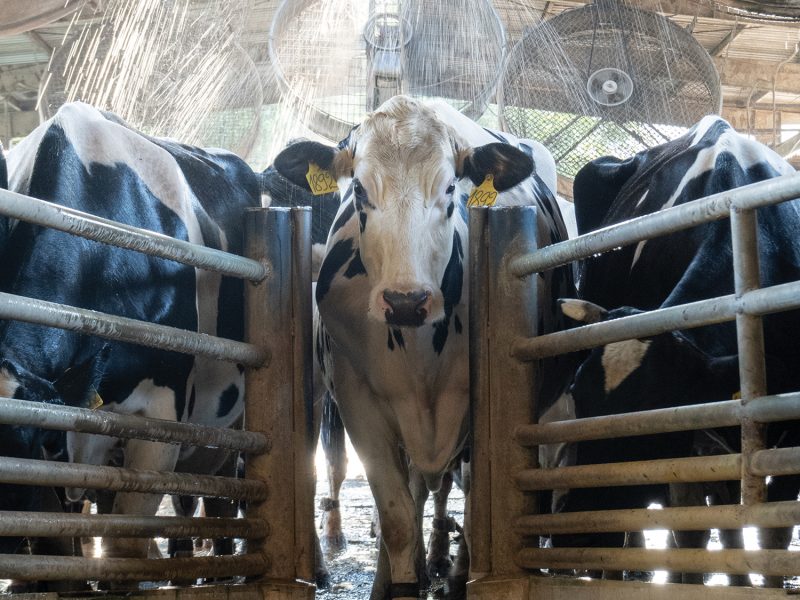
As extreme temperatures are predicted to become the norm, BC dairy producers are considering their options to reduce heat stress among their cows. FILE

August 1, 2021 byKate Ayers

CHILLIWACK – The unprecedented heat this summer has producers and consumers alike wondering what life will be like in the future as climate projections anticipate further temperature increases across the province.

The Pacific Climate Impacts Consortium at the University of Victoria says Chilliwack could average as many as 29 days over 30°C each year, up from eight today. This will help boost the average annual temperature in the Fraser Valley by up to 4.3°C by 2050.

Temperatures will not only increase, the range will also grow as temperature extremes become part of the new normal. The eastern Fraser Valley will be among the areas most impacted, with a temperature spread of about 12°C to 15°C, compared to a historical range of around 9°C and 11°C.

Livestock and poultry in the Fraser Valley are especially vulnerable to extreme heat events. The area is home to 50% of the province’s dairy operations and nearly 40% of BC’s poultry and egg producers.

Since the optimal ambient temperature range for dairy production is between 0°C and 20°C, higher temperatures will negatively impact productivity and cattle health. Some adverse effects of heat in animals include higher respiration rates, increased sweating and water consumption, lower feed intake, reduced fertility, lower butterfat content and lower milk production, a BC Agriculture & Food Climate Action Initiative (CAI) report says.

A research team at the University of Wisconsin-Madison found that heat stress can cost farmers upwards of several hundred dollars per cow per year.

The potential impacts of higher temperatures on animal health and productivity are prompting producers to future-proof their barns.

Some approaches include raising the ceiling height to allow for more airflow, investing in larger and more powerful fans, and using evaporative and conductive cooling techniques.

Bill and Jenny Van Reeuwyk of Summershade Farms Ltd. in Abbotsford were prepared for June’s heatwave, but their cattle were still impacted by the heat.

“In the new barn we put up four or five years ago, it’s completely open with huge fans and we’re going to put misters in there after what happened this year,” says Jenny.

The cattle’s milk production dropped and they were less active but the Van Reeuwyks were fortunate to not have lost any animals to the heat.

Indeed, ventilation plays a significant role in keeping cattle cool. Barns with large curtains help maximize air flow and improve the effectiveness of evaporative cooling over the animals, the BC Climate Change and Agriculture Initiatives report says. Natural ventilation, circulation fans and exhaust ventilation are most commonly used in the dairy sector.

“We put up a new barn just a few years ago and built it with very large side curtains. It’s wide open on the sides so the wind can flow right through. That really helps keep the cattle cool,” says Mark Ricka, a dairy producer in Chilliwack. “We have fans placed everywhere in the barn so there are no dead spots of air.”

Ricka also installed fans in each robotic milking room so the cattle always have air moving overhead. His 200 milking cows also fared okay during the heatwave, but feed intake dropped a bit and they stood more than normal.

Enderby dairy farmer Rene Miedema, who has been involved in interpreting the Climate Action Initiative report as a member of the Dairy Industry Research and Education Committee (DIREC), uses natural ventilation and fans to keep his 110 milking cows as comfortable as possible in the summer heat.

In his 12-year-old barn, they installed “large curtains so that we can open up the barn. We are lucky the barn is oriented east to west, so we have a lot of natural air flow,” he says. “Our summers in the Okanagan are fairly warm so we added two 72-inch variable-speed fans. They have made a tremendous difference. Our barn does remarkably well until 35-36°C, which is good, but I don’t think anybody was ready for 40-45°C.”

In addition, evaporative cooling is an effective way to cool cattle in dairy barns. Sprinklers and misters are the most common and effective tools in areas with low humidity.

“We put up a soaker rail. When the cows come up to eat, there are nozzles that point down and spray the cows’ backs while they’re in the feed alley,” Ricka says. “It’s not a mist. It’s more of a soak with a garden hose. It cools them down because they get wet and then the fans move air overhead.”

Conductive cooling is another strategy farmers can use to cool their herds. Waterbeds, for example, can be used under bedding to remove excess heat from cattle. Piping under the bedding area is another option, which circulates cold water.

Radiant barriers and breeding initiatives are other approaches to manage heat.

“We put solar panels on our barn and I noticed the next summer they acted as a radiant barrier. It was a happy accident, because they definitely lowered the temperature in the barn,” Miedema says.

The needs of each operation are unique, and the efficacy of tools will vary from farm to farm. Producers should consider operation size, location and costs of additional equipment required, water consumption and the amount of operation and maintenance that are required to implement each mitigation strategy.

“I think after this heat wave, a lot of farmers will look at misters if they can manage it. We have a lot of tools, I’m just not sure what tools are available to manage over 40°C,” Miedema says.

“Everyone was quite shocked with that heat. When I was walking through the barn, my fans were going full bore and it was like walking through a blast furnace. There is going to be a lot of talking amongst farmers. I will connect with farmers with misters to see how they made out in the heat. That’s the next logical step for me and then after that, I don’t know.”

Fortunately, research is ongoing to gather more information and evaluate the applicability of different technologies in the dairy sector as the effects of a changing climate make themselves felt across the province.

Related Posts

You may be interested in these posts from the same category.

Previous Post: « To hoard or not to hoard: that is the question
Next Post: BC jug recovery up »

Copyright © 2025 Country Life in BC · All Rights Reserved