
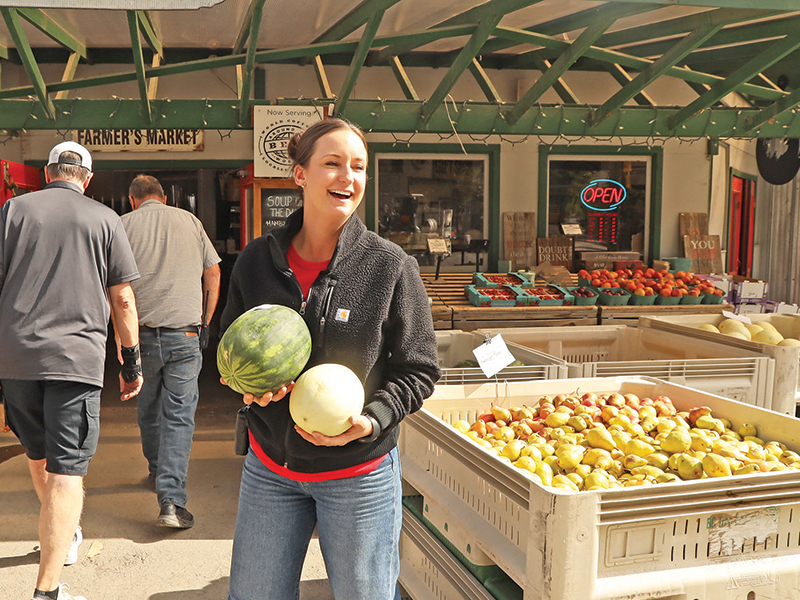
CACHE CREEK – For Marc Shane, nothing beats a good watermelon – and he’s found a way to share the love – and his product – with more people in BC.
The co-owner of Horsting’s Farm Market, a hop, skip and a jump from Cache Creek, is now selling its red watermelons, cantaloupe and canary and honeydew melons at Costco stores in Kamloops, Kelowna and Langley. Shane was approached by a Costco buyer last year, sparking a trial run.
“It’s been pretty successful,” says Shane, 62. “We’re getting lots of feedback from people all over BC who have had our melons and dropped us a line saying, ‘These are some of the best-tasting melons we’ve ever had.’ It’s nice to have that kind of feedback and be able to have local product in stores in BC.”
Shane and his wife Dianne acquired Horsting’s Farm by chance 12 years ago. Shane, who also runs Little Mountain Greenhouse and Garden Centre in Chilliwack, was contacted by his loan manager at Farm Credit Canada, who suggested he would be a good fit to take over the BC Interior farm. The farm had been sold years earlier by its namesakes Ted and Donna Horsting but had landed in receivership.
Shane dismissed the idea.
“I said, ‘Why would I want to go to Cache Creek and buy a place like that?’” he says.
The loan manager persisted, convincing him to take a look. His family visited the farm, but it was so rundown the answer was still no. Finally, six months later, after a last-minute plea by the loan manager, who wanted the property sold, Shane put in a bid that was so low he didn’t expect a second glance.
Eight months later, he was told the farm was his.
“I had to pull over to the side of the road. I told her, ‘What the heck am I supposed to do now?’ I had forgotten all about it,” Shane recalls. “I kind of got it by default.”
The farm was a mess. It had sat idle for years, and the orchards were overgrown. Looters had taken what they could from the market. Shane invited his nephew Ryan Nuyli and his fiancée Chelsey to visit the farm. They never left, got married on the farm and have since become partners in the business.
Chelsey, who grew up in Calgary, says it was a match made in heaven.
“We love this farm. Our biggest dream is to share it with people,” she says.
From the start, the family wanted to keep the Horstings’ legacy. The Horstings were generous with their original recipes for their homemade pies and potato bread and business advice. They agreed to let their name stay on the farm.
“They were very instrumental in giving us the recipes and showing us their successful business model,” Shane says. “Both of them said, ‘If you do this, you will not fail, and we guarantee it.’ And they were right.”
Growing ideas
Chelsey Nuyli says they had envisioned having a hobby farm, but the ideas kept evolving.
The apple orchards were resurrected, along with the u-pick strawberry fields and new raspberry and saskatoon bushes. Homegrown berries and fruit are used in their pies. Potatoes are turned into bread and dough for cinnamon buns. Cucumbers are grown for homemade pickles for sandwiches.
Inside the market, visitors can find fresh produce – from carrots and broccoli to squash and pumpkins – alongside local honey, breads and artisan fudge. Freshly made sandwiches, specialty coffees and roasted corn on the cob are on order. This year, Horsting’s opened the BBQ Shack, with slow-roasted meats like pulled pork and farm-to-table sides such as potato salad and coleslaw made with vegetables grown at the farm.
“We’re a food tourism-based business. We have the farming, the restaurant and BBQ Shack and u-picks so we are very diversified,” Nuyli says. “The farming is growing. We’re excited to be growing it further with our wholesale.”
Growing melons was a no-brainer. Horsting’s Farm Market is in a semi-arid desert, the perfect medium for melons with its hot days and cooler nights, low humidity, sandy soil and dry climate.
“As long as you’ve got water, you can produce a very good quality melon. If you have a bunch of those ingredients, it becomes a good recipe to do that,” Shane says.
It took years, though, to develop the perfect melon.
The family started out trialling different varieties, and it took forever to figure out the timing. The farm team became more technical, putting in innovative liquid feeding and drip irrigation.
Melons are challenging to grow, Shane says, because they must do tests and holds on some to ensure there are no risks of listeria, E. coli or salmonella. Shane’s son Alex and daughter-in-law Taya have also joined the farm and are responsible for food safety.
“It’s not as simple as just growing a melon,” Shane says. “You have to make sure you’re growing a super clean and safe product to go in their stores.”
Over the years, Horsting’s has established a 30-acre melon patch. Next year, they will start producing the ‘Dino’ melon, so called because it has a speckled white rind and resembles a dinosaur egg. Shane says it has a unique, sweet taste.
“Every year, we’re doing something different – just making it a little bit better,” he says.
Wildfire delays harvest
The melons – along with the other produce – are started in the Chilliwack greenhouse and transplanted to Horsting’s Farm between late April and mid-May. They are usually picked in the second week of July, but harvesting was delayed this year due to the Pear Lake Wildfire. Heavy smoke meant temperatures never rose above 20°C, and melons need heat.
Nuyli says the family is getting good at pivoting, having dealt with COVID, floods and wildfires over the past 12 years. It’s a community effort in the Cariboo, she says, which helps. During the recent Pear Lake wildfire, when tourism came to a standstill, Desert Hills in nearby Ashcroft took some of Horsting’s produce to a pop-up stand in 100 Mile House.
“In a wildfire, the farming doesn’t stop, so he was able to take some produce up north for us,” Nuyli says. “Farmers helping farmers.”
Horsting’s also gives back to the community. During the wildfires, the farm provided breakfast, lunch and dinner to Clinton firefighters for weeks, dropping meals off at a checkpoint. Once residents returned home, Horsting’s delivered 150 fruit and vegetable boxes to the resiliency centre in Clinton. They had offered the same help to Lytton in 2021 when that community burned.
Shane says he never expected to face so many natural disasters, but the farm has proven to be a great family business.
“Farming is challenging at the best of times without fires and floods,” he says. “Sometimes you wonder why you do it. But it’s turned out good, and it’s fun.”
All content on this website is copyrighted, and cannot be republished or reproduced without permission.
