
• Menu
  • Skip to primary navigation
  • Skip to main content
  • Skip to primary sidebar

Country Life In BC Logo

The agricultural news source in British Columbia since 1915

  • Headlines
  • Calendar
  • Subscribe
  • Advertise
  • About
  • Archives
  • Contact
  • Search
  • Headlines
  • Calendar
  • Subscribe
  • Advertise
  • About
  • Archives
  • Contact
  • Search

Primary Sidebar

Originally published:

JANUARY 2021
Vol. 107 Issue 1

Subscribe Now!

Sign up for free weekly FARM NEWS UPDATES

Select list(s) to subscribe to


By submitting this form, you are consenting to receive marketing emails from: Country Life in BC. You can revoke your consent to receive emails at any time by using the SafeUnsubscribe® link, found at the bottom of every email. Emails are serviced by Constant Contact
Your information will not be
shared or sold ever

Stories In This Edition

Full moon rising

New year, new era

Insurance premiums soar

Popham looks forward to a new term

Editorial: New openings

Back 40: New farmers are a crop worth growing

Viewpoint: Let’s get real about mental wellness on the farm

Trade issues, pandemic dog dairy producers

Dairy associations pull through challenging year

Second wave of pandemic hits close to home

Grain producers mark one of their worst harvests

Grower takes issue with groundwater limits

Grape phylloxera found on Vancouver Island

Pioneering entomologist remembered

Leasing farmland a vital strategy for farmers

Raspberry growers tackle new pest challenge

Province comes through with replant money

Pacific Ag Show embraces the digital realm

Berries, berries and more berries

Sidebar: Short course continues to educate growers

Green shoots on the vegetable front

Gala closes out opening day

Ag innovation day

The show must go on

CannaTech West returns

Optimism follows on the heels of 2020’s challenges

Rotational grazing improves soil health

Taking the guesswork out of herd management

Research: Highly sensitive pigs help solve soybean allergies

Bill Awmack honoured with leadership award

Farmers put electric tractors to the test

Kootenay farm advisors resume field days

Kelowna school embraces new container farm

Farm Story: Winter is a good time to problem-solve

Farm women encouraged to take a stand

Woodshed: Breaking the good (and not so good) news

Uncertainty prevails for BC fairs in new year

Jude’s Kitchen: Leftovers re-imagined make tasty meals

More Headlines

Follow us on Facebook

Comments Box SVG iconsUsed for the like, share, comment, and reaction icons

2 weeks ago

The Canadian Food Inspection Agency is preparing to implement changes to its livestock traceability rules that will include mandatory computer reporting within seven days on movement of animals for veterinary appointments, community pastures, exhibitions, carcass and on-farm disposal and the births and deaths of every animal on your farm. Writer Tom Walker first brought these changes to the attention of our readers back in June 2023. We've posted his story to our website:

www.countrylifeinbc.com/cfia-proposes-traceability-updat#BCAg#BCag
... See MoreSee Less

The Canadian Food Inspection Agency is preparing to implement changes to its livestock traceability rules that will include mandatory computer reporting within seven days on movement of animals for veterinary appointments, community pastures, exhibitions, carcass and on-farm disposal and the births and deaths of every animal on your farm. Writer Tom Walker first brought these changes to the attention of our readers back in June 2023. Weve posted his story to our website: 

https://www.countrylifeinbc.com/cfia-proposes-traceability-updates/

#BCag
View Comments
  • Likes: 11
  • Shares: 21
  • Comments: 15

Comment on Facebook

I love hpw the cow in the picture hasn't even got a RFID tag in it but I digress. We can not read the link, it says "we are not permitted to read drafts". Please post again with the correct link.

Dairy farmers having been doing this several years. The app we use has become quite simple to use

Including equine?

Premise ID was slowly rolled through the country, voluntary then mandatory. Transparency and 'Consultation' has been light. Those who tried to bring this for discussion a couple years ago, because of forseen overreach, were quite often labeled conspiracy theorists and that it wasnt meant to be so heavily regulated and controlled. Gardens and seeds will be next. "Invasive species" reporting, check out the plants medicinal properties. Read the BC intentions papers. The premise ID that already heavy regulated commodities have claims to be treated different in the intentions papers on page 8. www2.gov.bc.ca/assets/gov/farming-natural-resources-and-industry/agriculture-and-seafood/food-saf...

Says i am "not allowed to preview draft".

Also concerning is the part on compliance...they can 'stumble onto' any farm and if you're not complying there are consequences.

When the CFIA stumbles into the wrong place compliance will be met with civil engagement

Says I can't preview draft

This is government overreach - Do Not Comply!

Do not comply

Fu

As if the price of beef isn't bad enough for consumers,,,,,be prepared to be gouged some more now

Ridiculous!!

Let's hold up on the beef exports tell we can get our own house in order... we need to deregulated, cheapen up the supply chain back into a 5 buck a pound rage so the good people canada can eat healthy food.. fuck your bean diets, that's retarded

This, along with the majority of new legislation pertaining to any type of farm, is a blatant squeeze on any sort of small, alternative agricultural venture. I am a massive believer in working together and sharing resources and costs and solutions - do not get me wrong - but this and the water registration among others, is an overreach (at most generous) and an absolute killer to smaller, local initiatives that LITERALLY save lives during extreme events. There is ONE ROAD into and out of my community. We don’t need or want some sort of backlogged government response when shit goes sideways. We want the ability AND SUPPORT to provide for our communities without penalty when things go badly. We want to produce sustainability for our communities. We live here, we work here, we want to STAY HERE. Stop making it harder.

View more comments

3 weeks ago

BC's minimum piece rates for 15 hand-harvested crops increased 2.6% on December 31. Crops include peaches, apricots, brussels sprouts, daffodils, mushrooms, apples, beans, blueberries, cherries, grapes, pears, peas, prune plums, raspberries and strawberries. Farm-worker piece rates in BC were increased by 11.5% in January 2019 and 6.9% in December 2024. BC’s current minimum wage sits at $17.85 per hour.

#BCAg
... See MoreSee Less

BCs minimum piece rates for 15 hand-harvested crops increased 2.6% on December 31. Crops include peaches, apricots, brussels sprouts, daffodils, mushrooms, apples, beans, blueberries, cherries, grapes, pears, peas, prune plums, raspberries and strawberries. Farm-worker piece rates in BC were increased by 11.5% in January 2019 and 6.9% in December 2024. BC’s current minimum wage sits at $17.85 per hour. 

#BCAg
View Comments
  • Likes: 10
  • Shares: 0
  • Comments: 2

Comment on Facebook

I'm not sure what they're telling us. Did peace rates have to increase so that Farm workers could make minimum wage?

They deserve it, but the general public will be whining about increased prices in the stores. Will need to make more information average to the g.p.

3 weeks ago

... See MoreSee Less

View Comments
  • Likes: 14
  • Shares: 0
  • Comments: 1

Comment on Facebook

105 Mile Ranch

4 weeks ago

... See MoreSee Less

View Comments
  • Likes: 7
  • Shares: 0
  • Comments: 0

Comment on Facebook

1 month ago

Water volumes from the Nooksack River are at levels similar to 1990 and 2021, but the province says flows should peak at 10pm tonight. The shorter duration, as well as conditions in other watercourses within the watershed and performance of flood protection infrastructure should avoid a catastrophe on the scale of 2021. However, several landslides mean road closures have once again effectively isolated the Lower Mainland from the rest of the province.

#BCAg
... See MoreSee Less

Water volumes from the Nooksack River are at levels similar to 1990 and 2021, but the province says flows should peak at 10pm tonight. The shorter duration, as well as conditions in other watercourses within the watershed and performance of flood protection infrastructure should avoid a catastrophe on the scale of 2021. However, several landslides mean road closures have once again effectively isolated the Lower Mainland from the rest of the province.

#BCAg
View Comments
  • Likes: 9
  • Shares: 3
  • Comments: 1

Comment on Facebook

Family living in Sumas WA say it's very much like '21. They have the same amount of water in their house as last time.

Subscribe | Advertise

The agricultural news source in British Columbia since 1915
  • Email
  • Facebook

Kelowna school embraces new container farm

Microgreens project promises many teaching moments

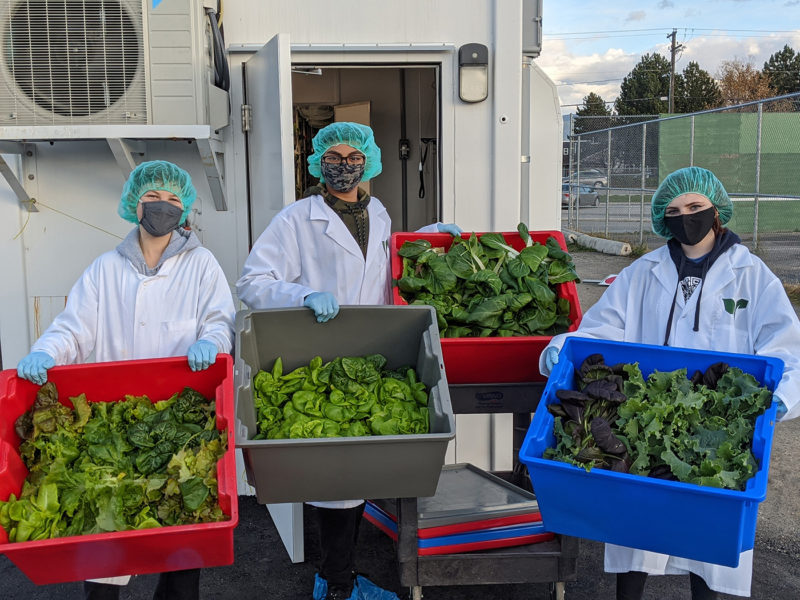
KLO Middle School student farmers Riley Gayford, Arsh Rifan and Kaydence Aubin show off some of the produce grown in the school’s new container farm. The farm was gifted to the school by President’s Choice Children’s Charity. PHOTO / KLO MIDDLE SCHOOL

January 1, 2021 byMyrna Stark Leader

KELOWNA – The newest container farm in BC is at Kelowna’s KLO Middle School. Since mid-November, a 40-foot shipping container just outside the school’s front doors has produced lettuce, kale and bok choy. The next crop will include basil, thyme and oregano.

“Right now, we’re only growing about one-sixth capacity but the farm could produce 525 lettuce plants every harvest,” says Karla Lockwood, a Grade 9 math and science educator.

“This farm hits on the Grade 9 science curriculum of scientific method – starting with a question, developing a hypothesis, identifying variables, gathering data, analyzing it and reporting it. That’s all the competencies,” says Lockwood. “From a content standpoint, we teach nutrient cycles, the nitrogen, phosphorus and carbon cycles, which is exactly what a modular farm does. It’s an automated version of nutrient cycling.”

Raised in Kelowna, Lockwood watered plants at Lake Country Greenhouses in Winfield during high school and part of university. Her second teaching job was in Summerland, where the school also had a small outdoor greenhouse.

The container farm at KLO is much bigger since nearly every school subject across Grades 7-9 can be linked to the farm. Food classes, career education, math, physical education around healthy food choices, English and French classes where students can write about the project and even technical education, where students might design and build an entry area where students can prepare themselves to enter the farm.

KLO’s farm is the second pilot project President’s Choice Children’s Charity has funded. The first is at a school in La Loche, Saskatchewan. The charity helps combat child hunger by raising and distributing about $16 million annually. Funds come from donations by Loblaws customers, employees and suppliers, as well as direct fundraising. The charity is the largest charitable funder of school meal programs across Canada.

“We’re focused on tackling childhood hunger, food access and food-based education, but also innovation, which led us to offering container farms as a way to grow food year-round in the north, our first pilot project site,” explains the charity’s executive director Lisa Battistelli.

KLO’s principal Ashley Ragoonaden learned of the La Loche project when his son and the son of Peter Boyd, owner of the Independent store in Kelowna, were playing soccer. Boyd mentioned La Loche to Ragoonaden, who sought more information through the charity and spearheaded KLO’s grant application. He also won approval for the project from the local school district.

“I’ve seen schools with little gardens, but this was different,” says Ragoonaden. “My teaching team are really working on our environmental stewardship and sustainability. The farm connected immediately to those ideas.”

Battistelli says KLO was approved for several reasons: the potential to interest urban students in new farming methods and innovation, the possibility of using produce to feed kids and families, and KLO’s intention to work with Kelowna Secondary School and Okanagan College, both across the street.

But KLO’s commitment to develop a Grade 9 credit course rooted in the farm was the clincher.

“We recognize the limited capacity of all teachers to create new curriculum and/or lesson plans related to the farm and appreciate KLO’s commitment to sharing the content they create,” says Battistelli.

The charity fully funded the unit and equipment, transportation, set up and three years of 24-hour support, technical as well as servicing costs and supplies such as seed. The grant is worth approximately $250,000 so far.

In addition, the school’s parent advisory council committed $50,000 towards site prep.

KLO chose the Canadian-made Growcer brand container system. The Ottawa-based company was founded three years ago by Corey Ellis and Alida Burke, who wanted a customizable plug-and-play hydroponic food-growing system northern communities could use to grow healthy food and help them become more self-sufficient. The farm’s hydroponic system doesn’t require soil.

Lockwood says the students she’s had working in the farm at this early stage are highly engaged. The farm has also piqued the curiosity of others.

“The farm is an amazing way to grow food really quickly and efficiently. Instead of taking up a lot of flat ground, we grow the plants in shelves so that there’s more food growing at once,” says Grade 8 student Arsh Rifan. “The automatic water chemical control is a very handy piece of equipment because we don’t have to test the water every day. The hydroponic farm is the future of farm agriculture.”

“It’s a pretty amazing gift,” says Tamara Knott of Bright Greens Canada when she learned about KLO’s farm. “I hope the students will understand what they’ve been gifted.”

Knott and her husband Bruce have been producing greens in converted shipping containers in Central Saanich since 2016. She and two farm helpers grow about 70-80 pounds of fresh produce each week in two containers, located on a property within the Agricultural Land Reserve. About 70% is marketed to direct to consumers and 30% to restaurants.

Knott sees KLO’s farm as a great student learning opportunity. Her experience with Bright Greens has taught her the need for strong scheduling and recording of farm data and procedures. She believes having a system to transfer knowledge between teachers and students working in the farm will be critical as things can be accidently overlooked. A way to share knowledge between those working inside the farm is also important.

Lockwood and her colleagues are employing two apps to help coordinate farm operations. Growlink monitors the farm’s system while Artemis AG helps schedule harvesting, cleaning and other chores.

“We can set up independent users and as farm tasks are done individuals can identify what they’ve completed, make notes and even post pictures as documentation,” says Lockwood.

The farm has been a bright spot for the school in a year dominated by COVID-19. Future opportunities include using produce in cooking classes and the school lunch program as well as working with President’s Choice Children’s Charity to address challenges like creating enough fridge space for the harvested produce.

“We are working hard to create a culture of learning, not just one course … it’s about building an environment where, you know, everybody is involved, it becomes part of our fabric,” says Ragoonaden.

Related Posts

You may be interested in these posts from the same category.

Previous Post: « Tsartlip acquire farmland
Next Post: Leasing farmland a vital strategy for farmers »

Copyright © 2026 Country Life in BC · All Rights Reserved