
• Menu
  • Skip to primary navigation
  • Skip to main content
  • Skip to primary sidebar

Country Life In BC Logo

The agricultural news source in British Columbia since 1915

  • Headlines
  • Calendar
  • Subscribe
  • Advertise
  • About
  • Archives
  • Contact
  • Search
  • Headlines
  • Calendar
  • Subscribe
  • Advertise
  • About
  • Archives
  • Contact
  • Search

Primary Sidebar

Originally published:

JULY 2022
Vol. 108 Issue 7

Subscribe Now!

Sign up for free weekly FARM NEWS UPDATES

Select list(s) to subscribe to


By submitting this form, you are consenting to receive marketing emails from: Country Life in BC. You can revoke your consent to receive emails at any time by using the SafeUnsubscribe® link, found at the bottom of every email. Emails are serviced by Constant Contact
Your information will not be
shared or sold ever

Stories In This Edition

Good land at risk

Borrowing costs rising

Biosecurity rules limit bird flu outbreaks

From far and white

Back 40: A reality check for those living in a virtual world

Viewpoint: Don’t overlook tax incentives for innovation

Chicken growers battle disease, high feed costs

Delayed seeding means lighter crop, higher prices

Dairy farmers welcome price increase

Ag Briefs: Dutch Treat

Ag Briefs: Bearing fruit

Ag Briefs: Photo finish

Ukraine’s loss in the global market is everyone’s loss

Diesel prices plateau but gas pains continue

Farms expected to meet carbon emission targets

Sidebar: Regulating cannabis emissions

Carbon tax tops greenhouse grower concerns

New extension initiatives for orchard sector

Langley farmers air grievances to politicians

Drought, fires mark chaotic year for ranchers

Reduced forage quality complicates the math

Targeted grazing project reduces wildfire risk

BC bee colonies see significant winter losses

Hay down

Slocan market garden finds its sweet spot

Farm co-operatives aim to do business right

Sidebar: What about larger scale cooperatives?

Researchers close in on grapevine trunk disease

Sidebar: Fighting fungi with fungi

Summer sweet

Industry collaborates on smoke taint research

Farm Story: The usual thing isnt working

Researchers investigate sunscreen for fruit

Sidebar: Larger rootstocks could alleviate heat stress

Startup supports seasonal worker payments

Woodshed: Kenneth’s rescue is TikTok worthy

Family and friends honour rancher’s legacy

Jude’s Kitchen: Summer salads are cool and refreshing

More Headlines

Follow us on Facebook

Comments Box SVG iconsUsed for the like, share, comment, and reaction icons

6 days ago

... See MoreSee Less

View Comments
  • Likes: 4
  • Shares: 0
  • Comments: 0

Comment on Facebook

6 days ago

On the last day of the BC Organic Conference, Thursday, Molly Thurston of Pearl Agricultural Consulting helped growers learn how to manage bugs such as codling moth, wireworm, and rootworm in organic growing systems. Her talk alongside Renee Prasad included hands-on activities in which participants checked out various traps and examined pests under microscopes. Be sure to look for more upcoming ag events on our online calendar at www.countrylifeinbc.com/calendar/

#BCAg
... See MoreSee Less

On the last day of the BC Organic Conference, Thursday, Molly Thurston of Pearl Agricultural Consulting helped growers learn how to manage bugs such as codling moth, wireworm, and rootworm in organic growing systems. Her talk alongside Renee Prasad included hands-on activities in which participants checked out various traps and examined pests under microscopes. Be sure to look for more upcoming ag events on our online calendar at www.countrylifeinbc.com/calendar/

#BCAg
View Comments
  • Likes: 15
  • Shares: 0
  • Comments: 0

Comment on Facebook

1 week ago

Well-known organic farmer and podcaster Jordan Marr gets interviewed by Country Life in BC’s own columnist and potato mavin Anna Helmer during the opening session of the BC Organic Conference at Harrison Hot Springs yesterday. Sessions run today (Wednesday) and Thursday and include organic and regenerative growing practices and expanding and advocating for the organic sector, all under the background of the newly launched Organic BC banner.

#BCAg
... See MoreSee Less

Well-known organic farmer and podcaster Jordan Marr gets interviewed by Country Life in BC’s own columnist and potato mavin Anna Helmer during the opening session of the BC Organic Conference at Harrison Hot Springs yesterday. Sessions run today (Wednesday) and Thursday and include organic and regenerative growing practices and expanding and advocating for the organic sector, all under the background of the newly launched Organic BC banner.

#BCAg
View Comments
  • Likes: 37
  • Shares: 2
  • Comments: 1

Comment on Facebook

Interested in finding out more about this

3 weeks ago

Today, we remember those who sacrificed their lives or their well-being for our freedom. Lest we forget. ... See MoreSee Less

Today, we remember those who sacrificed their lives or their well-being for our freedom. Lest we forget.
View Comments
  • Likes: 8
  • Shares: 0
  • Comments: 0

Comment on Facebook

1 month ago

FarmFolk CItyFolk is hosting its biennial BC Seed Gathering in Harrison Hot Springs November 27 and 28. Farmers, gardeners and seed advocates are invited to learn more about seed through topics like growing perennial vegetables for seed, advances in seed breeding for crop resilience, seed production as a whole and much more. David Catzel, BC Seed Security program manager with FF/CF will talk about how the Citizen Seed Trail program is helping advance seed development in BC. Expect newcomers, experts and seed-curious individuals to talk about how seed saving is a necessity for food security. ... See MoreSee Less

Link thumbnail

BC Seed Gathering - FarmFolk CityFolk

farmfolkcityfolk.ca

Save the date for our upcoming 2023 BC Seed Gathering happening this November 3rd and 4th at the Richmond Kwantlen Polytechnic University campus.
View Comments
  • Likes: 1
  • Shares: 0
  • Comments: 0

Comment on Facebook

Subscribe | Advertise

The agricultural news source in British Columbia since 1915
  • Email
  • Facebook

Larger rootstocks could alleviate heat stress

Researchers investigate sunscreen for fruit

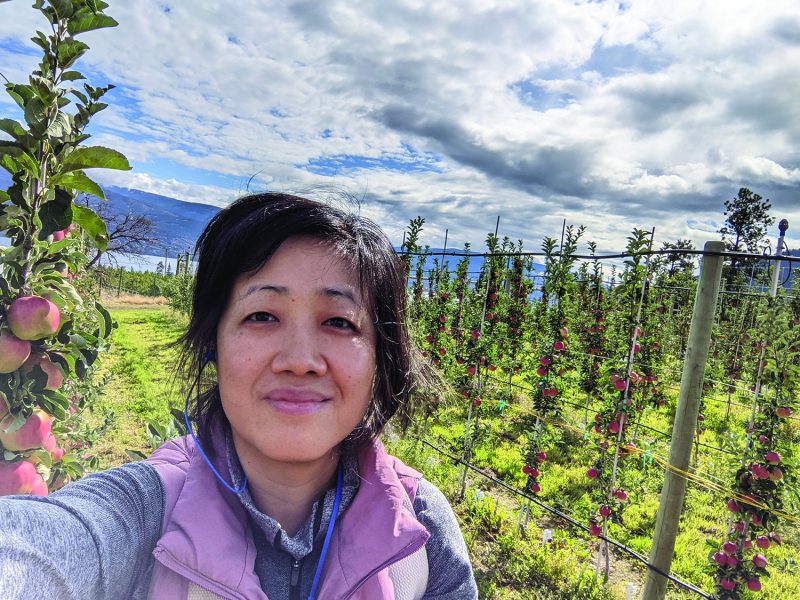
Summerland research scientist Hao Xu is working to make fruit trees more resilient to heat stress. AAFC

July 4, 2022 byKate Ayers

Research scientist Hao Xu has always been interested in sustainable agriculture and carbohydrate partitioning, especially in fruit trees.

Following work as a research assistant at the Chinese Academy of Sciences and visiting scholar at the Universidad de Murcia in Spain, Xu studied symbiosis and root water uptake at the University of Alberta. She completed a PhD, majoring in forest biology and sustainable management and was a postdoctoral fellow, studying fungal and plant aquaporins, mycorrhizal symbiosis, plant-water relation and plant stress physiology.

Her work in academia and interest in plant physiology led her to a position with Agriculture and Agri-Food Canada in Summerland in 2017.

Since joining the AAFC team, Xu has conducted research to “investigate tree fruit crop resilience and fruit production in terms of yield and fruit quality under different environmental stressors and different approaches of mitigation,” she says. “Under this umbrella we have been looking at how rootstocks can impact tree resilience, carbohydrate partitioning and fruit production.”

Last year, she investigated the effects of heat on tree fruit quality in the Okanagan Valley. Other projects include looking at irrigation scheduling and how water management impacts fruit quality.

Indeed, one potential long-term mitigation approach to heat stress that she’s found is using larger rootstocks.

“Larger rootstocks … showed promising results last year that they are capable of reducing the ratio of heat damage in fruits per tree, consequently producing more damage-free trees per acre,” Xu says. “The larger rootstocks such as G.935, … we saw an increase in yields. It’s larger than M.9 or M.26 and a lot larger than B.9, which are commonly used rootstocks by growers right now.”

Larger rootstocks contain xylem, which transport water, with larger diameters allowing for higher transport capacity through the grafting union, where the scion and rootstock are united.

“When you supply sufficient water to the trees, the G.935 is able to transport more water,” Xu says. “That provides more transpirational cooling in the canopy and they have a large canopy so there is more foliage density to provide more shading onto the fruits in the canopy. This contributes to a decrease in the counts of sunburn browning on necrotic apples compared to smaller rootstocks.”

However, a downside to larger rootstocks is that they use more water.

“We are trying to sustain production in a very water-limited environment. We need to take that into consideration and do a longer time evaluation on their performance,” Xu says.
 

Related Posts

You may be interested in these posts from the same category.

Grapegrowers discuss freeze event

Previous Post: « Next policy framework worth $3.5 billion
Next Post: Producers take steps against heat »

Copyright © 2025 Country Life in BC · All Rights Reserved