
• Menu
  • Skip to primary navigation
  • Skip to main content
  • Skip to primary sidebar

Country Life In BC Logo

The agricultural news source in British Columbia since 1915

  • Headlines
  • Calendar
  • Subscribe
  • Advertise
  • About
  • Archives
  • Contact
  • Search
  • Headlines
  • Calendar
  • Subscribe
  • Advertise
  • About
  • Archives
  • Contact
  • Search

Primary Sidebar

Originally published:

APRIL 2025
Vol. 111 Issue 3

Subscribe Now!

Sign up for free weekly FARM NEWS UPDATES

Loading form…

Your information will not be
shared or sold ever

Stories In This Edition

Standing her ground

Minister endorses farmland loss

BC ag funding hits record level

Okanagan drives increase in land values

Editorial: Choosing engagement

Back 40: Trade war claims lack economic reality

Viewpoint: Tried of the to and fro of the tariff foe?

Popham fields questions at town hall

Fruit growers find strength in united front

Sidebar: Tesche quits

BC research leading way on avian influenza

Ag Briefs: Premier’s task force members announced

Ag Briefs: Carbon tax under fire

Cuthberts win Outstanding Young Farmers award

BC delegation urges  review of foreign ownership

Alliance strengthens Westgen’s bottom line

Major BC Tree fruit Co-op asset changes hands

Elbows up

Island farmers insitutes garner local support

Potato processors hold key to tariffs

Tech solutions highlight packed hort show

BC-bed apple set to fill market niche in 2026

Cherry growers optimistic after tough years

Local bylaw will increase access to farmland

Sidebar: First of its kind

Drone technology takes flight on BC farms

Sidebar: Okanagan pilot project heads off problems

Tech investments transform BC farm operations

Ranchers cry foul over green energy projects

Top bull

Ranchers oppose plans for solar energy project

Johne’s disease management critical for sheep

Food Shed gets $1 million for distribution

Market farm works smarter, not harder

Digging deep into soil amendments

Farm Story: Spring thaw unveils winter’s secrets

Berry farm goes soil-free for strawberries

Woodshed: Rocket’s revenge makes a cowboy out of Kenneth

Comox Valley sweeps farmers market awards

Jude’s Kitchen: Cooking Canadian is not a problem

All content on this website is copyrighted, and cannot be republished or reproduced without permission.

More Headlines

Follow us on Facebook

Comments Box SVG iconsUsed for the like, share, comment, and reaction icons

11 hours ago

A draft update to the Code of Practice for the Care and Handling of Beef Cattle is now open for public comment until June 12. The code, one of 14 animal care codes developed and maintained by the National Farm Animal Care Council, is undergoing a routine 10-year review. "Your feedback will help shape the industry's guide to cattle welfare for the next decade," says Canadian Cattle Association policy manager Jessica Radau, urging producers to weigh in. For more information, visit tinyurl.com/58a3u9fz.

#BCAg
... See MoreSee Less

A draft update to the Code of Practice for the Care and Handling of Beef Cattle is now open for public comment until June 12. The code, one of 14 animal care codes developed and maintained by the National Farm Animal Care Council, is undergoing a routine 10-year review.  Your feedback will help shape the industrys guide to cattle welfare for the next decade, says Canadian Cattle Association policy manager Jessica Radau, urging producers to weigh in. For more information, visit https://tinyurl.com/58a3u9fz.

#BCAg
View Comments
  • Likes: 2
  • Shares: 0
  • Comments: 1

Comment on Facebook

I sat in the webinar yesterday by the Canadian Cattle Association. My initial concern was that this would be another "play" into the government's hands. It has been worked on by people that are actually in the Beef industry from Cow calf to feedlot. The thrust is an update of the 2013 Code of Practice which was reviewed in 2018. The changes are more a move from "left to the producers discretion" to clearer directions regarding pain management, proper transport of animals which are impaired and keeping cattle in in good condition. Much of what is recommended is what producers who care about animal husbandry already do. The important part is to GIVE THEM FEEDBACK good, bad or otherwise. The document is about 60 pages long, and I ran it through CHAT to see what had been changed. It is important to understand that the PUBLIC is invited to comment on the draft not just producers. Think about it... do you really want the public influencing how you manage your cattle. If you think that this is just one of those things, I have been following Bill 22 in Alberta which will grant the SPCA a proactive roll in entering farms and checking on animals. When I asked CHAT how the new bill relates to the Cattle Code, it came back that the Code although not a regulation will be able to be used as a guide by producers for backup in dealing with the SPCA regarding cattle conditions, sick animal handling etc. Take the time.... Go onto the Canadian Cattle Association website and speak to those parts that you wish to input.

1 day ago

According to the BC River Forecast Centre, the Okanagan snowpack stood at just 58% of normal on April 1 — the lowest reading since measurements began in 1980 — raising concerns about drought conditions in the region this summer. The rest of the province sits at 92% of normal.

#BCAg
... See MoreSee Less

According to the BC River Forecast Centre, the Okanagan snowpack stood at just 58% of normal on April 1 — the lowest reading since measurements began in 1980 — raising concerns about drought conditions in the region this summer. The rest of the province sits at 92% of normal.

#BCAg
View Comments
  • Likes: 3
  • Shares: 0
  • Comments: 0

Comment on Facebook

2 days ago

At her first AGM as executive director of BC Meats, held Saturday in Abbotsford, Jennifer Busmann spoke about her strong ties to agriculture and her optimism for the organization's future. Busmann has cattle of her own and came to the role with existing relationships with members and the board of directors that helped her feel integrated from the start. She stepped into the position in Februa#BCAg#BCAg ... See MoreSee Less

At her first AGM as executive director of BC Meats, held Saturday in Abbotsford, Jennifer Busmann spoke about her strong ties to agriculture and her optimism for the organizations future. Busmann has cattle of her own and came to the role with existing relationships with members and the board of directors that helped her feel integrated from the start. She stepped into the position in February.

#BCAg
View Comments
  • Likes: 6
  • Shares: 0
  • Comments: 0

Comment on Facebook

4 days ago

Shannon Wiggins of Headwind Farm in North Saanich is this year's Mary Forstbauer Grant recipient from the BC Association of Farmers Markets. The $500 grant will help Wiggins expand her plot at Sandown Centre for Regenerative Agriculture, growing more storage crops to extend her harvest season. Wiggins credits farmers markets with inspiring her own farming journey and commitment to building community through food. Congratulations!

tinyurl.com/45bdd#BCAg#BCAg
... See MoreSee Less

Shannon Wiggins of Headwind Farm in North Saanich is this years Mary Forstbauer Grant recipient from the BC Association of Farmers Markets. The $500 grant will help Wiggins expand her plot at Sandown Centre for Regenerative Agriculture, growing more storage crops to extend her harvest season. Wiggins credits farmers markets with inspiring her own farming journey and commitment to building community through food. Congratulations!

https://tinyurl.com/45bddtw8

#BCAg
View Comments
  • Likes: 46
  • Shares: 2
  • Comments: 3

Comment on Facebook

Wahoo! Congrats Shannon! I love your produce. Can’t wait for the radishes 🫜

Congratulations!

Well done!! 🩷🩷🩷

6 days ago

New farmers can avoid costly mistakes by learning from those who've been there. At a Young Agrarians mixer in Penticton, five BC farmers shared hard-won lessons on pricing, pivoting, relationships and burnout. From coyote losses to business burnout, their message was clear: set prices that reflect true costs, make decisions quickly and don't let farming define your worth. Myrna Stark Leader's story appears in our April e-edition, now available to view online at: tinyurl#BCAg2uw53vvm

#BCAg
... See MoreSee Less

New farmers can avoid costly mistakes by learning from those whove been there. At a Young Agrarians mixer in Penticton, five BC farmers shared hard-won lessons on pricing, pivoting, relationships and burnout. From coyote losses to business burnout, their message was clear: set prices that reflect true costs, make decisions quickly and dont let farming define your worth. Myrna Stark Leaders story appears in our April e-edition, now available to view online at: https://tinyurl.com/2uw53vvm

#BCAg
View Comments
  • Likes: 15
  • Shares: 0
  • Comments: 0

Comment on Facebook

Subscribe | Advertise

The agricultural news source in British Columbia since 1915
  • Email
  • Facebook

Market farm works smarter, not harder

Silverstar Veggies in Vernon is planning to diversify

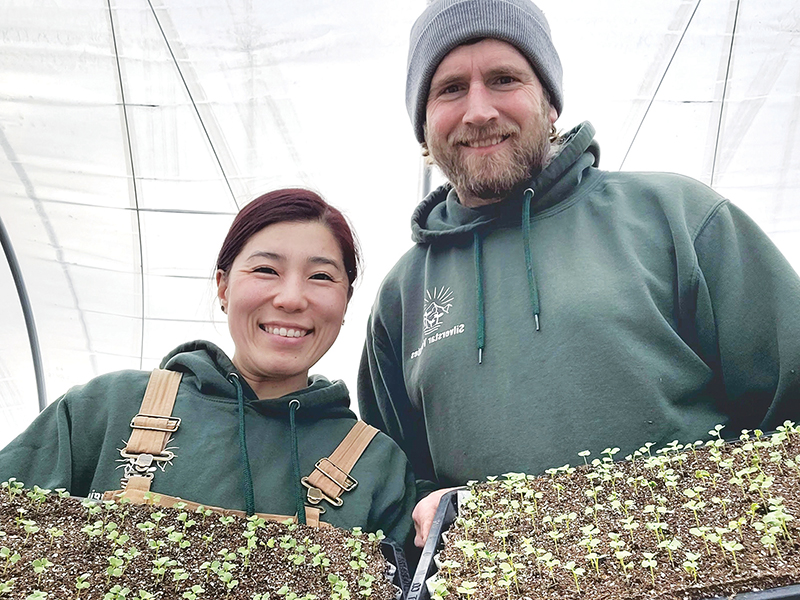
Miho Shinbo and Eric Feehely are growing Silverstar Veggies together. SILVERSTAR VEGGIES

April 1, 2025 byMyrna Stark Leader

VERNON – Silverstar Veggies, a five-year-old mixed vegetable and herb farm in Vernon, thrives on passion and innovative ideas.

A former watersport and adventure sport instructor, owner Eric Feehely began farming in his native Ireland in 2010 before emigrating to BC and working for Hermann and Louise Bruns at Wild Flight Farm in Mara in 2013.

“I was blown away how they were making a living with seasonal cultivation with year-round sales,” says Feehley, who returned to vegetable growing in 2021 after seven years in the wine sector.

He started as field crew at Lake Country’s 50th Parallel Estate Winery, then Peak Cellars, eventually assisting with vineyard management. But he also built gardens to supply the wineries’ on-site restaurants, a sideline that eventually led him back to market gardening following COVID as he considered what kind of a world he wanted to create for his son.

“I was wasting my skill set producing alcohol when I could be producing acres of vegetables that BC actually needs,” he says.

Today, Silverstar Veggies grows 30-plus crops on 2.5 acres. While the farm embraces organic practices, it’s not certified since it grows Salanova lettuce, a variety not approved for organic production because the seeds can’t be saved, and because most customers don’t ask.

Crop variety aids in marketing and keeps farming interesting for Feehely and partner Miho Shinbo. She’s a skilled cook who’d worked in fine dining in Europe and was cooking at SilverStar Mountain Resort where they met.

“The farm would not have succeeded without her. I went into it thinking, I can do this all by myself. Really, you can’t. It’s easy to make plans on paper in winter, then executing it in July is a whole different story,” says Feehely.

In addition to their meeting, another chance ski hill encounter helped procure their farmland on the site of Cambium Cider Co., formerly BX Press Cidery. A long-term lease was signed with the help of Young Agrarians, with sod turning in just six months. The land was already deer-fenced, and Bobcats were on site ready to be put to work.

“We’re in a unique and blessed situation that changes the game,” reflects Feehely.

Although farm revenues aren’t fully supporting them yet, it is growing. It now has six hoophouses, up from two hoophouses on a single acre at the beginning.

In 2022, the Community Futures Reach program in Vernon aided an initial business plan as well as funded professional photography, branding and a website, assets for which Feehely lacked cash.

More recently, the BC government’s New Entrant Farm Business Accelerator Program helped fund the development of a five-year business plan, aided by consultant Andrea Gunner, plus new irrigation on 1.5 acres. In spring, they’ll add fruit, planting a quarter acre of table grapes on their existing land.

Staffing

Like other farms, finding employees willing to come back season after season isn’t easy. Two new full-time seasonal employees are being hired this year, one of which brings four years of experience on a CSA farm in Vancouver. While the staff may not be the same, experience can bring a fresh perspective to the farm’s development.

A community-supported agriculture (CSA) program accounted for 45% of sales last year.

“If we could do 100% CSA, we would go that route, but I don’t see it happening in Vernon,” says Feehley. “We’d be talking a 400-member CSA, and we haven’t broken 100 members yet.”

Wholesale and restaurant accounts make up 35% of sales, including to Butcher Boys, SilverStar Resort, Masiero Pizzeria and Cambium restaurant.

To diversify sales, they’re returning to the Vernon farmers market this year after trialling that last year. Feehely says restaurants tend to want only certain products, usually at the same time, so selling at the farmers market provides balance.

To encourage a larger spend per market customer, they’re introducing a loyalty program this year. Buying a set-value voucher will save the customer 10%.

“The market crowd like to spread their dollars buying one or two things from each producer … they aren’t motivated to buy $500 in credit from us in March, so I think we’ll sell a lot of the vouchers at the market,” he says, hoping customers come back to spend remaining voucher credit.

It’s another way to appeal to Vernon’s older and often bargain-hunting market crowd.

“After the pandemic, everything changed with production costs, transportation and logistics. Every producer feels those costs, but you can’t really increase the price of a bag of spinach to match inflation every year, or you won’t sell much,” says Feehely.

Instead, Silverstar has shrunk package sizes to keep retail prices in check. A six-ounce salad bag, for example, is now five ounces for the same price.

“Efficiency is your best cost-saving measure on a small farm,” says Feehely.

They’ve encouraged growth for the 28-week CSA program by opening customer registration a month earlier this year and starting the service one week later, ensuring a greater variety of produce.

“CSA is great because people sign up for a long term and it becomes a pattern for them. We’re also quietly expecting a little Canadian vacation resurgence and maybe more Americans coming this way (at the market),” he says optimistically.

Having such crop variety enables CSA substitutions if a crop is later than expected or doesn’t grow well, while labour intensive peas and beans help attract customers.

“It can be a bit difficult for crop planning and logistics, where we are growing and when we are sowing or resowing crops, but I’m counting on making a living here. It’s part of a much bigger picture.”

Now in his 40s, Feeheley is aways trying to work smarter. The future picture could include gardening classes and farm tours, attracting school student visits and hosting events.

Eventually, SilverStar Veggies hopes for more direct sales and a possible diversification into gardening supplies. It’s also working with Polson Market’s team to collaborate and expand a successful pumpkin patch begun last year.

“We have a two-acre field for parking. We’re fenced off the road. We have the insurance. We had the porta potties. So, these are alternative means for income,” Feehely says.

Given its high-volume traffic location, there are early plans for a potential roadside store, four shipping containers fashioned in a square with vegetable prep space in the middle.

Ideally, it would be built after this growing season but it’s a large investment requiring borrowing at a time of less economic certainty in BC, Canada and the world.

“We’re wondering, is this a great idea or a terrible idea? I don’t think it’s terrible since people are always going to want food, and they’re going to want to buy it nearby if they can,” Feehely says. “We’re always ebbing and flowing with our ideas. I tend to have large ambitions but Miho keeps me in check. Ultimately, we’re trying to make something that’s viable, that we can be passionate about and that the community needs. It’s easy to grow too fast. I’d rather sell 95% of my produce and feel successful than selling 60% of my produce and feel like we failed, with the same gross income either way.”


All content on this website is copyrighted, and cannot be republished or reproduced without permission.

Related Posts

You may be interested in these posts from the same category.

Previous Post: « Milk board undertakes review
Next Post: Reminiscences of a honeyed career »

© 2026 COUNTRY LIFE IN BC - ALL RIGHTS RESERVED