
• Menu
  • Skip to primary navigation
  • Skip to main content
  • Skip to primary sidebar

Country Life In BC Logo

The agricultural news source in British Columbia since 1915

  • Headlines
  • Calendar
  • Subscribe
  • Advertise
  • About
  • Archives
  • Contact
  • Search
  • Headlines
  • Calendar
  • Subscribe
  • Advertise
  • About
  • Archives
  • Contact
  • Search

Primary Sidebar

Originally published:

SEPTEMBER 2021
Vol. 107 Issue 9

Subscribe Now!

Sign up for free weekly FARM NEWS UPDATES

Loading form…

Your information will not be
shared or sold ever

Stories In This Edition

Wildfire response improves

Bad timing for election call

Hay there!

Food sales still reeling from the pandemic

Editorial: Restart, regenerate

Back 40: Anti-vax rhetoric is far worse than the cure

Viewpoint: Organic practices key to our collective well-being

Producers face unannounced welfare checks

Livestock feel the heat as forage dries up

Farmers take issue with water restrictions

Ag Briefs: Grape growers optimistic as harvest approaches

Ag Briefs: Greenhouse nursery specialist named

Feed BC connects producers with opportunities

Sidebar: Nutrition program continues

Growers welcome grocer code of conduct

Chicken growers address heat stress

Greenhouse growers undertake strategic plan

Turning manure into renewable energy

Sidebar: Biogas gets a boost with changes to regulations

Blueberry growers welcome higher berry prices

Ranchers, farmers on the wildfire frontlines

Sidebar: Water and fans keep cattle cool

Province halts livestock watering reg update

BC farm sales sets new monthly record

Mental wellness resources meet a growing need

Sidebar: Mental health resources

Saving the farm business hinges on planning

Hot potatoes

Farmers produce crops, and loads of plastic

Barnston Island farmers face uncertain future

Market garden rises from battle of the weeds

Sidebar: Oostenbrink’s tips for no-till vegetables

Research: Bumblebee declines not as dire as study states

A non-family succession plan that worked

Living plants are revolutionizing herb sales

Food hub readies for fall opening

Farm Story: Good help at the right time

Small-scale abattoir in the works for Island

Breeding better tasting beets

Woodshed Chronicles: Plans unfold for the ride of a lifetime

Young entrepreneur weaves new use for twine

Jude’s Kitchen: Simpler eats for a new, normal September

More Headlines

Follow us on Facebook

Comments Box SVG iconsUsed for the like, share, comment, and reaction icons

6 hours ago

The Township of Langley Farm and Ranch Exhibition Society is hosting a public open house this evening to gather input on plans to transform the historic Belmont Farm into an agricultural exhibition, education and heritage hub. Farmers, ranchers, and community members are invited to share their feedback. The open house is at the George Preston Rec Centre, 6-8 pm.

Township of Langley Farm and Ranch Exhibition Society
#BCAg
... See MoreSee Less

The Township of Langley Farm and Ranch Exhibition Society is hosting a public open house this evening to gather input on plans to transform the historic Belmont Farm into an agricultural exhibition, education and heritage hub. Farmers, ranchers, and community members are invited to share their feedback. The open house is at the George Preston Rec Centre, 6-8 pm. 

Township of Langley Farm and Ranch Exhibition Society 
#BCAg
View Comments
  • Likes: 8
  • Shares: 0
  • Comments: 0

Comment on Facebook

9 hours ago

The sold-out Southern Interior Horticulture show continues today. Education sessions range from rodent control to new tree fruit varieties, with the afternoon devoted to improving spraying techniques for orchardists and vineyard managers. When not listening to speakers, producers are checking the trade show.

#BCAg
... See MoreSee Less

The sold-out Southern Interior Horticulture show continues today. Education sessions range from rodent control to new tree fruit varieties, with the afternoon devoted to improving spraying techniques for orchardists and vineyard managers. When not listening to speakers, producers are checking the trade show.

#BCAg
View Comments
  • Likes: 6
  • Shares: 0
  • Comments: 0

Comment on Facebook

11 hours ago

The BC Poultry Association has lowered its avian flu biosecurity threat level from red to yellow, citing declining HPAI risk factors and fewer wild bird infections. Strong biosecurity practices helped BC limit cases this winter to 38 premises, down from 81 last year. For more, see today's Farm News Update from Country Life in #BCAg#BCAg ... See MoreSee Less

Link thumbnail

Poultry biosecurity notches down

www.countrylifeinbc.com

Declining risk factors for highly pathogenic avian influenza (HPAI) have prompted the BC Poultry Association to lower the industry’s biosecurity threat level from red to yellow. The decision…
View Comments
  • Likes: 11
  • Shares: 2
  • Comments: 1

Comment on Facebook

🐥💛

1 day ago

The application deadline for cost-shared funding through the Buy BC program is coming up on February 20. Up to $2 million through the Buy BC Partnership Program is available annually to BC producers and processors to support local marketing activities that increase consumer awareness of BC agriculture and BC food and beverages. For more information, visit buybcpartnershipprogram.ca/.

Buy BC

#BCAg
... See MoreSee Less

Link thumbnail

Home - Buy BC Partnership Program

buybcpartnershipprogram.ca

Buy BC Partnership Program Increase your visibility with Buy BC The Buy BC Partnership Program is a fundamental component of Buy BC that provides up to $2 million in cost-shared funding annually to lo...
View Comments
  • Likes: 3
  • Shares: 0
  • Comments: 0

Comment on Facebook

1 day ago

The Sik-E-Dakh (Glen Vowell) First Nation's Skeena Fresh hydroponic operation has doubled production capacity thanks to a $130,632 Northern Development Infrastructure Trust grant. Growing lettuce, kale, herbs and more in shipping containers, the operation uses 90% less water than traditional farming while providing 1,200 people with year-round access to fresh, locally grown greens. Their story is in the February edition of Country Life in BC, the agricultural news source for BC’s farmers and ranchers.

Northern Development Initiative Trust
#BCAg
... See MoreSee Less

The Sik-E-Dakh (Glen Vowell) First Nations Skeena Fresh hydroponic operation has doubled production capacity thanks to a $130,632 Northern Development Infrastructure Trust grant. Growing lettuce, kale, herbs and more in shipping containers, the operation uses 90% less water than traditional farming while providing 1,200 people with year-round access to fresh, locally grown greens. Their story is in the February edition of Country Life in BC, the agricultural news source for BC’s farmers and ranchers. 

Northern Development Initiative Trust 
#BCAg
View Comments
  • Likes: 15
  • Shares: 1
  • Comments: 0

Comment on Facebook

Subscribe | Advertise

The agricultural news source in British Columbia since 1915
  • Email
  • Facebook

Market garden rises from battle of the weeds

No-till farming was secret to weed control for Local Harvest

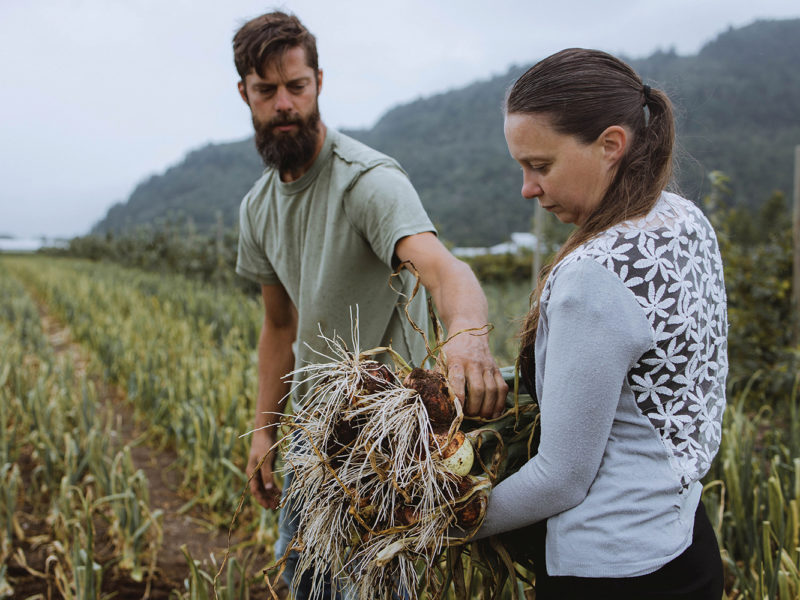
Dan and Helen Oostenbrink of the Local Harvest in Chilliwack practice no till farming methods to supply their on-farm market and restaurant customers. SUBMITTED

September 1, 2021 bySandra Tretick

CHILLIWACK – Local Harvest Farm and Market is a true family farm where Dan and Helen Oostenbrink have embraced innovative weed control practices to transform 37 acres of former pasture into a thriving market garden supplying local residents, restaurants and wholesalers.

Tucked into a prime location just off Hwy 1 at the corner of Lickman and Yale roads near Chilliwack Heritage Park, the operation yields just about every vegetable it’s possible to grow in the region as well as herbs, fruits and flowers. Greenhouses help extend their growing season.

“We’re intensively vegetable farming about 25 acres,” says Dan, who says the farm cycles through two or three crops on each block every year.

The Oostenbrinks arranged to take over the property from Dan’s father in 2013. They set about planting vegetables and constructing greenhouses on the former pasture, but their early vision of agritourism soon gave way to market gardening.

Even though they started farming conventionally, the weeds were out of control. When they hired a farmhand in 2014 with experience in market gardening, he convinced them to get rid of their big farm equipment, chemical fertilizers and sprays and turned one acre into a market garden.

Oostenbrink expanded the market garden the following year and thus began his own somewhat accidental experiments in weed control. He laid down compost in one bed, but didn’t do anything to the next bed because he ran out of time. He seeded spinach in both beds. The bed that was mulched had no weeds and really good germination. The adjacent bed, the one that had been tilled, was underperforming. Weeds were everywhere. He started to research no-till.

“Not a lot of people were doing no-till at that time,” says Oostenbrink. “Now it’s all the rage in market gardening; everybody’s talking about it.”

Since switching to no-till farming practices, Oostenbrink estimates weeding has dropped by 75% to 90% and soil health has greatly improved.

Tillage reduces soil’s structural stability and results in severe soil loss through erosion. Since making the switch to no-till farming about six years ago, Oostenbrink has noticed that soil microbes are flourishing, moisture conservation is higher and yields are better. As an added bonus, he finds it easier to flip beds between crops.

Oostenbrink credits his no-till practices with the minimal damage his farm suffered during the extreme heat at the end of June, when temperatures at Oostenbrink’s farm hit 43°C. During the hottest days he watered in short bursts through the heat of the day – 20 waterings, five minutes at a time.

“Nothing was damaged,” says Oostenbrink. “[It was] hard to tell we had a heat wave.”

Permits challenging

With the weeds under control, the Oostenbrinks began ending up with more produce than they could sell out of a simple roadside stand.

They ran into hurdles when a barn they had renovated without the necessary building permits ran afoul of Chilliwack bylaws and the Agricultural Land Commission. A purpose-built market completed in 2018 meant they needed to keep the crops growing year-round to keep the shelves stocked. Oostenbrink says the ALC was hesitant to allow a purpose-built facility on the farm to market al.l the product it was growing, and municipal building and safety requirements, which don’t distinguish between large grocery stores and small on-farm markets, were difficult to meet for a small business like his.

“The costs become prohibitive and the wrangling with governments becomes really, really challenging,” says Oostenbrink. “It takes a lot of time.”

Approval hinged on a split-zoning that saw the property designated 91% agricultural lowland and 9% agricultural commercial, but Oostenbrink says the market is still really small to handle the production from a 25-acre market garden.

The ALC requires that 50% of the product they sell be grown on farm, but they have to bring in complementary products from off the farm to attract people year-round and keep the market financially viable.

“If we were to do it with just the product that we grow on the farm at this point in time we would not be sustainable,” says Oostenbrink, although he adds that they are getting there. “We’re able to satisfy the requirement of the ALC, certainly better than a lot of other markets have.”

Their eldest son Dustin, now 21, runs a wood-fired bakery on site where he makes sourdough breads during the week and pizzas on Saturdays. Daughter Courtenay, who’s 20, helps out in the market. Their next two sons are currently working off the farm, but their youngest daughter, 13, is also involved. They also employ a couple of full-time staff year round and hire high school students throughout the summer.

The Oostenbrinks also have a couple of cows and a small herd of alpacas grazing on about six acres. Harking back to their original agritourism dream, the animals are there mostly for the enjoyment of visitors who come to the farm market, although the alpacas are shorn annually and the fibre is sent off-farm for finishing. It makes its way back to the market in the form of socks.

Not all of their produce goes to the market. Some is wholesaled and some sells at farm markets in Abbotsford and Invermere. Some makes its way to nearly 20 different restaurants, mostly in Vancouver, to which they personally deliver three times a week. COVID-19 hurt this part of their business, but it beats selling to large wholesalers and the big grocers.

“They hold you to these contracts and you’re obligated, but they’re not,” he says. “We’re much happier selling to independently-owned markets and restaurants. It is about knowing the chef and getting them out [to the farm].”

Demanding

Before making the switch to farming, Oostenbrink, 39, was a math and physics teacher. He’s put that background to good use in sharing his passion about soil health and the soil food web.

Oostenbrink offers a course on no-till gardening and recently partnered with Farm Folk/City Folk to conduct a virtual field day on no-till farming.

Oostenbrink says farming is a lot more demanding than being a teacher, with longer days and brutally hard work. He thinks five to seven acres is the right size for a family farm, but isn’t sure that would be financially viable.

“My farm’s too big,” he says.

In the virtual field day, Oostenbrink advised those thinking of making the switch to no-till farming to start small and build from there.

“Don’t take on too much. Do less and do it well,” he says.
Related Posts

You may be interested in these posts from the same category.

Produce drives BC exports

Previous Post: « Mental wellness resources meet a growing need
Next Post: Homegrown agritech ramps up »

Copyright © 2026 Country Life in BC · All Rights Reserved